Theater & the Arts
Charles Busch’s very funny campy satire of Catholic nuns hits all the bases, extending to a stereotypical Jewish philanthropist, a Da Vinci Code style mystery with a German faux-nun and a brown-robbed monk, and even a detour back to thirties movies about diligent good-guy reporters
Scoops

April 21, 2011 – Businessweek censored? A press release by the New York Attorney General censored? And by the organization that represents the nation’s school superintendents and principals!
Why would the American Association of School Administrators (AASA) ban letters from legislators and government officials as well as articles in several newspapers from a display table at its February National Conference on Education at the Colorado Convention Center in Denver? Thereby hangs a corporate tale.
The AASA didn’t ban the documents over the usual culture wars issues. It was to thwart distribution of training materials on how schools can avoid being ripped off by companies that provide school meals. The papers were stacked on a paid exhibit table that had been set up by the Service Employees International Union (SEIU), which represents food service workers. SEIU had also bought the right to run a workshop.
Blog
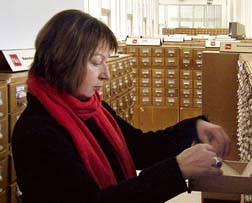
April 20, 2011 – Transit, a fascinating documentary by German filmmaker Angela Zumpe, seeks to understand the story of her 21-year-old brother Reinhard, who in 1968 immigrated from West to East Germany and eight months later – never contacting his family — jumped from a window to his death.
Theater & the Arts
Benefactors begins in 1968, during an era when England was building controversial housing projects. It was written in 1984 by Michael Frayn, who two decades later authored Democracy, the powerful recreation of West German Chancellor Willy Brandt’s early 70s dealings with East Germany. In both cases, in overlapping eras, the personal becomes political, and there is a strong ideological message that expresses Frayn’s general concern about democracy, writ small and writ large.
Theater & the Arts
Personal and family connections are fraught with psychological peril, disappointment, sometimes joy. It’s the stuff of many, even most, plays, films, novels. Bathsheba Doran weaves those strands into a complex web and network that connects and sometimes sustains lovers, friends, parents and children. It is a slim but appealing fabric, made richer by Sam Gold’s smooth, light touch.
Theater & the Arts
Alfred Uhry’s charming, moving play is part of his Atlanta trilogy about Southern Jews in the middle decades of the last century. Through the conflict and then growing warmth between an elderly middle-class white woman and a middle-aged working-class black man, one gets a sense of how human contact can break or at least crack the barriers of color and class. The production is tour de force for Vanessa Redgrave and James Earl Jones.
Blog
April 4, 2011 –
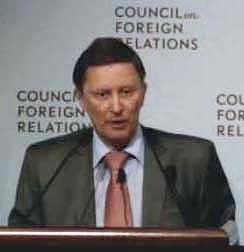
Sergey Ivanov, the Russian deputy prime minister, spoke at a Council on Foreign Relations lunch today. I asked if he thought the U.S. and Russia should get together to put a stop to offshore tax evasion. He smiled and agreed that the two countries need to deal with the international offshore system. That was something to consider in the future. And then he said, There are more than 1,000 banks in Russia. They are not banks but launderers.
Theater & the Arts
This is an unlikely melodramatic potboiler about American slavery and a Jewish family in Richmond, Va., that turned its slaves into believers. It’s an unlikely premise in spite of historical documentation, but you no sooner get to the point of accepting one unlikely premise, than playwright Matthew Lopez throws you another. The play is full of action and mystery, secrets and surprises, but is somehow unsatisfying.

