Scoops
Dec 28, 2007
Twenty years ago, on a campaign trip in rural Pakistan in October 1987, Benazir Bhutto told me of her concern about the long-term effect of Afghan refugees who had set up safe houses, stored munitions and created networks in her country.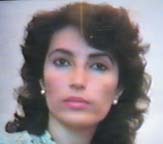
We talked for an hour in an interview I videotaped. It was the day after I traveled with her on a political procession in Sailkot, in the Punjab, northern Pakistan, where she was mobbed by supporters.
She was prescient about the impact of the Islamic Afghanis who had arrived in Pakistan during the war with the Soviet-supported government.
She said a long-term domestic fallout would be that even if Afghanistan today is solved and guaranteed by both superpowers, what about the future? Because the network has been created.
Theater & the Arts
Inter Press Service (IPS), Dec 14, 2007
As the 1994 genocide in Rwanda slips into the dark hole of history, the U.S. playwright J.T. Rogers’ The Overwhelming reminds one how it happened and how both the moral, the complicit and the cynical in the West were present in the killing fields. 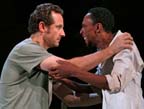
In Rogers’ fictional story, a U.S. family visits Rwanda in 1994. Jack, a professor, accompanied by wife Linda and son Geoffrey, is researching a book about grassroots activists and comes to interview his old college roommate, Joseph, a Tutsi who runs a children’s AIDS clinic. But Joseph has disappeared.
Blog
Dec 13, 2007
I chatted for a few minutes with Italian President Giorgio Napolitano 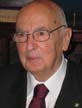 after he spoke this morning at a Council on Foreign Relations breakfast. He agreed that there is a problem posed by offshore financial centers and pointed to concern in Europe reflected in a recent joint letter on the subject by the UK, France and Germany.
Napolitano is an extraordinary man who served nearly 40 years in the Italian parliament and was a leader of the Italian Communist Party, the PCI, helping to move it out of the Stalinist camp to social democracy.
Richard Gardner, US ambassador to Italy 1977 to 81, who presided over the meeting, told me that he had tried to persuade Henry Kissinger that Napolitano was a social democrat. Gardner said that Kissinger never could grasp that.
Scoops
Inter Press Service (IPS), Dec 5, 2007
There is irony in the recent announcement by Peru’s President Alan GarcÃa that he would publish the names of 1,800 freed terrorists, so that people might recognise and report them if they were participating in anti-state conspiracies. His list includes people imprisoned on false charges or never convicted or sentenced.
One name that is not on the list is that of Alan GarcÃa. 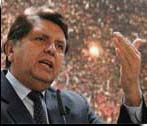 However, according to a declassified U.S. government document, GarcÃa, during his first administration from 1985-1990, gave instructions to terror squads organised by his political party to assassinate suspected leftists. Victims included trade unionists and other civil society leaders.
This writer discovered the document, and it was declassified at her request. It is posted following the full article.
Theater & the Arts
Plays show western complicity in Nigeria and Rwanda violence.
Dec 1, 2007
 Murderous conflicts in Africa are dramatized in two American plays off-Broadway that vividly call up the clashes in the oil region of Nigeria and the Rwanda genocide of over a decade ago. In both cases playwrights show inter-communal violence heightened by western interests‘ actions or neglect.
The one-man “Tings dey happen” by Dan Hoyle is most successful in presenting the characters of the Niger Delta, from militants demanding their share of oil wealth to the self-serving American ambassador and expatriates. “The Overwhelming,” by J.T. Rogers, also uses the “American visitor” device, though the personal stories seem trivial in the context of events.
Blog, Corporate Abuses, Offshore
Dec 1, 2007
When there’s a financial crisis tied to lack of transparency, follow the culprits offshore. Evidence comes out now that this is true about the subprime debacle.
Reuters reports that a German bank is implementing accounting changes including consolidation of an offshore conduit whose soured investments triggered a government-led rescue. The offshore operation was set up to invest in subprime mortgages.
Pam Martens in Counterpunch points out that, Citigroup, is discovered to have stashed away over $80 billion of Byzantine securities off its balance sheet in secretive Cayman Islands vehicles with an impenetrable curtain around them.
Among those securities count subprimes. Citigroup has $55 billion of subprime exposure and in November said it would write down up to $11 billion in subprime losses. Goldman Sachs said that won’t be all, that the bank may have to write off $15 billion.

