

By Lucy Komisar
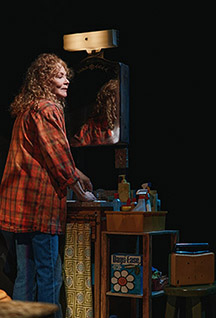
“Call Me Izzy” is a feminist play about a rural Southern woman abused by her husband. But it’s not depressing. Jean Smart is brilliant as Izzy, stifled in a small Louisiana railroad town, her life a struggle between freedom and submission. The play is chilling but also invigorating, because Izzy finds solace and power in her identity as a poet. It is a solo performance, all Smart’s narrative.
Kudos to the male playwright Jamie Wax who tells this story with sympathy, including some stunning poems. He is aided by director Sarna Lapine, who keeps the story unsettling but away from soap opera.

Izzy’s first sign of self-assertion is in the 4th grade reciting a poem on a school stage, then starting a journal and even calling herself Izzy instead of Isabel. But social constraints to keep her down start with her teacher, “No one likes a know-it-all,” reinforced by her mother, “Nobody likes a smartypants.” And finally her husband Ferd, who snarls that she’d better not try being better than him.
Showing allegorically how imprisoned she is, her refuge is the cell-sized bathroom where she writes her poems with eyebrow pencil on toilet paper. Even dropping in tank tablets becomes poetry as she recites, “azure, saphire, swirlin’ cerulean, Lapis lazuli, indigo.” They are also defiance. She says, “My husband, Ferd, he hates the blue cleaner I put in the toilet almost as much as he hates… my writin’. “ She hides rolled up writing in a blue Tampax box and imagines people reading it.

She had married at 17 just out of high school, Ferd was five years older. She thought him fiery and strong. She should have seen the writing when he got her a funeral plot as wedding gift. They lived in a mobile home
He is nasty even on small things. He appears and says, “Where’s my Phillips head? I can’t find my Phillips head! From now on I want you to leave my things where I set ’em!” She is confused, but of course, it’s a screwdriver and it’s on the floor.
After verbally assaulting her, he puts his arms around her. She says, “I try to hug him back, but my heart’s not in it. Funny how I can fake an orgasm, but I can’t fake a hug worth shit.”

Her high school teacher recommends she go to LSU. When at dinner she shows Ferd the application, he stomps out and returns drunk, smashes her figurines. She throws the application in the trash but will keep writing. She keeps so many things to herself, mind pictures, crafting a new person in notebooks hidden in a closet.
When they move to a bigger trailer next to a pine forest, Rosalie is a neighbor and becomes a friend. She introduces her to classes at the community college and gets her to visit the library where she reads Shakespeare’s sonnets and plays
But one evening at dinner table she wants to make Ferd feel better about not getting a promotion, and quotes:
“Glory is like a circle in the water,
Which never ceaseth to enlarge itself
Till, by broad spreading,
it disperse to naught.”
It’s from “Henry VI.” Obviously, he doesn’t get it. He smacks her on the side of the head. You wonder why she doesn’t leave.
Surprisingly, when she shows him a brochure for a free community college, he doesn’t tear it up, just says, “Don’t go actin’ like yer better than me, Isabelle. And don’t get sloppy with your chores.”
So, we know the essential problem of such abusive men is their sense of inferiority, the need to feel better than women.
The class is told that a poetry magazine is looking for voices of rural America. She submits poems and wins a fellowship for two months in Brewster, Mass., and $15,000, both funded by a New York couple.
To her shock, she learns that Rosalie submitted, in her name, two very powerful poems she didn’t want public. One is a sonnet for the common woman, herself.
“Sonnet Number One” by Isabelle Scutley
“A lightning bug sends flickers through the dark
Revealing me, a woman, and a wife
Whose dreaming dropped me in this trailer park
To serve a sentence others call a life.
Within a coffin made of tin and shit,
I try to speak, although I find no voice,
I try to stand, though I am forced to sit
And make decisions, though I have no choice.
And so, we flit, the lightning bug and I
While, as she glimmers, star-like in the black,
I wish on her my man would say good-bye,
And send my floodlight lightnin’ floodin’ back.
An insect doesn’t give much light, I know,
But that does not suppress her need to glow.”
Another poem
“My lover gives sweet gifts to me that I can call my own:
A spattered scarf, a tattered dress,
A ring of shattered bone,
A string of blue-black bruises,
Every single one a gem.
They quickly cover me,
And then I rush to cover them.
A rosary of crimson garnets trickles from my lip,
I cry out, you’re too generous, but still, the gemstones drip.
I wonder what I gave you,
Love, to cause you to devote,
Your breath inside my nostrils.”
The poems are featured in the magazine, the college applauds and against her wishes, the local paper prints them. Ferd’s company puts him on leave for investigation and a social worker arrives. He quits. At home, he finds her notebooks, throws them into the backyard oil drum and sets them on fire. A red blaze colors the sky around the pine trees.
Curiously, the only times Izzy feels powerful, exuberant, is when she sleeps with other men, once years ago with someone she met at a nearby honky tonk (he got her drunk on tequila and seduced her), then recently with her community college professor (she seduced him).

The dénouement includes some surprises. Rosalie, who admits submitting the poems, invites the New York couple to dinner at the trailer, tells Izzy, “You should leave with them.” We think again, if Izzy is so smart, why can’t she save herself?
When Ferd finds out about the visit, he grabs and shakes her. She declares, “You send them away and they know it’s right what I said in poem.” His answer is a threat.
On a comic note, she tells Jack and Irene the dinner is canned ham Hawaiian and they say they’re kosher. “Levitsberg.”
The men drink bourbon and also trade insults and slaps. Irene says, “They’re not so different. And neither are we…You and me…. There are all kinds of ways to beat a person down.” She gives her a paper with her phone number. Will Izzy take the way out? The ordeal is not yet over.
This play should be presented by women’s groups around the country and especially in shelters for those abused. A memorable performance by Jean Smart, a sensitive play by Jamie Wax and subtle but intense direction by Sarna Lapine.
“Call Me Izzy.” Written by Jamie Wax, directed by Sarna Lapine. Studio 54, 254 W 54th Street, NYC. Runtime 85min. Opened June 12, 2025, closes Aug 17, 2025.