

By Lucy Komisar
Sept 25, 2025
South African President Cyril Ramaphosa says he learned from the fight against apartheid in his country that the legal route is the way to go to combat apartheid by Israel.
He said that replying to a question I asked at the Council on Foreign Relations Tuesday, September 23, 2025.
Q: My name is Lucy Komisar. I’m a journalist.
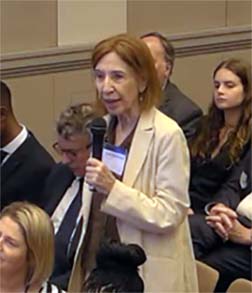
I was in South Africa at the time of the changeover. I know a lot about the work that you did as the head of COSATU, the labor movement, to fight the repressive white apartheid regime. What did you learn then in the strategy, you and your fellow fighters against repression learned, that now helps you understand what you are doing now and what you should be doing now to fight the repressive Israeli apartheid regime?
RAMAPHOSA: It was Nelson Mandela who, as a gigantic leader taught us a great deal of lesson(s) and one of those that he articulated so well, which still rings very clear when we have to deal with an issue—a difficult issue like what is happening between Israel and Palestine—was that we as South Africans would never say we are free until the Palestinians are free.
And he didn’t say that because he was a good friend of Yasser Arafat. He was saying that because we saw in that part of the world a system that was similar to ours—apartheid—and it appalled him. It pained him to even come to that conclusion.
What we learned in our own struggle is that we’ve got to wage struggle not only for ourselves, largely, because we were supported by the whole world. The world rose up against apartheid and declared apartheid a crime against humanity, and we were humbled by that and we felt that the world having helped us to get to where we were.
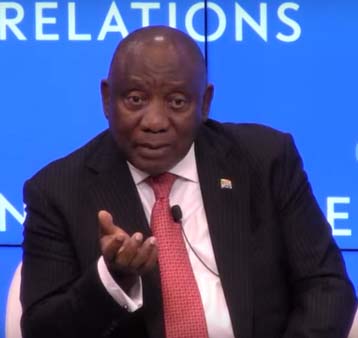
And let me say we always knew that we would defeat apartheid. Nelson Mandela also knew. But we knew that it would take us longer without the help of many people around the world. And in the end, the support we got in the U.S. when sanctions were applied and the U.S., not only various nongovernmental organizations but even at government level, decided that they could no longer countenance a system like apartheid.
The apartheid rulers knew that the game was up and it is what really—that’s when the penny dropped for them and they changed around.
Now, what did we learn? We learned that pressure is important to be put. The articulation of an injustice has got to be verbalized more loudly and support needs to be given. This is what has propelled us to give support to the cause of the Palestinians. We have been very harshly criticized for the step that we took to take the case to the United—to the International Court of Justice.
Other people have taken resolutions to the United Nations, but they were never really criticized. But when we decided that we would take the legal route, the only route that our adherence to the rule of law has taught us works, we were heavily criticized by many nations around the world and in some cases were even being punished for having taken that step.
But we are rather pleased today that many countries are seeing the usefulness, if I can use that term, of what we did and are now coming behind us to support what we did because not so much that we wanted to punish Israel but because we wanted the genocide to end—what is happening there to end.
We thought and are convinced that the only way we can do it is to do it legally. We cannot go and wage arms, war against Israel. It’s not possible. But we can speak in the U.N. and we can use U.N.-allied organizations or institutions to put the case across, which is exactly what we have done.
Working together with others is what has taught us to do what we do and the lessons that we have gained. Nelson Mandela was very strong in working together with others and amassing and mobilizing many forces and many entities to end systems that he believed were unjust.
So that is what we have learned over the years.
This video opens at the Q&A.
Komisar blog comment: Of course the U.S. instead of opposing apartheid by Israel has sanctioned three International Criminal Court judges: Nicolas Yann Guillou, Judge, Trial Division, Nazhat Shameem Khan, Deputy Prosecutor, Mame Mandiaye Niang, Deputy Prosecutor, for supporting arrest warrants against Israeli Prime Minister Benjamin Netanyahu and former Minister of Defense Yoav Gallant for their genocide against Palestinians.
Ramaphosa’s reply would suggest that Americans against Israel’s mass murders in Gaza should campaign to get U.S. support for the International Criminal Court case.