

By Lucy Komisar
Oct 19, 2025
Ironic that the Indigenous Peoples Parade in New York this year took place the same time and a few blocks away from the massive New York “No Kings” demonstration. On Saturday there were probably fewer than 50 marchers and performers among the Native Americans gathered at Madison Square Park and marching from 27th Street inside unnecessary metal police barriers down Broadway at 12 noon, compared to the estimated 100K that took off from Times Square down Seventh Avenue at 11 am. I went to both.
What was missing was any connection between the murderous settler colonials that obliterated most Native Americans and banished the survivors to reservations, ie open air concentration camps, and the policies by both Trump and his Democratic predecessors who supported the genocide by Israeli settler colonials of Palestinians in Gaza.
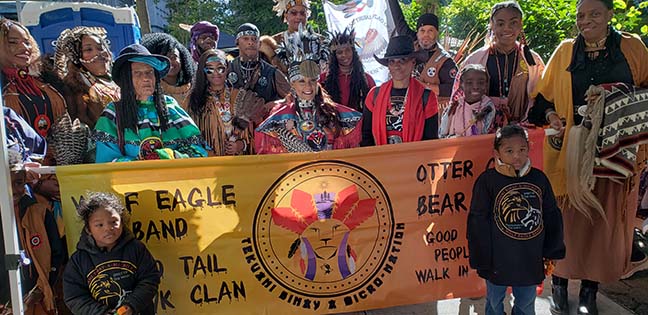
The Indigenous Peoples Parade had a very few political comments, one about Native women who had been disappeared. “No more stolen relatives.”
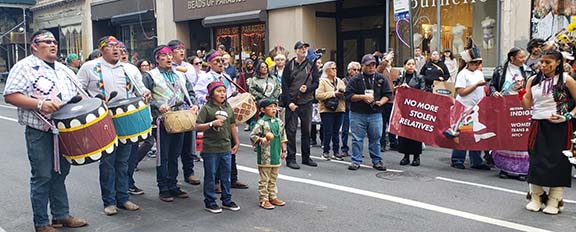
Women dancers raised the issue.
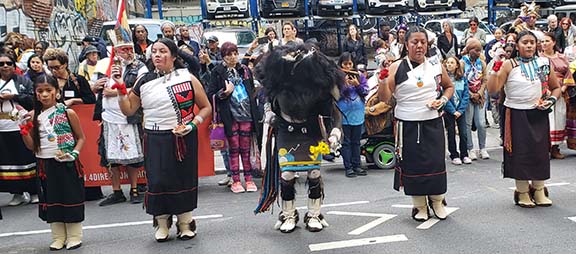
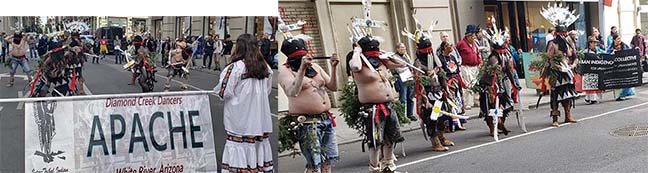
The rest was largely cultural. Between running back and forth between the two parades I might have missed something, but this seemed like what tourism departments stage.
For what the colonists did to Native Americans, there is more powerful commentary in the Whitney Museum “Surreal Sixties” exhibit just opened than in this parade. In my review I included this.
Fritz Scholder
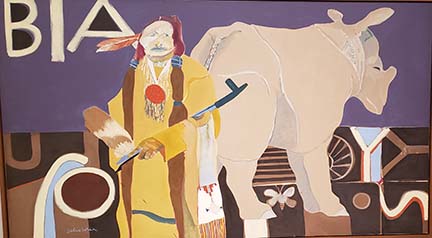
So I researched the BIA.
In the continuing American war against the indigenous people, the BIA – Bureau of Indian Affairs – is a U.S. federal agencies with a history of abuse largely aimed at land acquisition and assimilation — both to destroy the indigenous nations.
- Broken Treaties: The U.S. government signed over 370 treaties with Native tribes, most of which guaranteed land, resources, and sovereign rights. The BIA, as the enforcing arm of the government, systematically oversaw the violation of these treaties, leading to massive land loss.
- The Dawes Act (General Allotment Act) of 1887: This was a devastating policy administered by the BIA. It forced the breakup of communally-held tribal lands into individual allotments. “Surplus” land was then sold off to white settlers. This act resulted in the loss of 90 million acres of tribal land—about two-thirds of the land base tribes held in 1887. It also shattered communal social structures and created a complex, often mismanaged, system of individual land ownership that persists today.
- Mismanagement of Trust Funds and Assets: The U.S. government holds Native American lands, minerals, and other assets “in trust.” The BIA has a fiduciary responsibility to manage these assets for the benefit of tribal nations and individuals. For over a century, this management has been marked by profound incompetence, corruption, and a failure to account for billions of dollars in royalties from oil, gas, timber, and grazing leases. The landmark case Cobell v. Salazar (1996-2009) exposed this systematic failure, leading to a multi-billion-dollar settlement for the mismanagement of Individual Indian Money (IIM) accounts.
2. Cultural Genocide and Forced Assimilation
The BIA was the primary instrument for policies designed to destroy Native cultures and force assimilation into white American society.
- Indian Boarding Schools: The BIA operated, or funded through religious organizations, a system of off-reservation boarding schools. The explicit philosophy, famously stated by Captain Richard H. Pratt, was to “Kill the Indian, Save the Man.”
- Children were forcibly removed from their families.
- They were punished for speaking their native languages.
- Their traditional hair was cut, and they were forbidden from practicing their religions or cultural customs.
- They often faced physical and sexual abuse, malnutrition, and neglect. Many children never returned home.
- Banning Religious and Cultural Practices: For decades, the BIA enforced policies that outlawed traditional religious ceremonies, such as the Sun Dance and Potlatch. These policies were not fully reversed until the passage of the American Indian Religious Freedom Act in 1978.
3. Political and Social Control
The BIA exercised near-dictatorial control over the daily lives of Native people in open-air concentration camps called reservations.
- The “Pass System”: For a period, Native Americans needed written permission from the BIA agent to leave their reservation, severely restricting their freedom of movement.
- Undermining Tribal Governance: BIA agents often had the power to overrule tribal councils and leaders, interfering with internal tribal politics and imposing decisions that benefited the government or outside interests rather than the tribe.
- Relocation Program (1950s-60s): This policy encouraged (often through false promises) Native people to move from reservations to major cities like Chicago, Denver, and Los Angeles. While framed as an opportunity for jobs and a better life, it was often a means to further assimilate Native people and terminate federal responsibilities. It resulted in broken communities, urban poverty, and a loss of cultural connection for many.
4. Neglect and Inadequate Services
Even in fulfilling its mandated duties to provide services, the BIA has a long history of failure.
- Inadequate Education: BIA-run schools have been chronically underfunded, leading to substandard education, poor infrastructure, and lower academic outcomes for Native students compared to national averages.
- Poor Healthcare: While now primarily managed by the Indian Health Service (IHS), the federal government’s provision of healthcare, historically linked to the BIA’s role, has been marked by underfunding, inadequate facilities, and poor health outcomes for Native communities.