

By Lucy Komisar
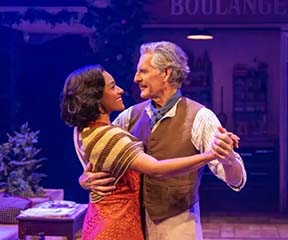
The bread crisis in the small Provençal town of Concorde is urgent, existential and entirely self-inflicted. This is the buttery premise of “The Baker’s Wife,” the charming, stubbornly hokey, and ultimately satisfying musical that has rolled into the Classic Stage Company with the comforting aroma of a warm baguette.
Based on Marcel Pagnol’s 1938 film “La Femme du Boulanger,” this long-gestating project—with a book by Joseph Stein (“Fiddler on the Roof”) and music and lyrics by Stephen Schwartz (“Wicked,” “Pippin”)—is a quintessential slice of old-school Broadway craftsmanship. It offers few surprises, but considerable pleasure, delivered by a sterling cast under Gordon Greenberg’s expansive direction in an intimate space that convincingly conjures a sun-drenched town square.
The story, as simple as a flour-and-water dough, follows Aimable Castagnet (the immensely likable Scott Bakula, embodying a man whose name means “likable” in French). A baker who has spent over 40 years under his mother’s thumb, he arrives in Concorde with his beautiful, much younger bride, Geneviève (a luminous Ariana DeBose). The town, desperate for pastries after its previous baker’s death, welcomes them as saviors. Harmony, however, is as scarce as a day-old croissant in Concorde—an ironically named hamlet brimming with petty feuds, marital discord, and a casual disdain for women.
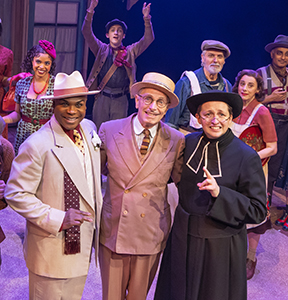
The town is run by the powerful men, the mayor, “the Marquis” (delightful Nathan Lee Graham), the Teacher (pompous Arnie Burton) and the priest (ready to pounce on sins, Will Roland).
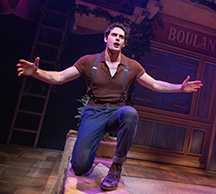
The plot thickens when Geneviève, feeling restless and unfulfilled, impulsively runs off with the mayor’s handsome, dim driver, Dominique (Kevin William Paul). This central catalyst feels undercooked; the spark between the two is a mere flicker, making Geneviève’s flight seem more a plot device than a passionate choice.
Yet, this misstep gives rise to the show’s richer elements: Aimable’s poignant, drunken despair (Bakula masterfully balances comedy and pathos) and, more compellingly, the town’s collective unraveling and reknitting as they face a future without bread.
Where “The Baker’s Wife” rises highest is in its social observation, particularly its sly, feminist commentary. As the men of the town—led by the hilariously morose Claude (Robert Cuccioli) and the stubborn Barnaby (Manu Narayan)—perform a vaudevillian two-step celebrating Aimable’s “luck” in being free of a wife, the women gather for a glass of Sauterne and a moment of stunning clarity.
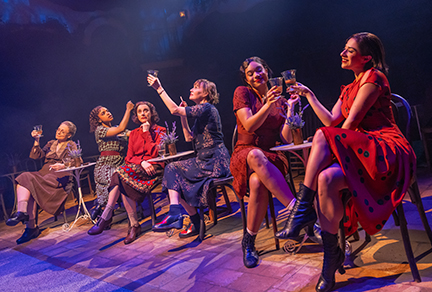
In a superb scene-stealing turn as Denise, the café owner, Judy Kuhn leads the women in a bittersweet lament, “Romance.” Alongside Sally Murphy’s wistful Hortense and the mayor’s knowing “nieces,” they deconstruct the erosion of marriage with sharp, witty lyrics. “His passion shrinks,” Denise sings. “As his belly grows,” Hortense adds. In this number, Schwartz’s score finds its most sophisticated and emotionally resonant voice, transforming a sweet comedy into a poignant reflection on longing and compromise.
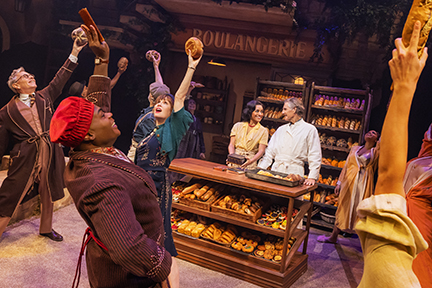
The supporting cast is a delight, mining Schwartz’s clever lyrics and the village’s petty grievances for consistent laughs. Greenberg’s staging is fluid and imaginative, making the small stage feel vast enough for a pétanque court and the town’s sprawling gossip.
If the finale is as predictable as sunrise, the journey there is rendered with such warmth and skill that it’s easy to forgive. “The Baker’s Wife” may not be a revolutionary addition to the musical canon, but it is a supremely well-made one. It earns high marks for its melodic score, witty lyrics, vibrant staging, and its unexpected, welcome dose of female solidarity. In the end, it serves up exactly what it promises: a hearty, comforting theatrical meal that leaves you smiling.
“The Baker’s Wife.” Book by Joseph Stein, music and lyrics by Stephen Schwartz. Classic Stage Company, 136 East 13th Street, NYC. Runtime 2hrs30min. Opened Nov 11, closes Dec 21, 2025.