

By Lucy Komisar
Robert Icke at only 43 solidifies his place among Britain’s theatrical greats with his stunning new production of Oedipus at Studio 54. A master of turning classic plays into modern parables—from Hamlet to The Doctor— Icke now takes Sophocles’ 2,500-year-old tragedy and forges it into a riveting, contemporary political thriller.
Forget ancient Thebes. The plague here is a power vacuum. A king is dead, and a nation is restless. Live video feeds on a stark wall screen show a crowd gathering outside, holding signs for a new movement. They are the modern chorus, their chants the pulse of the play.

They’ve come for Oedipus (a magnetic Mark Strong), a left-wing politician promising renewal. In reality, he’s a mediocre, middle-of-the-road operator—an everyman demagogue (Obama? Tony Blair?). Strong masterfully embodies the polished, self-absorbed candidate, all focus-grouped sincerity, who traps voters in a web of spun narratives.
The action unfolds in a monotonous gray campaign headquarters, a sterile war room where fate is now a matter of polling and press strategy. A neon digital clock relentlessly counts down to the closing of the polls, turning the tragedy into a race against time.

Jocasta (a riveting Lesley Manville) is not a queen of myth but a political survivor. As the teenage bride of the late king, she was a pawn in an older man’s world—a detail the text underscores with chilling matter-of-factness. Now, she is the key to legitimacy for the new regime. Oedipus, having married her for political advantage after the king’s mysterious death, has built his campaign on a promise to investigate the very murder he unknowingly committed years before.
That past occurs at a “three-way crossroads” which represents Fate vs. Choice. Oedipus thinks he is choosing a new road away from Corinth (to avoid his prophesied fate), but he is actually walking directly into it. Oedipus, traveling on foot, encounters King Laius’s entourage in a horse-drawn chariot. A herald (or the charioteer) orders Oedipus to get out of the road. An angry Laius strikes Oedipus. Oedipus, in a rage of pride and self-defense, fights back. He kills the herald, the charioteer, and finally, King Laius himself.
Later, the sole surviving servant’s description of “the place where three roads meet” is the critical piece of evidence that triggers Oedipus’s realization.
Icke renders it in sharp, modern terms: a fatal car crash at a three-way junction—a modern analogue of Sophocles’ fateful crossroads—where a violent altercation left a stranger dead.” It feels less like fate and more like a buried scandal waiting to be unearthed by an opposition researcher.

The inevitable truth closes in not through oracles, but through interruptions the candidate is too busy to heed. His adoptive mother, Merope (a beautifully anguished Anne Reid), arrives desperate to speak with him, but is brushed aside—a crushing portrait of personal truth sacrificed to political momentum.
The fortune teller Creon (a calmly devastating John Carroll Lynch), is reimagined as the campaign manager who arrives with a damning dossier, not riddles. He warns Oedipus that the investigation will expose the secret of his birth—a “birth certificate” issue with devastating, familiar resonance.
Icke seems to argue that the campaign trail has replaced the tragic path to the throne. The ritualized, public performance, the need for a flawless narrative, the vulnerability to exposure—it’s all the same. Oedipus isn’t fated by gods but by his own need to win, which forces him to follow the script (“Find the King’s killer”) even as it destroys him.
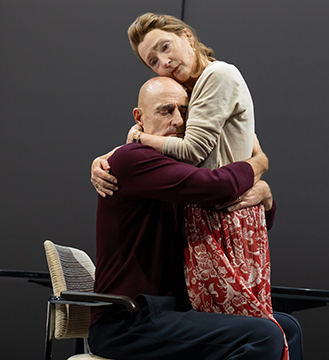
We, the audience, know the horrific secret. Yet Icke makes it newly unbearable. We are forced to watch Oedipus and Jocasta interact with easy intimacy, even share passionate embraces, their ignorance curdling every touch with dread. The genius of this production lies in this suspense: it’s not about what will be revealed, but how the modern machinery of politics—the campaigns, the screens, the spin—will catastrophically fail to contain a truth as old as time.
Icke’s Oedipus is more than an update; it is an excavation. He strips the myth to its core engine—a man racing toward a truth he is running from—and reinstalls it in the nervous system of our present. The result is a breathtaking, gut-punch of a thriller that holds a black mirror up to the theater of politics, leaving us to wonder if the most tragic flaw today is the inability to stop campaigning long enough to see oneself.
“Oedipus.” Created and directed by Robert Icke based on play by Sophocles. Studio 54, 254 West 54th St, NYC. Runtime 2 hrs. Opened Nov 13, 2025, closes Feb 8, 2026.