

By Lucy Komisar
It seemed like a noble idea: take James Joyce’s 1922 novel, a book far more discussed than actually read, and put its famously dense prose in the mouths of actors. Surely, hearing the words spoken aloud would unlock something. Surely, the stage could illuminate what the page obscures.
About that.
Elevator Repair Service, the downtown troupe known for its marathon adaptations of literary modernism, has brought “Ulysses” to the Public Theater. Directed by John Collins and Scott Shepherd, the production gathers seven gifted actors around a long table, facing the audience, and proceeds to demonstrate that even live human breath can’t warm up Joyce’s polarizing prose.
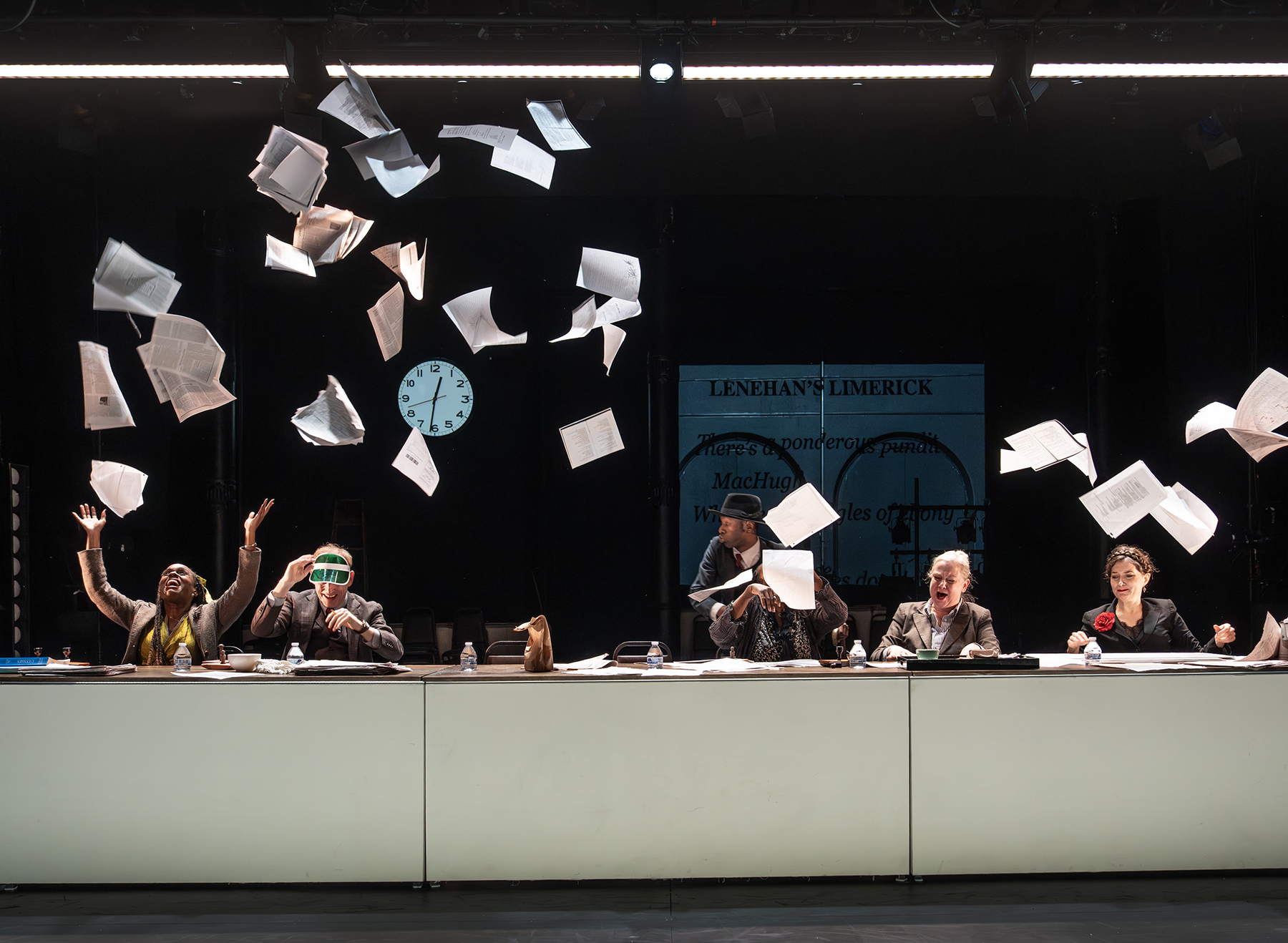
The conceit is familiar from the company’s legendary eight-hour “Gatz,” which conjured theater from the entire text of “The Great Gatsby.” Here, the approach is more selective—a two-and-a-half-hour “fast-forward” tour through Bloom’s day, with much of the novel cut. But the format remains stubbornly static. For much of the evening, the actors sit and deliver, rarely interacting. They play multiple roles, but the decision to keep them planted in chairs, reciting toward us rather than engaging one another, leeches drama from the proceedings. Theater relies on action and reaction; when performers don’t move or relate, audiences drift. I confess, my own mind wandered frequently into the more scenic streets of Dublin.
The production’s challenges are compounded by matters of diction. Several actors swallow Joyce’s language, rendering it even more impenetrable. And a harder-to-ignore choice: the casting of black actors in roles for which they deploy heavy black accents—an aesthetic decision that sits uneasily against the specificities of Joyce’s 1904 Dublin, a city not known for its diversity. When characters speak through mouthfuls of food, one can only agree with the character exclaiming, “I hate dirty eaters.”
This is not to fault the performers individually. Vin Knight brings a searching quality to Leopold Bloom, the Jewish ad canvasser navigating a day of cuckoldry and casual anti-Semitism . Maggie Hoffman suggests the earthy appetites of Molly Bloom, whose famous soliloquy closes the show. Christopher-Rashee Stevenson plays Stephen Dedalus, the brooding young writer. Scott Shepherd doubles as co-director and Blazes Boylan, Molly’s swaggering lover.
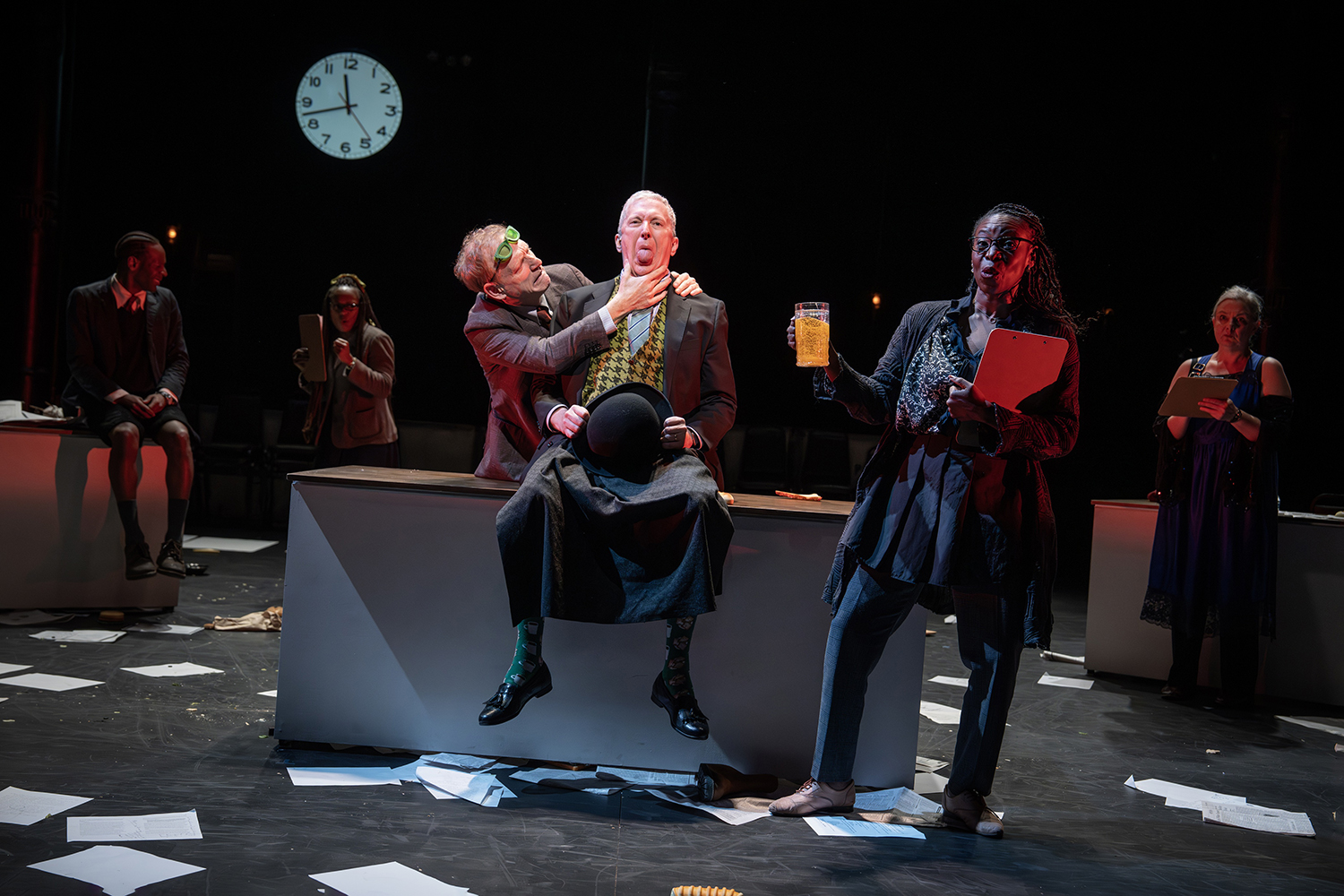
But individual competence cannot compensate for a production that tells rather than shows. When the actors occasionally rise from their chairs, the stage briefly comes alive with surreal possibility—and so does the audience. One craves more of these moments, more of the theatrical imagination that might crack open Joyce’s wordplay and reveal something visceral.
The Public’s playbill helpfully summarizes the plot: June 16, 1904. Bloom lingers away from home to allow his wife, a singer, to begin an affair with her concert promoter. Meanwhile, the drunken young writer Stephen Dedalus wanders the city. Joyce’s revolutionary stream of consciousness (deployed around the same time by Virginia Woolf) floods the text with interiority. But interiority on stage requires more than recitation.
Perhaps “Ulysses” resists adaptation by design. It is a novel about the privacy of thought, the unspoken currents beneath daily life. To dramatize it faithfully may be to betray its deepest nature. Elevator Repair Service has attempted the impossible, and impossibility, it turns out, remains impossible.
“Ulysses.” Written by James Joyce, directed by John Colins, co-directed by Scott Shepherd. The Public Theater, 425 Lafayette Street, NYC. Runtime 2:45. Opened Jan 25, 2026, closes March 1, 2026.