

By Lucy Komisar
The stage is a sleek, white box. Suddenly, it is dark and edged with pulsing blue light, throbbing to an electronic score as if the room itself is booting up. This is the world of “Data,” Matthew Libby’s unnerving new play about the young engineers building the surveillance state, one algorithm at a time.
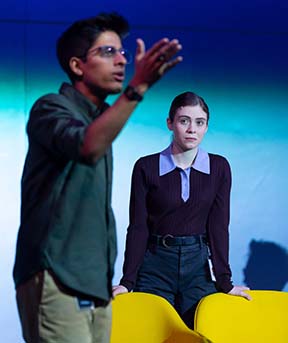
Directed with clinical precision by Tyne Rafaeli, “Data” often feels less like fiction and more like a documentary that wandered into the theater by mistake. It taps directly into the ambient dread of our current moment, evoking the spectral presences of Palantir, ICE, and the Orwellian proliferation of government data-gathering. This is not a sci-fi vision of the future; it is a slightly dramatized everyday afternoon.
The plot centers on a secretive software team of Athena Technologies. Young Maneesh Singh (a jittery, affecting Karan Brar) has just landed his first job out of college, placed in the “U.S. Interface” department. He is very smart, having developed a “rare event model”—an algorithm capable of making frighteningly accurate predictions from massive data sets. His former classmate, Kate Riley (Sophia Lillis, radiating a cool, weary intelligence), works in the more prestigious “Data Analytics” division. Knowing his talent, she pulls him into a hush-hush project for Homeland Security: an AI system designed to automate visa applications by predicting who will “contribute value” to the U.S. and who poses a “threat.”
For a while, the play stalls in the startup sandbox. We get a lot of tech-bro chatter, a few too many knowing glances, and an inexplicably extended ping-pong match. Jonah (Brandon Flynn, aptly playing the office jerk) hits on Riley (she is referred to by her last name throughout, a subtle linguistic marker of her isolation among the men). We learn an engineer named Phoebe quit in protest, but the mystery hangs in the air, unresolved.
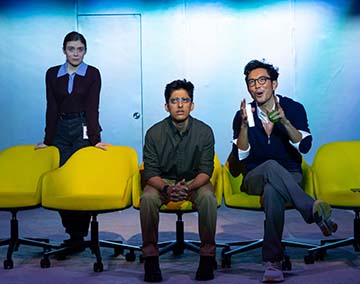
Then Maneesh reads the fine print. The system isn’t just vetting applications; it is scraping decades of personal data—old blogs, forgotten emails, digital ghosts—to predict future behavior. Appalled, he recognizes the fundamental lie of the algorithm: it cannot accurately predict human intention, only justify predetermined bias. It is a tool for automated suspicion.
This is where “Data” finds its groove, transforming into a taut ethical thriller. Riley is the play’s tortured conscience. She admits, with devastating honesty, that every day at work she makes the world a worse place. She flagged her concerns to the ethics board; they brushed her off. She has loans. And a mother to support. Lillis captures this paralysis perfectly—the way complicity feels like a cage built from good intentions and bad options.
The play wisely complicates its politics through its immigrants. Maneesh’s parents, moved from Calcutta to North Carolina because Sikhs were being hunted in the street, then had bricks thrown through their window in Raleigh. His father removed his turban out of fear. Maneesh was born in Raleigh. When he runs his parents’ names through his model, it recommends their deportation. His boss Alex (Justin H. Min, perfectly bureaucratic and chilling) is also an immigrant, a former Singaporean army man. His tech employer messed up a form and his visa was delayed for three years. Yet he sees no problem with the system. Min’s performance is a stark reminder that the bootstrapping immigrant myth often aligns perfectly with the machinery of exclusion.
There is a fascinating layer to the text that may escape casual theatergoers. Libby studied cognitive science at Stanford, the very discipline that underpins artificial intelligence. The play is, in a sense, about what happens when theories of mind meet the reality of power.

That said, a word to the tech-adjacent: bring your suspension of disbelief. My theater companion, who works in data analytics (the exact field depicted on stage), told me, “No college kid builds that algorithm alone. That takes a dozen Ph.Ds.” He also noted that the ignorance of the “Interface” team regarding the “Analytics” project is a dramatic convenience, not a corporate reality. The devices work for the theater, even if they don’t work for the software business.
But the larger argument of “Data” is unassailable. Whether or not the code is accurate, the intent is real. The play’s final act snaps into focus as a nerve-shredding game of cat-and-mouse. Jonah reveals his darker stripes, and Maneesh and Riley are left with the classic question of the modern dissident: how can you expose the truth without letting it destroy your life?
“Data” is a sleek, smart, and deeply unsettling look at the people we have entrusted to build the levers of control—and the terrifying moment when some of them realize the evil they are doing.
“Data.” Written by Matthew Libby, directed by Tyne Rafaeli. Lucille Lortel Theatre, 121 Christopher St., NYC. 1hr40min. Opened Jan 25, 2026, closes March 29, 2026.