

By Lucy Komisar
Oct 9, 2025 – This Whitney exhibit of the Surreal Sixties shows a time of art that existed alongside a political movement against the U.S. imperialist attacks on Vietnam that were also part of repressive attacks earlier against indigenous Americans and later against people of color. In other word, these paintings show a history of murderous repression that continues to the present.
This painting, which most of us never saw, sets the stage.
Andrew Myrick, born in 1832, was a trader at the Lower Sioux Agency at the time of the U.S.-Dakota War which he played a role in starting. When Dakota leaders asked the traders to extend them more credit for goods when annuity payments were late, the traders refused. Myrick wrote to his brothers July 26, 1862,

Dear Brothers —
The Lower Indians have been playing the devil in general. They had two secret councils at which they resolved not to pay a dollar of their credits, established a soldiers lodge of one hundred warriors to execute the plan…. we all determined not [to] give any more credit hoping to starve them into a change of sentiment….
[Yesterday] they formed a line of battle marched to all the stores and made the following… speech “You have said you have closed your stores for 2 Sundays and that we should have to eat grass. We warn you not to cut another stick of wood or to cut our grass,” feeling themselves probably much relieved departed … In their secret council there [were] some intimations that the present traders were to be driven off and someone new to have exclusive control of the trade. Now whether the agent had anything to do with it we can’t find out but it looks very much as if that was the programme.
I am at a loss and so doing have given out no credits since last Sunday and at present deem it best not to give away any more for a week or ten days hoping it will produce a reaction. They will get very hungry and possibly if the officials are not engaged in it they may change their sentiments and favor paying their credits …
I wish you could come up and suggest to Forbes to come and help straighten out the snarl the Indians have got us in. I have not talked with them yet seeming it best to let them get hungry first hoping they might retract and become decent again.”
When the war began a month later, Myrick was killed. He reportedly was found with grass stuffed in his mouth.
Fritz Scholder
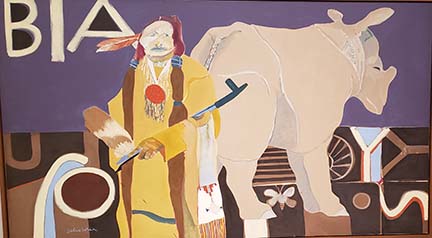
So I researched the BIA.
In the continuing American war against the indigenous people, the BIA – Bureau of Indian Affairs – is a U.S. federal agencies with a history of abuse largely aimed at land acquisition and assimilation — both to destroy the indigenous nations.
- Broken Treaties: The U.S. government signed over 370 treaties with Native tribes, most of which guaranteed land, resources, and sovereign rights. The BIA, as the enforcing arm of the government, systematically oversaw the violation of these treaties, leading to massive land loss.
- The Dawes Act (General Allotment Act) of 1887: This was a devastating policy administered by the BIA. It forced the breakup of communally-held tribal lands into individual allotments. “Surplus” land was then sold off to white settlers. This act resulted in the loss of 90 million acres of tribal land—about two-thirds of the land base tribes held in 1887. It also shattered communal social structures and created a complex, often mismanaged, system of individual land ownership that persists today.
- Mismanagement of Trust Funds and Assets: The U.S. government holds Native American lands, minerals, and other assets “in trust.” The BIA has a fiduciary responsibility to manage these assets for the benefit of tribal nations and individuals. For over a century, this management has been marked by profound incompetence, corruption, and a failure to account for billions of dollars in royalties from oil, gas, timber, and grazing leases. The landmark case Cobell v. Salazar (1996-2009) exposed this systematic failure, leading to a multi-billion-dollar settlement for the mismanagement of Individual Indian Money (IIM) accounts.
2. Cultural Genocide and Forced Assimilation
The BIA was the primary instrument for policies designed to destroy Native cultures and force assimilation into white American society.
- Indian Boarding Schools: The BIA operated, or funded through religious organizations, a system of off-reservation boarding schools. The explicit philosophy, famously stated by Captain Richard H. Pratt, was to “Kill the Indian, Save the Man.”
- Children were forcibly removed from their families.
- They were punished for speaking their native languages.
- Their traditional hair was cut, and they were forbidden from practicing their religions or cultural customs.
- They often faced physical and sexual abuse, malnutrition, and neglect. Many children never returned home.
- Banning Religious and Cultural Practices: For decades, the BIA enforced policies that outlawed traditional religious ceremonies, such as the Sun Dance and Potlatch. These policies were not fully reversed until the passage of the American Indian Religious Freedom Act in 1978.
3. Political and Social Control
The BIA exercised near-dictatorial control over the daily lives of Native people in open-air concentration camps called reservations.
- The “Pass System”: For a period, Native Americans needed written permission from the BIA agent to leave their reservation, severely restricting their freedom of movement.
- Undermining Tribal Governance: BIA agents often had the power to overrule tribal councils and leaders, interfering with internal tribal politics and imposing decisions that benefited the government or outside interests rather than the tribe.
- Relocation Program (1950s-60s): This policy encouraged (often through false promises) Native people to move from reservations to major cities like Chicago, Denver, and Los Angeles. While framed as an opportunity for jobs and a better life, it was often a means to further assimilate Native people and terminate federal responsibilities. It resulted in broken communities, urban poverty, and a loss of cultural connection for many.
4. Neglect and Inadequate Services
Even in fulfilling its mandated duties to provide services, the BIA has a long history of failure.
- Inadequate Education: BIA-run schools have been chronically underfunded, leading to substandard education, poor infrastructure, and lower academic outcomes for Native students compared to national averages.
- Poor Healthcare: While now primarily managed by the Indian Health Service (IHS), the federal government’s provision of healthcare, historically linked to the BIA’s role, has been marked by underfunding, inadequate facilities, and poor health outcomes for Native communities.
And then of course in the 60s the American War in Vietnam inspired anti-war art, some seen through prisms of sexism and racism.
Nancy Spero
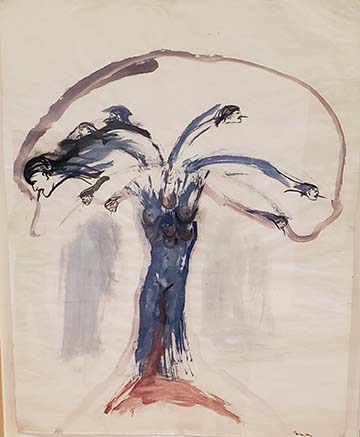
This belongs to Spero’s War Series (1966–69) personified weapons and wartime horrors in response to the conflict in Vietnam. The work shows several vicious-looking heads extending from a female body, blood seeming to spout from each as well as from the figure’s breasts and vagina. In Female Bomb, Spero collapses depictions of a weapon and the body that has been destroyed by it, highlighting the devastation caused by tools of warfare. Spero was fiercely committed to the representation of women in art and portrayed them as both victims and as sources of violence. The strokes of red extending from the heads in Female Bomb have been read as tongues as well as blood, giving form to Spero’s rebelliousness. She said of her work at the time, “I was literally sticking my tongue out at the world—a woman silenced, victimized, and brutalized.”
Peter Saul
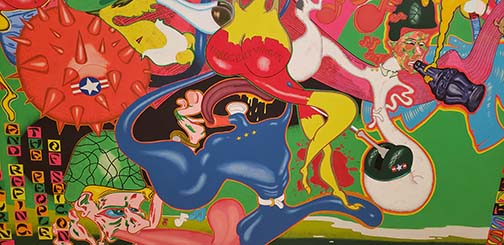
A critique of American policy during the Vietnam War. The war-torn environment that includes uprooted palm trees, a river of blood, a spiked American bomb, and voluptuous Vietnamese girl who has been trussed and labeled “Innocent Virgin.” A couple of American GIs are shown drinking Coca-Cola as they rape, dismember, and torture the girl’s family. Te figures, include a headless, three-star officer in blue, two blasted Vietcong guerillas, and a nightmarish profusion of body parts. In the canvas’s lower corners, old-fashioned Oriental-style letters spell out “White Boys Torturing and Raping the People of Saigon: High Class Version”—emphasizing Saul’s condemnation of the war’s hypocrisies.
Benny Andrews
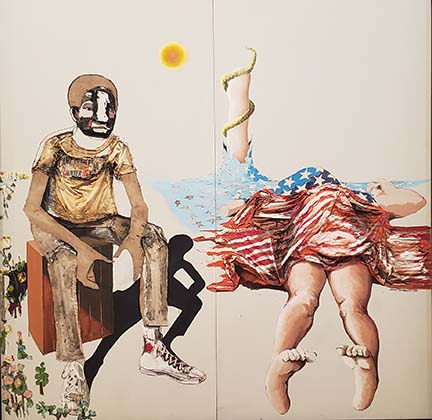
On the left, a figure sits on a box with a weary expression. His t-shirt partially shows the words “CAMP TOTAL WHITE CENTER.” To the right, a legged figure appears draped in a cloth resembling the American flag. Above a snake twists around a leg-like column.
Timothy Washington
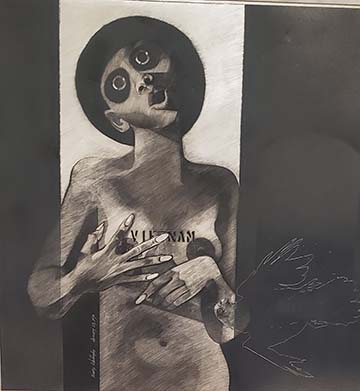
This commentary on the Vietnam War was created at the height of its controversy and American casualties including the disproportionate number of black soldiers drafted and killed in Vietnam. It highlights the central, stylized black soldier, whose body is integrated with the machinery of war, mechanical parts (wires, gears, a tank-like torso) to show how war strips away humanity, turning individuals into cogs in a military machine.
Edward Kienholtz
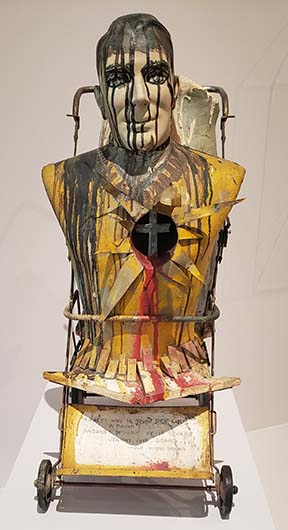
And then Kienholtz’s bloody”John Doe,” an indictment of U.S. military interventions, which he commented on regularly – especially about the American War in Vietnam. A critic wrote: “This piece is a striking sentiment towards the way human lives can be subject to manipulations by powers they cannot control.”
Kay Brown
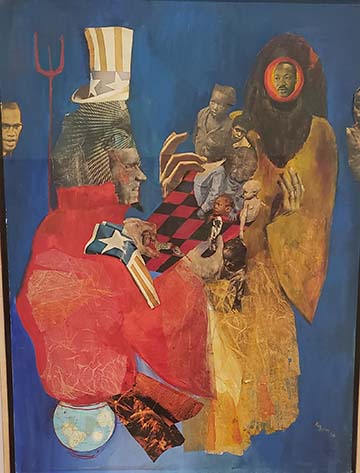
As Martin Luther King made clear, racism was an important element of U.S. foreign policy and the American War in Vietnam. Here Kay Brown depicts Nixon’s attacks on blacks. Nixon is at the center, Malcom X top left, King on top right. Does the checkerboard mean it is all a (deadly) game?
Now waiting for the Whitney to mount an exhibit of artists on America’s repression and warmongering of the 1980s to the present.
Whitney’s Surreal Sixties. 99 Gansevoort Street bet Washington and West Street, NYC. Visitors 25 years and under and Whitney members free. Free admission Friday eve 5–10 pm and second Sunday every month. Exhibit opened Sept 24, 2025, closes Jan 19, 2026.
Pingback: Indigenous Peoples Parade 2025 showed an ironic lack of attention to American genocide : The Komisar Scoop