

By Lucy Komisar
There is a moment in Bess Wohl’s new Broadway play “Liberation” when the characters—a consciousness-raising group in 1970 Ohio—discuss the upcoming Women’s Strike for Equality. One of them, Celeste, a black feminist scholar, scoffs: “I don’t really know that protesting changes anything… It sort of feels like they just laugh at everyone marching around and waving their signs.”
This cynical aside, dismissing a pivotal, nation-shaking event of the women’s movement, is delivered not as a point of dramatic tension to be explored, but as a casual, accepted truth. It crystallizes everything that is wrong with this production. “Liberation” purports to be a memory play about the unfinished revolution of second-wave feminism. What it actually delivers is a shallow, often insulting travesty of a history I lived through and helped shape.
I came to the women’s liberation movement in the late 1960s, a journalist finding her voice and her cause. I organized, served as a national vice president of the National Organization for Women, and wrote extensively on feminism. I know the electrifying, frustrating, and profoundly serious work of those early meetings. This play does not.
Wohl’s story is framed by Lizzie (a fluid and committed Susannah Flood), a present-day woman interrogating the life of her mother, also named Lizzie, who founded the group. The device aims for generational reflection but mostly provides cover for a parade of middle-class stereotypes whose concerns are played for easy laughs or melodrama.
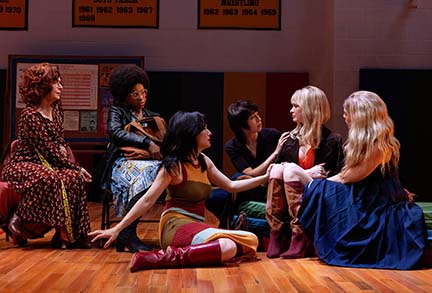
We meet the archetypes: Lizzie, the journalist stuck writing obituaries and weddings; Margie (Betsy Aidem), the housewife driven mad by her retired husband; Dora (Audrey Corsa), the secretary passed over for a less competent man; Celeste (Kristolyn Lloyd), the Radcliffe grad caring for an ailing mother; Susan (Adina Verson), the burnout lesbian writer; and Isidora (Irene Sofia Lucio), the immigrant filmmaker who voted for Nixon. Their dialogues are peppered with period-appropriate grievances—“women deserve a turn,” “why are we still getting fucked”—but the script treats their politics as a backdrop for personal soap opera, not the engine of it.
The play’s most egregious failure is its complete lack of political grounding or rigor. The movement is presented as a naive belief that talking could change the world, when for those of us in it, consciousness-raising was a strategic tool to transform private pain into public action. The play reduces complex figures like Betty Friedan to offhand objects of derision and turns Stokely Carmichael’s infamous quip into a cheap punchline, stripped of any context about the fierce debates within the Left.
Then comes the second act, an act of such profound bad faith it nearly defies criticism. In a scene that lasts a numbing 15 minutes, the women disrobe for a meeting inspired by an article in Ms. Magazine. They stand on stage, bare-breasted, making awkward jokes. “I love my tits,” says one.
The production notes and other, more forgiving reviews insist this is a scene about “body positivity” and “vulnerability”. It is nothing of the sort. It is the very exploitation the movement fought against—the reduction of women to their bodies, presented for public consumption. To drape this in the banner of feminism is grotesque. One can only imagine the coercion, or the sheer need for a job, that led the actresses to agree to this. That the creative team—playwright Bess Wohl and director Whitney White—orchestrated it and the Roundabout Theatre Company approved it is a profound betrayal.
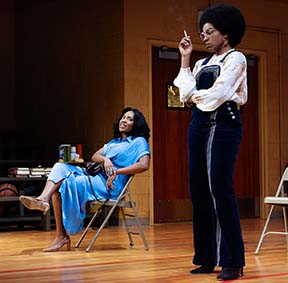
The play gestures toward its own limitations when a black woman named Joanne (Kayla Davion) stumbles into a meeting and pointedly asks why the group meets at an hour impossible for working mothers and questions the assumed unity between white and black women. It’s a sharp, necessary, complex debate, but it’s a fleeting moment. The play acknowledges the problem only to quickly shoo it away, returning to its core cast’s navel-gazing.
“Liberation” has been met with hosannas from some critics and won awards for its ensemble work. This acclaim, I fear, speaks to a contemporary desire for history to be palatable, messy in a safe, sentimental way. It turns a radical political uprising into a quirky story about mommy issues.
True liberation was, and is, hard, unglamorous work. It was forged in cramped apartments, not the spacious, musty-basement gym of David Zinn’s set. It was fought with organizing manuals, legal briefs, and painful, strategic debate—not with disrobing. This play offers a hollow simulation, a distortion that those who were on the front lines will not recognize. It is, in the end, not an act of remembrance, but of exploitation, like the advertising photo with a provocative image that could have been in a Jeffrey Epstein “meet my girls” album.

“Liberation.” Written by Bess Wohl, directed by Whitney White. James Earl Jones Theatre, 138 West 48th St, NYC. Runtime 2hrs30min. Opened Oct 28, 2025, closes Feb. 1, 2026.