

By Lucy Komisar
Tracy Letts’s psychological thriller, under David Cromer’s masterful direction, turns a motel room into a terrifying laboratory of American anxiety.
The true horror in Letts’s “Bug,” now receiving a skin-crawling and brilliant revival directed by Cromer, does not scuttle in on six legs. It enters softly, politely, a shy man emerging from a motel bathroom asking for a friend. The terror is in the quiet click of a mind latching onto an explanation—any explanation—for the pain of a lonely, battered life. By the final, frantic scene, the Manhattan Theatre Club stage has become a shrieking, tin-foiled monument to the American need to believe, even in monsters, if it means not being alone.
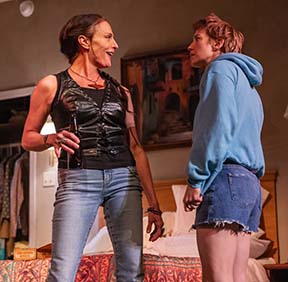
Cromer, a virtuoso of intimate dread, directs with the patience of a pathologist. He begins not with the grotesque, but with the crushingly ordinary. The place is a worn-but-decent motel room on the outskirts of Oklahoma City (the meticulously lived-in set design by Takeshi Kata). Here we find Agnes (Carrie Coon, the wife of the playwright), adrift in a haze of coke and fear, jumping at the silent phone calls she’s sure are from her ex-husband, Jerry (Steve Key), just released from prison. “I gotta gun,” she mutters, a declaration that sounds less like a threat than a pitiful hope.
Coon’s performance is a masterclass in unraveling. Her Agnes is all raw nerve endings and defensive slouch, her Oklahoma drawl masking a bottomless grief over the disappearance of her young son years prior. Her brief solace is her friend R.C. (a wonderfully grounded and no-nonsense Jennifer Engstrom), who arrives in a cloud of leather and brings with her a stranger, Peter (Namir Smallwood).
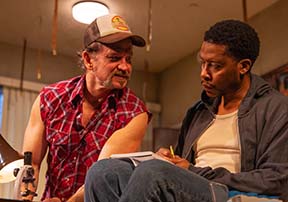
Smallwood’s Peter is the play’s terrifying catalyst. With gentle, almost apologetic manners, he seems the antithesis of the brutish Jerry (played by Key with such loathsome, charismatic menace you can almost smell the stale beer). Peter doesn’t snort coke; he finds it unhealthy. He is a scholar of entomology. He is, he jokes nervously, “not an axe murderer.” His politeness is the perfect camouflage, making Agnes’s (and our) slow acceptance of his escalating paranoia feel terrifyingly credible.
The play’s genius lies in how Letts, through Cromer’s deliberate pacing, grafts a conspiracy thriller onto a story of working-class desperation.

Peter is the antithesis of Jerry: polite, soft-spoken, the perfect guest, and soon, the perfect partner in constructing a new, shared refuge. Their trust is immediate and devastating; her loneliness is such that any companion is preferable to the void.
Peter’s delusion begins with a single aphid and spirals into a labyrinthine theory involving the CIA, Nazi scientists, subcutaneous microchips, and the 1995 Oklahoma City bombing. He cites the real Bilderberg Group meetings and the demonstrated military-corporate domination and exploitation of the world’s people, twisting historical fact into a personal nightmare of persecution. “It’s the rich get richer, and the poor get poorer,” he explains to a confused Agnes, offering her a grand narrative for her private suffering.
Is he a victim of government experimentation or a psychotic unraveling? Cromer and Smallwood keep the question open, making Peter’s detailed, intelligent rants all the more persuasive. The horror is not that he is obviously mad, but that his madness is so logically constructed from the paranoiac marrow of the internet age.
This is the play’s terrifying insight: a conspiracy theory is a nest for a mind with nowhere else to roost. It provides structure, purpose, and belonging. As Peter talks of egg sacs under his skin, Agnes, haunted by the unsolved disappearance of her young son, finds in his delirium a story that makes sense of her chaos.

Agnes, starved for connection and purpose, doesn’t just believe him; she needs to. Coon’s transformation is harrowing to witness. Her declaration, “You brought the bugs, and R.C. brought you. R.C. brought the bugs,” is delivered with the ecstatic clarity of a convert finding gospel.
A nude scene is stripped of all sensuality, revealing only mutual vulnerability. They create a perverse communion, sealed with rolls of aluminum foil as they turn the room into a makeshift Faraday cage against the world, a “protective nest” designed to scramble the signals of the outside world. But Cromer ensures we see the truth: they are not keeping the world out; they are sealing themselves in a tomb of their own design.
Key’s Jerry is the crude, real-world threat that now seems almost simple compared to Peter’s abstract horrors. Engstrom’s R.C., all leather and logic, represents the last tether to a shared reality, a tether Agnes eagerly severs.
The production’s sound design (Josh Schmidt) is a subtle weapon—the intermittent thrum of helicopters outside the motel, never confirmed, never dismissed, feeds the delicious uncertainty. Are “they” really out there, or is this the sound of the paranoia now buzzing inside our own heads?
“Bug” is more than a top-tier psychological horror story. It asks how fantasy metastasizes in peoples’ loneliness and powerlessness. In an era where conspiracy theories have moved from the fringe to the mainstream, Letts’s play, first produced in 1996, feels unnervingly of this moment. It forces us to ask: At what point does the desperate need for a story—any story—to make sense of our pain, become a bug we can never pick off? This is a gripping, masterfully acted production that will cling to you long after you’ve left the theater.
“Bug.” Written by Tracy Letts; directed by David Cromer. Manhattan Theatre Club at Samuel J. Friedman Theatre, 261 West 47th St, NYC. Runtime 1hr45min, one intermission. $35 tks available for people 35 or under. Opened Jan 8, 2026, closes March 8, 2026.