

By Lucy Komisar
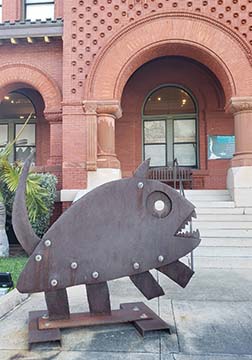
The thing about Key West is that it makes artists of everyone—the ones with brushes, yes, but also the ones who simply show up at dusk with a drink and an open gaze. Here, human hands and natural forces compete for your attention, and the remarkable thing is that both win.
On a recent visit, I found myself moving between two kinds of masterpieces: the ones carved and painted by island hands, and the ones painted across the sky each evening by something larger than any of us.
Where Memory Meets Art
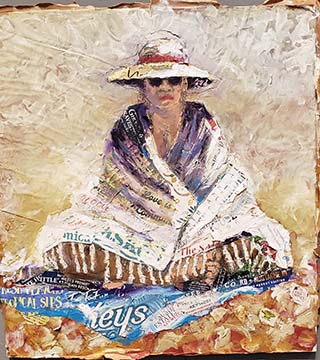
The Key West Art & Historical Society Museum at the Custom House is a necessary early stop. The museum rotates its shows with admirable frequency, and this season’s first offering, “Shadow and Light,” features local artists who see the island through their own particular lenses.
I was stopped by a Carol Faye painting called “Halcyon.” Faye works with scavenged and found materials, reimagining the commonplace as something approaching treasure. The piece glows with the particular quality of light that artists chase here—that golden hour that lasts longer than it should.
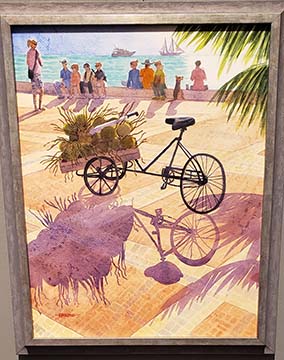
Nearby, Karen Beauprie’s “Coconut Man” tells its own story. The painting captures a Mallory Square memory: a man with his cart, his bicycle, a smaller cart full of coconuts, framed against the square’s famous chaos of performers and tourists. Beauprie writes of that evening: “I had to take a photo and knew one day I would paint that image.”
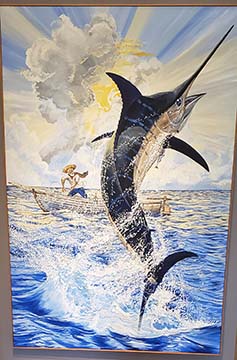
Up the stairwell, something unexpected: 59 pen-and-ink drawings by marine wildlife artist Guy Harvey, illustrating Hemingway’s “The Old Man and the Sea,” tracing Santiago’s battle with the marlin, with excerpts from the text.
The Poet of Painted Wood
But the museum’s soul resides in its permanent collection, where you’ll find the largest public assemblage of works by Mario Sanchez, Key West’s most beloved folk artist. A native son born in 1908 to Cuban immigrant parents, Sanchez spent most of his life chronicling the island’s character in carved and painted wood. He worked quietly at home, under a hand-painted sign nailed to a mango tree that read “Mario’s Studio Under the Trees,” capturing scenes from his Depression-era childhood: children flying kites, neighbors rocking on front porches, funeral processions led by African Bahamian bands.
Sanchez taught himself to carve in the 1940s, at his mother-in-law’s urging, and over seven decades produced more than 600 works. His motto, which he embraced with characteristic humility, was “Se que mi modesto arte no es bueno, pero gusta”—”I know my modest art isn’t good, but it pleases”.
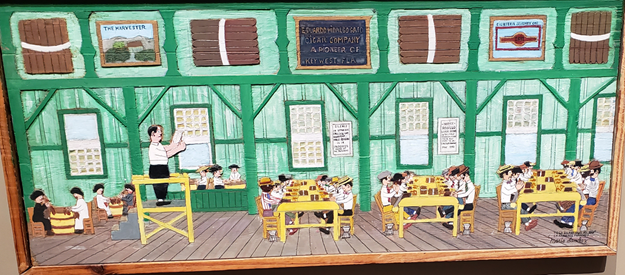
The society’s collection now exceeds 200 pieces, ranging from preparatory sketches on paper bags to handcrafted paper kites and intricate bas-relief woodcarvings. Recent acquisitions include “The Train That Went to Sea: Cayo Paloma,” depicting Henry Flagler’s Over-Sea Railroad crossing the old Seven Mile Bridge, and “Elegant Lady,” a Bahama Village street scene with the Blue Heaven restaurant in the background . These works join others that capture comparsa dancers on Front Street, funeral processions passing the Key West Lighthouse, and the everyday life of a vanished Key West. In 1984, the museum held a gala at East Martello to dedicate its Sanchez collection, and Mayor Richard Heyman proclaimed the date “Mario Sanchez Day”.
Sanchez’s work now hangs in the Smithsonian American Art Museum and the American Folk Art Museum in New York, but here, in his hometown, you see him whole. When he died in 2005, nearly 97, his funeral was exactly as he had painted so many times: a parade to the city cemetery with family and friends following behind the hearse.
Where the Water Takes Over
Which brings us to the actual sea.
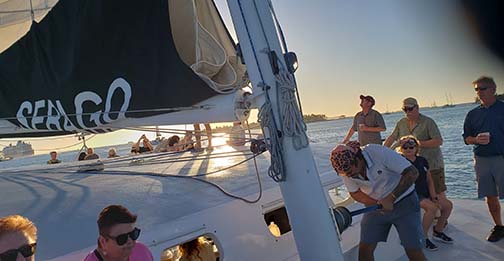
The Sebago catamarin casts off from the Historic Seaport with the late afternoon crowd—those of us who understand that a Key West sunset requires a proper platform. The crew raises the sails by hand, the old way, and for a moment the boat goes silent except for the snap of canvas catching wind.
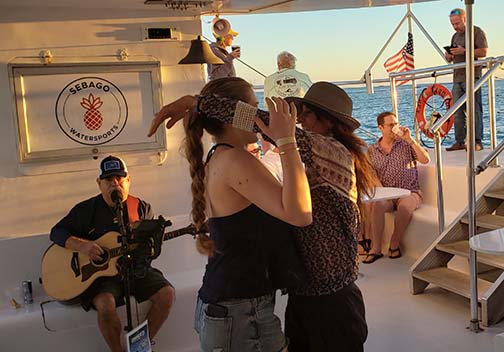
Then Mike starts playing guitar and the silence breaks into something more like a party. People dance on deck, drinks in hand, nibbling on shrimp and canapés and mini key lime pies, as the island shrinks behind us. And then the sunset.
Another sailboat glides across the horizon, silhouetted against red so deep it looks painted. The sky doesn’t just change color here—it performs, it makes you stop mid-sentence and just look.
We come for this moment when the island and the sea and the sky conspire to remind us that beauty doesn’t require our participation—just our attention. We come for the stories carved into wood by a man who understood that every generation should tell the next one about its ancestors.
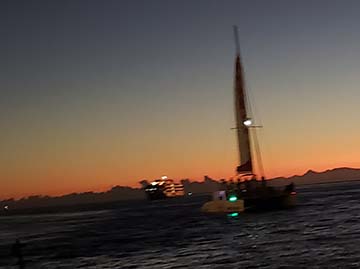
The Sebago turns back toward port. Last call for wine or beer or spirits. The sky cools to purple, then indigo. It’s the palette of a Key West sunset cruise.
All photos by Lucy Komisar.
If you go:
Key West Art and Historical Society.