

By Lucy Komisar
Red Bull Theater’s Titus Andronicus arrives like a punch to the gut—and stays there. This is Shakespeare’s bloodiest play given a production that understands exactly what it is: a horror film on a classical stage, rendered by director Jesse Berger with precision, brutality, and moments of unsettling lightness that make the violence land even harder.
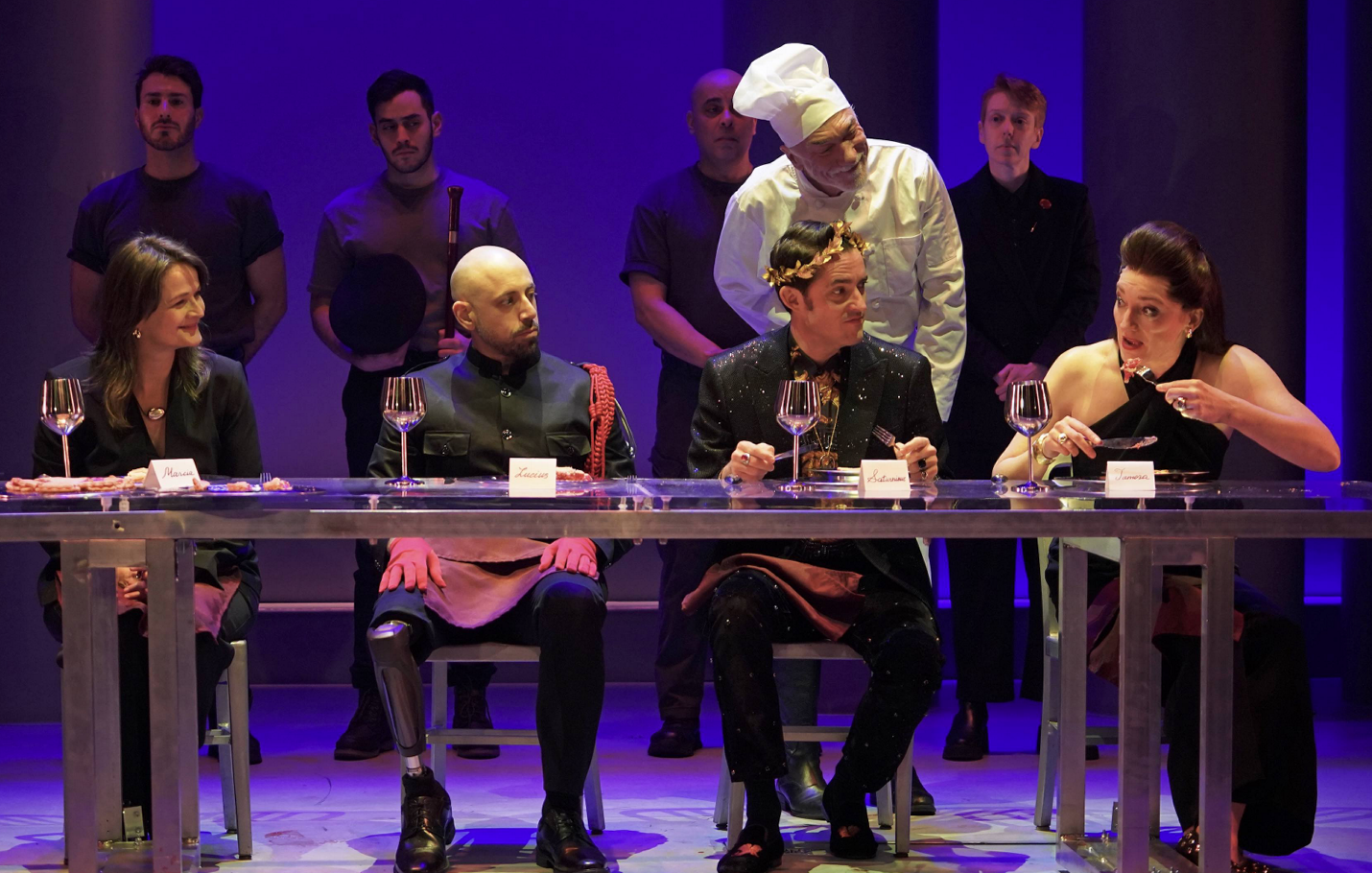
The production’s visual language is immediately striking. The choice to dress Saturninus (Matthew Amendt as the eldest son of the late emperor) and his court in black suits with red shoulder braid carries unmistakable echoes of fascist iconography, grounding the play’s political corruption in recognizable twentieth-century nightmare. Soldiers return in khaki, their war wounds visible and unglamorous—one with an artificial leg, another with an eye patch.
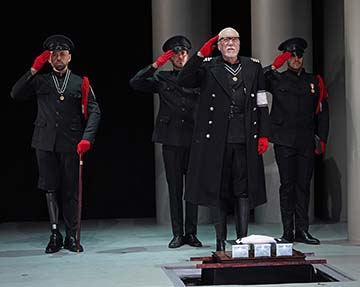
Women wear gowns that evoke no specific era, while Chiron (Jesse Aaronson) and Demetrius (Adam Langdon), the sons of the defeated Queen Tamora (Francesca Faridany), appear in S&M-inspired garb of black leather and silver studs, or in Adidas tracksuits complete with pushups and girlie magazines. This collision of aesthetics—military austerity, classical allusion, contemporary streetwear—creates a world out of joint, a Rome that has lost its cultural coordinates.
Yet the production undercuts any simple historical parallel with moments of absurdist lightness: villains who crack jokes, Saturninus lounging on a table drinking wine, the sheer camp of Tamora’s lover Aaron (McKinley Belcher III) in a delighted “I have done thy mother” when confronted with his illegitimate child.
These tonal shifts are not missteps but strategies. By refusing to let the audience settle into a single mood, the production replicates the play’s own volatile world—one where civilization and barbarism are not opposites but twins.
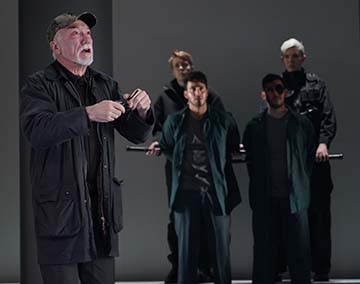
Patrick Page’s Titus is the center around which this production orbits, and the gravity is immense. Page, arguably America’s finest Shakespearean actor today (John Douglas Thompson stands as his only equal), gives a performance of extraordinary discipline. His early scenes as the conquering general carry the weight of a man who has spent his life believing in Rome’s structures only to watch them crumble. When he offers his hand for executioners to take in exchange for his sons’ lives, Page’s stillness is more devastating than any outburst.
The quiet anguish of “Rome is but a wilderness of tigers” lands with the force of a man who has just realized the entire architecture of his life was built on sand. And when he finally transforms into the avenging chef—white hat and apron, electric saw in hand—Page navigates the shift from grief-stricken father to methodical executioner without losing the thread of humanity that makes Titus more than a monster. This is a performance that earns its final madness.
The supporting cast matches him. Tamora, played as a temptress whose seductiveness masks surgical cunning, brings real nobility to her early pleas for mercy—making her later cruelty feel like a corruption of something genuine, not merely innate evil. The production wisely allows her grief for her sons to register as authentic, complicating any simple villainy.
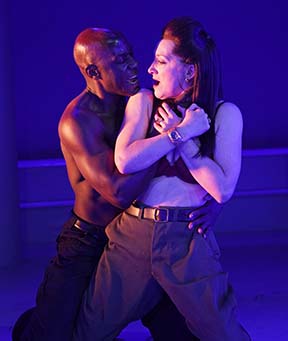
Saturninus emerges as a terrific corrupt politician: entitled, impulsive, his mood swings from casual to cruel reading as recognizably contemporary. The emperor who takes a Goth for his bride when he cannot have Lavinia (Olivia Reis) is played not as a master strategist but as a petulant child with absolute power—which may be the most chilling interpretation available.
Tamora’s sons, Chiron and Demetrius—the super-villains of the piece—benefit from the production’s willingness to let them be simultaneously monstrous and mundane. Their Adidas-clad cruelty, punctuated by pushups and pornography, suggests that evil doesn’t always announce itself with horns and a cape. Sometimes it’s just boys with attitude who happen to enjoy rape and murder.
Aaron the Moor, the queen’s lover and the engine of so much destruction, gets his due here. His delight in his black-skinned son provides one of the play’s few “normal” moments—a father’s pride—and the production lets it breathe before he knifes the nurse who witnessed the birth. This Aaron is not merely a vice figure but a man who has internalized Rome’s cruelty and turned it outward with terrifying consistency.
Lavinia, whose mutilation is the play’s central horror, transcends victimhood through performance that emphasizes her agency after the assault. Her ability to write names with a pen held in her mouth becomes an act of defiant will, and her smile when given a basin to catch her rapists’ blood suggests a woman who has moved beyond terror into something more complex.
Red Bull Theater’s framing, as described in press materials, positions Titus as “a thriller, a spine-chiller about peoples’ capacity for inhumanity and about standing up for justice and honor against the encroaching chaos at the fall of a corrupted and crumbling Roman Empire.” The contemporary parallels—particularly to Trump-era America—are not subtle.
This reading has legitimacy. Titus has become the Shakespeare play directors reach for in times of political crisis. The 2014 Globe production staged amid austerity politics; the 2017 RSC production following Brexit; the 2023 RSC production explicitly drawing Trump parallels—all have found in Titus a language for societal collapse.
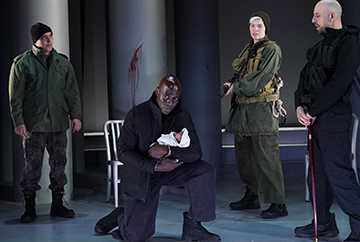
Rome in Titus is not Virgil’s glorious empire but a decaying body politic where succession is contested, law has been replaced by whim, the emperor is a tyrant who rewards evil, the state cannot protect its citizens, and barbarism sits at the center of power (Tamora, Queen of the Goths, becomes empress). The parallels to contemporary anxieties about institutions, democratic norms, and the normalization of cruelty are undeniable.
What makes Titus such potent political theater, however, is its refusal of moral clarity. Titus is standing up for justice—his daughter was raped, his sons murdered, his hand chopped off. But his revenge is cannibalism, murder, and the destruction of everyone who wronged him. The production forces the question: when a system is corrupt beyond repair, what does resistance look like? At what point does the resistor become indistinguishable from the tyrant?
The decision to end with “A Wonderful World” playing over the carnage—jazzy, ironic, deeply unsettling—captures this ambiguity. We have witnessed justice and horror intertwined, and the production refuses to untie the knot.
Understanding this production means understanding the play’s strange origins. Shakespeare wrote Titus around 1590–1593, at the dawn of the revenge tragedy craze. Thomas Kyd’s The Spanish Tragedy had created a sensation with its ghost, its play-within-a-play, and its graphic violence. The young Shakespeare—trying to make his name—essentially attempted to out-Kyd Kyd, amplifying the spectacle for a London audience hungry for it.
But the influences run deeper. The cannibalism comes directly from Seneca’s Thyestes, where Atreus serves his brother his own children. The rape and mutilation of Lavinia echoes Ovid’s Philomel, who wove her story into a tapestry after losing her tongue. Shakespeare points to his source explicitly when Lavinia uses a copy of Ovid to identify her attackers—a meta-theatrical moment that the Red Bull production handles with clarity.
The early 1590s were also a period of genuine crisis in England. The war with Spain dragged on. Successive harvest failures brought famine. Religious persecution intensified. The theaters themselves faced plague closures. And recent scholarship has linked the play’s strange scene of shooting arrows with messages attached into the sky to the 1591 Hacket affair, in which a Puritan extremist scattered libels through the streets claiming divine inspiration.Titus emerges from this moment of collapse—and it speaks to audiences in times of collapse because it refuses to pretend civilization is stable.
The production’s handling of violence deserves particular praise. The rape of Lavinia happens in shadow and sound, the horror registered through screams rather than spectacle. The mutilations are rendered with stagecraft that convinces without exploiting. The final feast—with Titus in chef’s whites, the electric saw, the pie brought forth—manages to be simultaneously absurd and horrifying, a tonal balance that could easily tip into camp but here lands as genuinely disturbing.
The decision to use knives throughout—no guns, no modern weapons beyond the saw—maintains the play’s ancient brutality while the costumes insist on its contemporary relevance. Violence here is intimate, hand-delivered, personal.
Titus Andronicus has the highest body count of any Shakespeare play: 14 on-stage deaths. To put this in perspective:
| Play | Death Toll |
| Titus Andronicus | 14 |
| Richard III | 11 |
| King Lear | 10 |
| Macbeth | 8 |
| Hamlet | 8 |
But it’s not just the number—it’s the quality. Hamlet‘s eight deaths are mostly poison or sword wounds. Titus gives us rape, mutilation, beheading, cannibalism, live burial. This production does not flinch from any of it, but neither does it revel. The horror is presented as horror, not entertainment.
A note on the production’s handling of Aaron and Tamora’s baby: in Shakespeare’s text, Titus kills and bakes only Tamora’s two sons, Chiron and Demetrius. The baby survives, with Lucius vowing to raise him. This production’s clarity on this point matters—it means the final image is not of complete annihilation but of a child who will be raised by those who defeated his parents. The question of what he becomes hovers over the ending.
Red Bull Theater’s Titus Andronicus is a production that knows when to be brutal, when to be funny, when to be profound. Patrick Page’s Titus is a career-defining performance from an actor already known for career-defining performances. The supporting cast matches him. The modern-dress concept serves the play rather than overwhelming it. And the political framing—while unsubtle—is justified by the text and by the moment we’re living in.
This is not a comfortable evening of theater. It’s not supposed to be. Titus is a play about what happens when power is unmoored from law, when cruelty becomes policy, when the only response to chaos is more chaos. In 2026, or whenever it happens to be staged—that remains the most urgent challenge Shakespeare puts to the rest of us.
“Titus Andronicus.” Written by William Shakespeare, directed by Jesse Berger. Red Bull Theater at Pershing Square Signature Center, 480 West 42nd Street, NYC. Runtime 2 hours. Opened March 29, 2026, closes April 19, 2026.
Brilliant observations – makes me want to see it again!