

By Lucy Komisar
This powerful unsettling play by Mark Rosenblatt, directed by Nicholas Hytner, drops you into an argument—no, an intellectual and moral battle—that has riven peoples and governments in the West to the point where critics of their government’s policies are imprisoned or deported.
It is inspired by a true story, the angry Zionist response to a book review by British children’s book author Roald Dahl condemning Israel’s slaughter of Lebanese children in a 1982 attack. Except for quotes from the review and a final interview with a journalist, the events and dialogue are invented, which lets the playwright contrive Dahl’s motivations.
As with all good mysteries, you get the key plot revelation only almost halfway through the play. But Hytner steadily raises the temperature to the level of a thriller.
We are in a construction site, indoors, with plastic sheeting on one side that leads to the garden, wood table and chairs set on a Persian rug (style counts and there is wine on the table), a step ladder, an umbrella stand filled with canes, and cardboard boxes piled up. (Set by Bob Crowley.) There is also noise from fumigating the garden. The writer Dahl (John Lithgow) and Felicity/Liccy Crosland (Rachel Stirling), his live-in girlfriend, are redoing the country house.
In the midst of the chaos, there is another disturbance. Someone is making threatening phone calls. We are not told more.
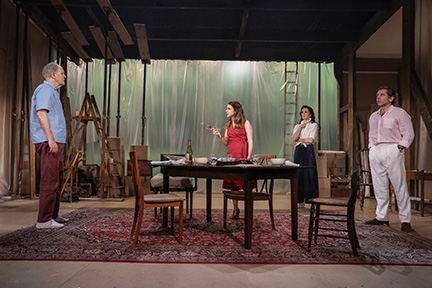
Jessie Stone (Aya Cash), in her mid-30s, arrives in an in-your-face red dress. She is sales director for Farrar, Straus & Giroux, the prestigious New York book publisher. Cash plays her as someone who likes to take clients to lunch. This trip is both a job and a political mission.
Roald is 67 with a back problem and needs the canes. But the grim demeanor Lithgow displays is due to more than physical pain. Liccy is 45, a successful interior designer. Actor Stirling makes clear she appreciates her author boyfriend of 11 years but is her own woman.
Tom Maschler (Elliot Levey), 49, is managing director of Cape Books, Roald’s British publisher. Levey is stolid, the type who checks the sales charts before the reviews.
Jessie has brought one of Roald’s books for him to sign. It is 1983. As he holds it, a clipping falls out—a book review he wrote. (Indeed, he wrote the review.) He sees she has scribbled “not true” in numerous places. The dialogue is invented.
He asks: “Are you Jewish? Stone, was it Stein?”
Jessie: “Yes, I’m Jewish.” She fumbles a bit. “We celebrate the big holidays.”
Roald: “I tried to go to church after my Olivia died. Worked for a bit. Till the scales fell from our eyes….And in the spirit of directness, how do you feel about Israel?”
Jessie: “I believe Israel has the right to exist.”
Roald: “Ah. Unconditionally?”
Jessie: “It’s a country… Sovereign. Recognized by international law. Created by the United Nations. What conditions do you have in mind?”
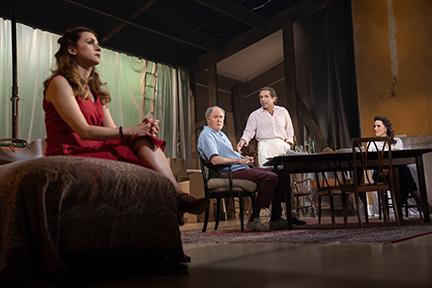
So far it’s just tip-toeing around why she has come from New York to see him in the village of Great Missenden in southeast England.
Then Jessie says: “The pressure on our end is that the New York Times called FSG yesterday. To know if you stand by your comments.”
Here’s where it is relevant that, based on the New York Times theater review of this play, the Times‘ view of the Israeli genocide of Palestinians hasn’t changed. It isn’t mentioned. Take a look at the outrageously deceptive review that echoes the “criticism of Israel is anti-Semitism” over 40 years before—the same stance the publishers took when they wanted Dahl to change his courageous and correct review of a book about Israel’s murder of Palestinians and Lebanese. It could be ripped from today’s headlines.
Tom, who is also Jewish, wants him to acknowledge that this is a divisive issue, with “complexity on both sides.” He can talk about his support for Palestine—
Roald: “… oh may I?”
Tom says he should mention his charity work and say that he is sorry for any offense caused, which FSG can use against any further backlash in the States. Dahl’s book The Witches is about to be published.
Jessie adds: “Mr. Straus [the S in FSG] wants to convey very clearly that if the New York Times attacks you, we might also lose the ALA”—the librarians.
Roald: “God. Satan’s Spinster Army. Gluttons for a wholesome message.”
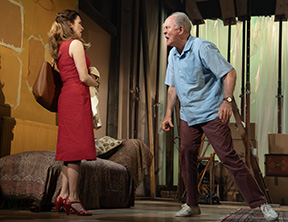
One should mention that offensive talk is part of this writer’s literary personality. His books are dark stories filled with nasty characters who say horrible things. Apparently, children have loved it and made him one of the best-selling children’s book authors of all time, translated into 68 languages and selling over 300 million copies worldwide. Some were made into films and plays such as Matilda, a smashing political allegory about confronting malevolent authoritarians who rule over cowering dolts. Dahl experienced that.
He’s also in the crosshairs of a Mr. Taft, who owns a bookstore in upstate New York and is part of a network of bookshops. Jessie says: “He wrote to us last week to say he’d no longer be taking your books”—because of the Holocaust.
Are these the people who fight banned books? Nobody raises the question of censorship. No ironic mention of the Nazis burning books.
Tom wants an apology, an acknowledgment of another point of view. Roald says: “It’s a Trojan horse… It won’t be enough.”
Playwright Rosenblatt’s technique has been to keep us guessing. But fifty minutes into the play, Jessie reads what Roald wrote: “… in June 1982 the Israeli forces were streaming northwards out of what used to be Palestine into Lebanon and the mass slaughter of the inhabitants began. Our hearts bled for the Lebanese and Palestinian men, women and children and we all started hating the Israelis. Never before in the history of man has a race of people switched so rapidly from being much pitied victims to barbarous murderers. Never before has a race of people generated so much sympathy around the world and then, in the space of a lifetime, succeeded in turning that sympathy into hatred and revulsion.” Sounds about right to me.
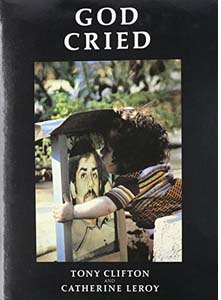
Jessie says: “You’ve written a rave review of a scathing book about Israel.” The article in The Literary Review was about God Cried, a book on Israel’s invasion of Lebanon.
Roald: “About Beirut, about Beiruti anguish, but if you must make everything about Israel.”
Jessie: “OK, about Beirut then, about the Israeli siege of Beirut, so sorry—in which the Israelis—all Israelis, all Jews in fact—are drawn as ‘barbarous murderers.'”
Roald: “They fired guided missiles into seven of the ten hospitals in Beirut, packed with children, into a mental hospital, so what are you saying?”
Jessie: “That an entire race of people is being blamed for the actions of the Israeli army. What happened in Beirut, Mr. Dahl, pains many Jews.”
Roald: “Well that’s very nice.”
Jessie: “The loss of civilian life is unbearable, hard to reconcile, even for many Jews, with—”
Roald: “What? The great Israeli project?”
Jessie: “With what Israel stands for. What it was created to be.”
Roald: “An apartheid fun palace?”
Jessie: “No! No! A liberal, progressive democracy.”
Roald: “Well if it irks Jews so, they should march, speak out—”
Jessie: “But they do!—400,000 Israelis protested the siege in Tel Aviv, protested Sharon, and the Supreme Court forced him out of the army. But here, in your review, you just lump every Jew in together. All Israelis—even though many resist—and all Jews—as if we’re all in cahoots. The Jews. The Jewish race. Jews. A single organism. But Mr. Maschler isn’t Israeli.”
Here is where you, the reader, should be brought up to date and know that Ha’aretz, the best daily paper in Israel, reports that all but a tiny minority of Israelis support the current genocide in Gaza—which playwright Rosenblatt must know. Israelis post videos with women calling for death to Palestinian children “because they would grow up to be terrorists.”
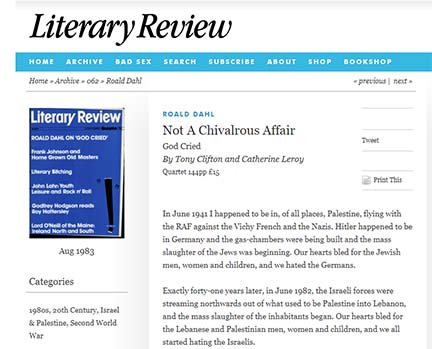
God Cried by Tony Clifton and Catherine Leroy, published in 1983, is a powerful, first-hand account of the 1982 Israeli siege of Beirut during the Lebanon War. Clifton, an Australian journalist, wrote the text. Leroy, a renowned French photojournalist, provided the images. Both had lived in Beirut since 1975. The play does not mention this.
Jessie reads from the review: “God Cried is a terrific book, every Jew in the world should read it. So should everyone who has any conscience at all. Now is the time for the Jews of the world to become anti-Israeli. But do they have the conscience? And do they, I wonder, have the guts? Or must Israel, like Germany” [Jessie: “You mean Nazi Germany—”] be brought to its knees before she learns how to behave in the world?” (Here is the full review.)
I agree. I am Jewish and first wrote about Israel’s crimes against Palestinians in “The West Bank as Bantustan” in The Nation in 1982 —the same year as events described in God Cried.
Playwright Rosenblatt has said that the review mixed meaningful thoughts and anti-Semitism. But none of what was quoted is anti-Semitic. Note that the play opened in London in 2024 the week Israel launched a strike on central Beirut.
“Giant” supposedly refers to Roald Dahl’s 6-foot-6 height. But he was a moral giant set upon by moral pygmies.
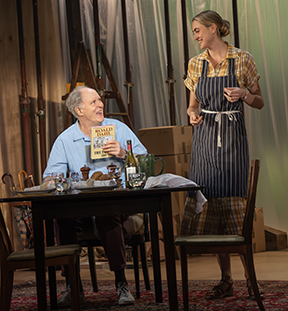
A bit of sardonic humor: Roald asks Hallie (Stella Everett), the 22-year-old cook and housekeeper from New Zealand, “If I refuse to buy Israeli avocados, is that antisemitic?” She quips, “Does the avocado know it’s Israeli?” A rare moment of levity.
I have quoted in detail because a novelist friend who read the New York Times review said, “Oh, Giant, that’s a play about anti-Semitism!” Which it certainly is not!
Lithgow’s face stays distraught. You learn that the caller threatened to slit his and Liccy’s throats. (Mossad? Just joking, but assassination is the top of their playbook.) The only soft moments come when Jessie admits her son was born with a brain tumor. Roald sympathizes because, in fact, his daughter Olivia died at 8 from measles that caused inflammation of the brain. He became a prominent advocate for vaccinations. Not mentioned.
Liccy tells him Tom is promoting him for “honors,” a knighthood, and the honors board loathes controversy. (It doesn’t mind corruption, which is why it recently gave a knighthood to conman and tax fraudster William Browder.) Roald says: “It’s no fucking honor if that’s the price.”
Plenty more will happen, including Roald’s clever way of burning the bridges publishers want him to cross to apologize for calling out Israeli genocide. The conversation with a reporter is true and recorded. You see from the devilish look in Lithgow’s eye that his rant is a device, aimed at the soi-dissant liberals who support Israel’s murderous acts. Of course, Israel’s apologists, who never use the G-word, call it anti-Semitism.
“Giant.” Written by Mark Rosenblatt, directed by Nicholas Hytner. The Music Box, 239 West 45th St, NYC. Runtime 2hrs20min. Opened March 25, 2026, closes June 28, 2026.
Add this: NYT runs another story accusing Dahl of being anti-Semitic! But interestingly, it quotes the Brit reporter who took down Dahl’s remarks used in the play as saying he was confused: “Was this phone call some sort of deep irony that was over my head, or a satire that he was about to explode or explain?” Of course it was! As I said in my review it was deliberate, to block more “you must apologize” demands! But when your boss (Arthur Sulzberger) deems criticism of Israel is anti-Semitism, you follow the line.