

By Lucy Komisar
As I watched this play by Jenny Lyn Bader about the arrest in Nazi Germany of Hannah Arrendt in 1933, my first question as a journalist was, is this story true? And did Arendt write about it?
In the play, admittedly fascinating, Arendt (Ella Kaille) has been arrested on suspicion of collecting German media articles for a Zionist operation to share examples of anti-Semitism with people abroad. She insists she is a philosopher reading historical books, that someone must have left some articles in the “machine” she was using.
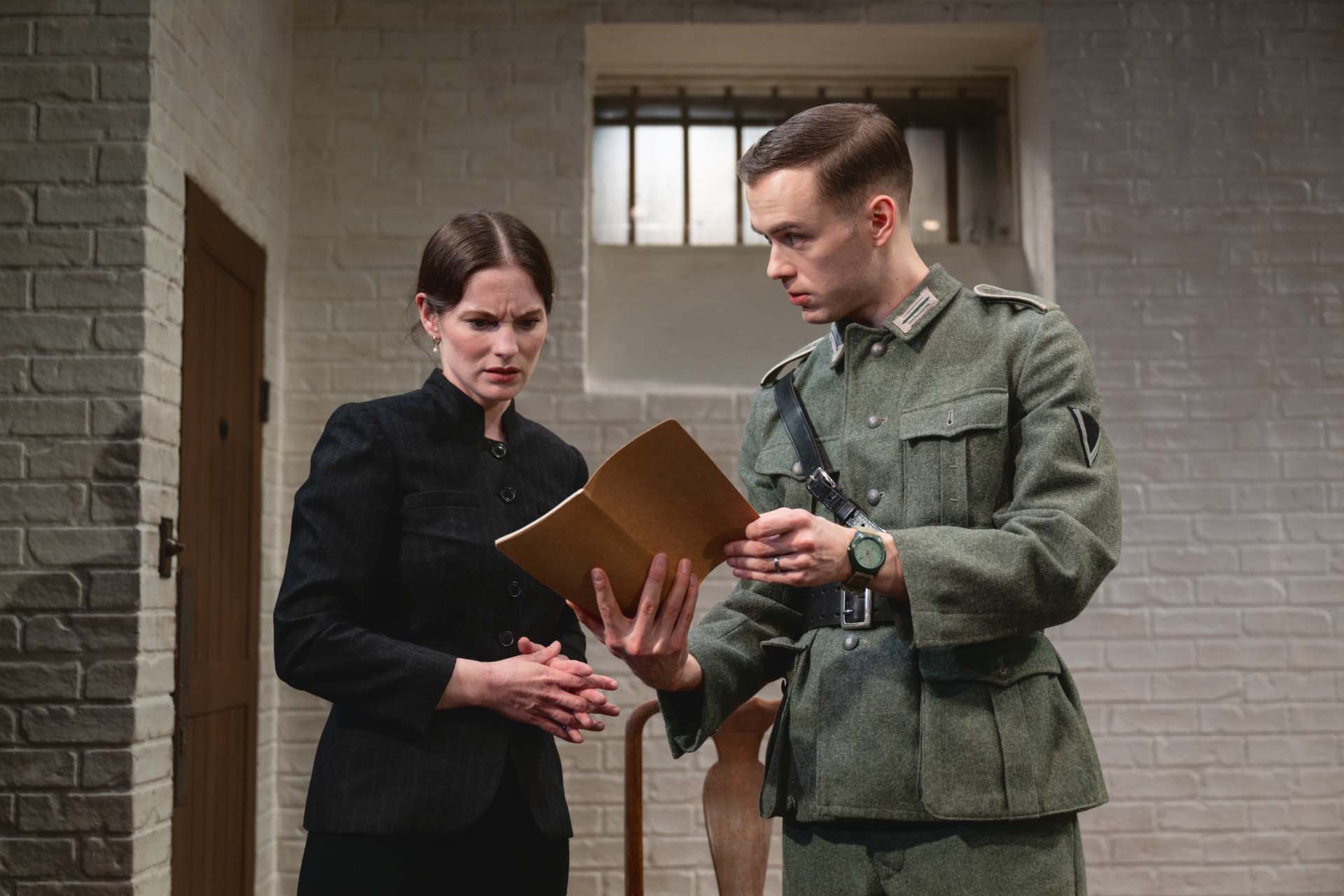
“He told me there were others arrested in the library, which makes me wonder: what if some of the pages you are talking about are not mine? What if someone afraid of being caught left some pages in the machine by accident, and then I took them by accident?”
Papers in the machine? A copy machine? What else could it be?
The key copy machine technology was invented in 1938, five years after Arrendt’s arrest. The first commercial, manually operated photocopier was the Xerox Model A, introduced in 1949. The first fully automated, plain-paper office copier was the Xerox 914, introduced in 1959. So why did Bader make this up? I know playwrights invent dialogue, but not reality. Sorry to be a stickler, but that’s what happens when in your other life you are an investigative journalist.
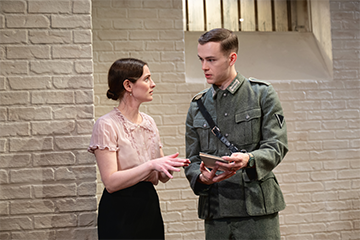
Back to the plot. In a white brick cell with high barred windows and a wood plank floor, a couple of stylish designer wood chairs (were elegant wood chairs standard prison décor, designer Lauren Helpern?) Hannah Arendt (a very composed Ella Kaille) – Stern is her husband – is elegant in pencil-thin black skirt and high-necked jacket over a pink blouse, not quite 1930s garb.
She appears confused about her detention, and worried about her mother in another cell. But though she knew what was happening to Jews in Germany, she shows no terror, not even unease. Director Ari Laura Kreith stages this with all the tension and melodrama as a meet-up at a bar.
The political police officer Karl (a rather mild-mannered Brett Temple) says people who stayed at her house have written disturbing articles. She pretends to be naïve. She has a doctorate and goes to the library to see what people have read historically. He claims she knows German Zionist Kurt Blumenfeld and accuses her of being a Zionist
After a time, a Jewish lawyer, Erich (Daniel Cantor), appears, sent by a Zionist organization to help her. He (very lawyerly) will argue her blameless past, her lack of interest in activism, and her studies with the new rector at Freiburg. Not mentioned that the rector is world-renowned philosopher Martin Heidegger, with whom as a student she had an affair. Heidegger, a supporter of Hitler by 1932, joined the Nazi party in 1933. His most active period of involvement coincided with his tenure as rector of the University of Freiburg, 1933-4 a position he took to align the university with the Nazi state. So he certainly could help, but it would interest the audience to know about him.
The lawyer says he may be able to persuade the authorities to release her temporarily. If not, they go to Plan B. He explains, “The Zionists could offer things on your behalf. Helping to transport émigrés. Endorsing Nazi laws.”
Hannah: “Why would Zionists endorse a Nazi law?”
Erich: “We live in complicated times, Mrs. Stern.”
The play does not explain. The Haavara (transfer) Agreement signed in August 1933 between the Zionist Federation of Germany (ZVfD), the Jewish Agency for Palestine, and the Nazi Reich Ministry of Economics was to facilitate the emigration of German Jews to British Mandatory Palestine while allowing them to salvage a portion of their assets.
Jewish emigrants would deposit their money in a special account in Germany. These funds were used to purchase German goods, which were exported to Palestine and sold by a company called Haavara Ltd. The proceeds from these sales were then paid to the emigrants in Palestinian currency upon their arrival. Between 1933 and 1939, this agreement enabled approximately 60,000 German Jews to emigrate to Palestine.
The Nazi government’s primary goal was to expel Jews from Germany. The Haavara Agreement served this aim by promoting Jewish emigration. Additionally, it helped break the international Jewish-led boycott of German goods, which was a significant concern for the regime in 1933, and it provided a boost to German exports at a time of economic depression.
For the ZVfD, the agreement was a desperate measure to rescue Jews from an increasingly hostile regime. The rise of the Nazis made their goal of encouraging Jewish emigration to Palestine more urgent, and the Haavara Agreement was seen as the only practical way to enable Jews to leave with more than nothing. A contemporary poster from the Jewish Agency argued that “Eretz Israel is the only hope of German Jews and the transfer is their last bridge”.
Many Jewish groups, particularly outside Germany, fiercely opposed the agreement. They saw it as a form of collaboration that undermined the international boycott of Nazi Germany and provided the regime with a degree of legitimacy. But tens of thousands were saved.
However the play ignores parts that would make it interesting: Hannah and Heidegger, the Haavar Agreement and her real role. Arendt had been largely apolitical, but after Hitler’s rise to power, she became involved in anti-Nazi work in Berlin. Her apartment was reportedly used as a safe house or way station for people fleeing the regime.
In 1933, Her friend Kurt Blumenfeld, a leading figure in the German Zionist Organization, asked her to assemble “a collection of all the everyday anti-Semitic expressions” then flooding German public life. The the material was to be sent to foreign press offices and world leaders to show how dire the situation in Germany had become, and it was also intended for use at the 18th Zionist Congress held in Prague that summer
Under cover of being a scholar, she went to the Prussian Library and wrote out quotations from the newspapers, journals, and speeches she examined. She was arrested by the Gestapo and held for about eight days. The Gestapo had discovered her “dozens of notebooks with transcribed quotations” but could not decipher them. The “code” that baffled the authorities was ancient Greek.
The most substantial account Arendt gave is in her famous 1964 television interview with Günter Gaus, titled “What Remains? The Language Remains” (Was bleibt? Es bleibt die Muttersprache).
She explains that she was arrested in 1933 for her illegal work gathering evidence of antisemitic propaganda for the Zionist Federation of Germany. She was detained in a Gestapo prison, and her release came about through a combination of luck and the decency of one of her captors. She recounts: “I was exposed. I was very lucky. Got out after eight days, I think, because I – the detective who arrested me, I became friends with him. And he was a lovely guy.”
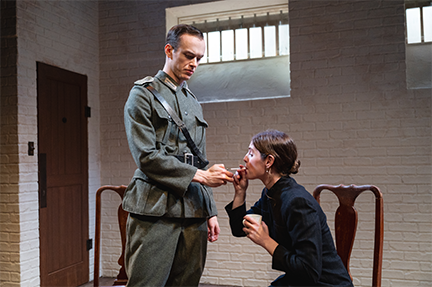
That is the strongest evidence of the truthful narrative of the play, where the interrogator is very decent, even brings her better coffee when she complains about the prison brew. He gives her cigarettes to which she appears addicted. In the script, she plays him, praises him, establishes a rapport with him. In the end he will help her and her mother escape. Released officially “to await trial,” it meant they could flee, first to Prague and Geneva, and later to Paris.
The problem with the play is that the most interesting parts of the real story are glossed over and all we get are the interactions between Arendt and the police investigator. We never learn what she was really doing in the library or her connection to the Zionists. Or about the Haavara Agreement. Playwright Bader could have had Arendt speak silent thoughts or added a narrator or some other device to tell us what was really going on.
I know that a critic should write about the play the author wrote, not what was not written. But this pretends to be an historical play. (No dramaturg is listed.) And the story of Arendt’s conversations with the interrogator are an interesting but minor fillip in a very important and dramatic story which you never learn.
“Mrs. Stern Wanders the Prussian State Library.” Written by Jenny Lyn Bader, directed by Ari Laura Kreith. 59E59 Theaters, 59 East 59th St, NYC. 90 min. Opened Sept 20, 2026 closes Oct 25, 2026.