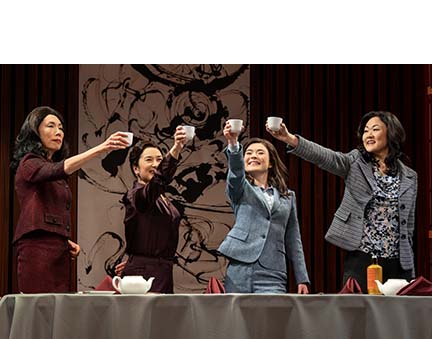
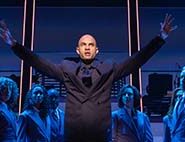
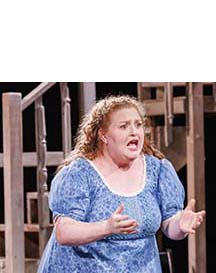
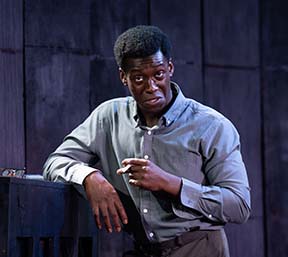
Alex Lin’s new play, “Chinese Republicans,” presented by the Roundabout Theatre Company, is ambitious, aiming to dissect the generational fissures within Chinese-American identity while simultaneously taking a sledgehammer to the glass ceiling of late-stage capitalism.
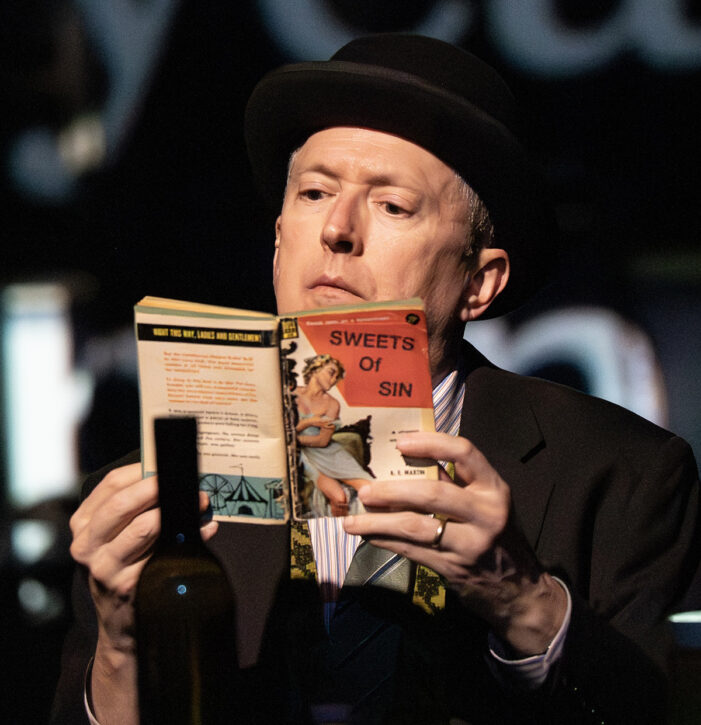
It seemed like a noble idea: take James Joyce’s 1922 novel, a book far more discussed than actually read, and put its famously dense prose in the mouths of actors. Surely, hearing the words spoken aloud would unlock something. Surely, the stage could illuminate what the page obscures.
Tracy Letts’s psychological thriller, under David Cromer’s masterful direction, turns a motel room into a terrifying laboratory of American anxiety.
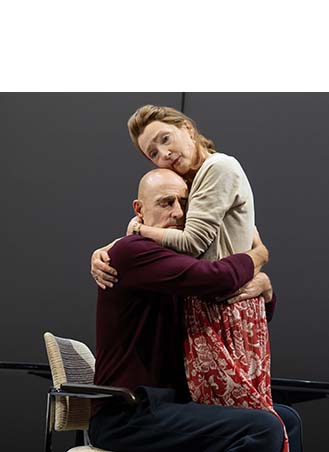
The true horror in Letts’s “Bug,” now receiving a skin-crawling and brilliant revival directed by Cromer, does not scuttle in on six legs. It enters softly, politely, a shy man emerging from a motel bathroom asking for a friend. The terror is in the quiet click of a mind latching onto an explanation—any explanation—for the pain of a lonely, battered life. By the final, frantic scene, the Manhattan Theatre Club stage has become a shrieking, tin-foiled monument to the American need to believe, even in monsters, if it means not being alone.
There is a moment in Bess Wohl’s new Broadway play “Liberation” when the characters—a consciousness-raising group in 1970 Ohio—discuss the upcoming Women’s Strike for Equality. One of them, Celeste, a black feminist scholar, scoffs: “I don’t really know that protesting changes anything… It sort of feels like they just laugh at everyone marching around and waving their signs.”
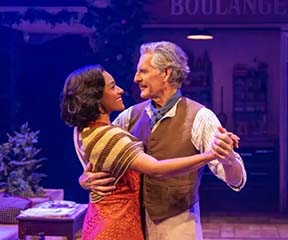
The bread crisis in the small Provençal town of Concorde is urgent, existential and entirely self-inflicted. This is the buttery premise of “The Baker’s Wife,” the charming, stubbornly hokey, and ultimately satisfying musical that has rolled into the Classic Stage Company with the comforting aroma of a warm baguette.
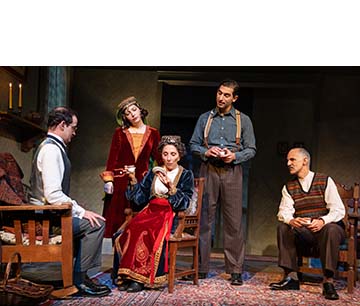
Talene Monahon’s piercing new play, “Meet the Cartozians,” is not merely a family drama; it is a forensic and often ferociously funny excavation of the American experiment itself. Under David Cromer’s meticulously calibrated direction, the work dissects a century of racial bargaining, cultural performance, and the enduring ache of identity forged in the crucible of a hostile state.
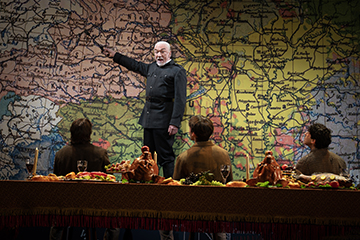
This play about a politically fraught chess match between an American and Russian champion in 1979 lasted only two months on Broadway in 1988, when Ronald Reagan was president. The time of the “evil empire.” (Plus ça change.) So maybe even then it was a wrong call.
Robert Icke at only 43 solidifies his place among Britain’s theatrical greats with his stunning new production of Oedipus at Studio 54. A master of turning classic plays into modern parables—from Hamlet to The Doctor— Icke now takes Sophocles’ 2,500-year-old tragedy and forges it into a riveting, contemporary political thriller.
“Queen of Versailles” – Book by Lindsey Ferrentino — starts out feminist, about a working-class girl who struggles to get an education, makes a bad marriage choice and pulls out of it. Then she becomes so entrapped by the lure of riches and conspicuous consumption that she devotes her life and sacrifices her daughter to it. I’d want to see that straight play.
Rajiv Joseph’s “Archduke” at the Roundabout is a surreal and entertaining take on an attempt to assassinate Archduke Ferdinand of Serbia organized by a soi-dissant military leader who wants to derail the Austro-Hungarian empire and achieve Serbian independence and Slavic unification. oseph is masterful at historical plays, and this is directed with a combination of realism and absurdity by Darko Tresnjak, who was born and raised in Zemun where some of the action takes place.
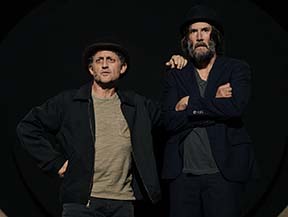
Jamie Lloyd’s vision of Beckett’s “Waiting for Godot,” is set in the opening of a huge round tunnel where the protagonists Estragon/Gogo (Keanu Reeves) and Vladimir/Didi (Alex Winer) hang out, sometimes climbing up and sliding down the circular walls. The set is by Soutra Gilmour. Usually, one begins by talking about the text of the play and the acting. In this case, the set overwhelms all.
Yasmina Reza’s superb surreal comedy takes aim at her favorite subject, the pretentious French bourgeoisie. (Another fine play of the genre is her “God of Carnage.”) I admit to liking this play’s target, the ridiculous one or two-color paintings that hang in galleries (and museums) with bloated prices and pompous wall labels and the arty “intellectuals” who admire them.
As the 30th international conference on climate change takes place in Belém, Brazil, — which the U.S. refuses to attend — this Royal Shakespeare Company production at Lincoln Center is a devastating exposé of how the American government run by the corrupt Democratic and Republican uniparty has brought the planet close to destruction. It is a brilliant play, telling you more than you will read in the American corporate media.
What happens when you mix the characters of a late 18th century novel by Jane Austin with the sensibility of modern teenage girls who spend their time on dating apps and 20-something boys who seem stuck in a past century or are confused about the current one?Inspired by “Pride and Prejudice,” Emily Breeze’s musical plays a bit loose with the text but is a happy romp that could have been set in a sorority house as much as at a modest estate in the English countryside. It’s a satire, a spoof. Or a sitcom. This is not your Cliff Notes “Pride and Prejudice.”
“The Best is Yet to Come, Celebration of Cy Coleman,” the first night of this year’s Cabaret Convention, put on by the Mabel Mercer Foundation, could have been called “the best is on these stages”– for all three evenings. Out of the 60 singers that appeared, I’ve picked what I thought were the best!
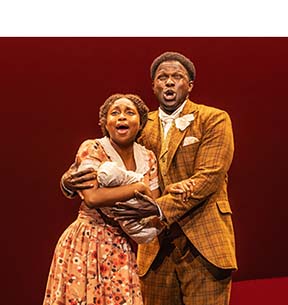
It’s the “melting pot” of 1906, but the melt isn’t easy. A few heroes and many moral cowards move in a swirl of racism and anti-immigrant abuses. Based on the stunning novel by E.J. Doctorow, a century later, one can say plus ça change.
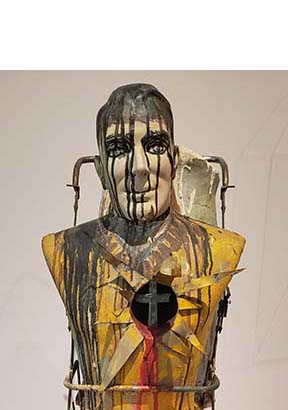
Oct 9, 2025 – This Whitney exhibit of the Surreal Sixties show a time of art that existed alongside a political movement against the U.S. imperialist attacks on Vietnam that were also part of repressive attacks earlier against indigenous Americans and later against people of color. In other word, these paintings showed a history of murderous repression that continues to the present.
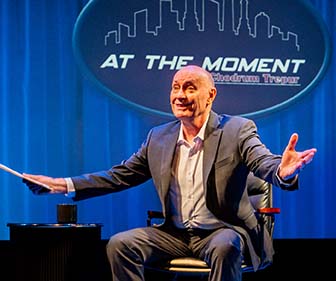
A journalist is interviewing Rupert Murdoch about his life. Except it is more than it seems. I figured it out midway but it doesn’t really matter to say it now: it’s his conscience. Which doesn’t exist. Otherwise, the interviewer is quite hokey.
The Public Theater’s production of Shakespeare’s “Twelfth Night” is a disappointment.
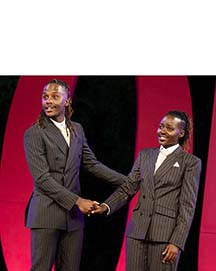
First surprise, the event starts with a Chinese woman who arrives on stage. She tells a story of how she came to New York a decade ago, her kid had problems (maybe autism, I forget), she went to school to help out. They thought she was so good they hired her. Please tell me what her ten-minute personal history had to do with Shakespeare!!!! Is this a woke satire? No, I think it was serious. For whatever its purpose.
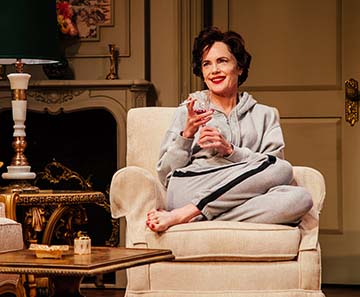
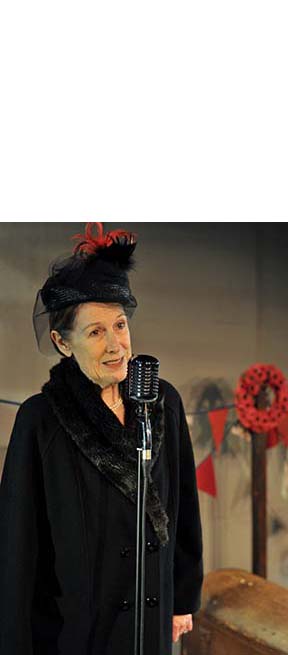
“Ava: The Secret Conversations” is the story of Ava Gardner, a Hollywood glamor girl pre-feminism. Elizabeth McGovern, the playwright and actor, is brilliant recreating a woman who somehow knew something was wrong with how the system and men treated her, but couldn’t quite figure it out. Women today would see her dialogue as a feminist cry of pain.
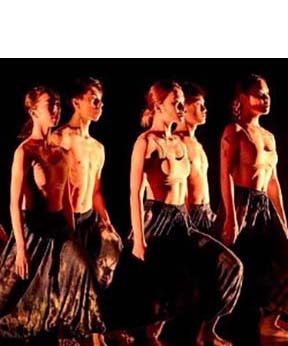
Dance programs always tell you what movements really mean. Poetic descriptions. But of course what matters is how you react to the movements.
So this production by “Taiwan Season: Trace of Belief” at the Edinburgh Fringe choreographed by Hsieh Yi-Chun is inspired by memories of temple processions and personal memories, including faith in a changing world, collective ritual vs individual will. Okay to see the dance through that prism. But I just love this company’s dance, which I have seen before at Avignon.
This biopic, written and performed by the masterful and accomplished British actress Alison Spilbeck at the Edinburgh Fringe, tells the story of the extraordinary Eleanor Roosevelt. To keep the interest of the British audience as this tours the UK, it is built around a wartime visit she made to London.
Mark Thomas is a British political actor. That means that the plays he performs in usually have strong social justice content. Sometimes in solo plays he brilliantly creates multiple characters. That is the case in “Ordinary Decent Criminal,” Written by Ed Edwards, directed by Charlotte Bennett, whose ironic title is explained near the end.
“Miles” at the Edinburgh Fringe is about the great jazz musician, his art and his life, Written and directed by Oliver Kaderbhai, it is not only a biography but a fascinating exploration of Miles Davis’s music with details that will fascinate jazz fans and musicologists. (Helps to know about flats and sharps.)
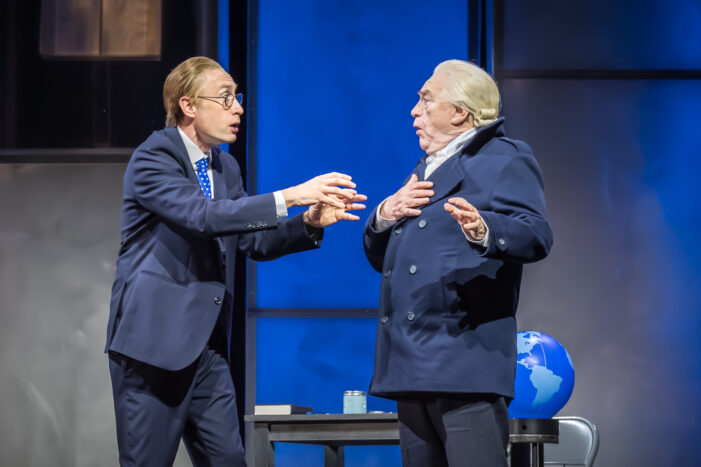
It’s a bankster thriller, doing to big-time financial charlatans what the play “Enron” did for corporate thieves. And more than that, it takes direct aim and hits the apparition of the capitalists’ god, Adam Smith. James Graham’s “Make It Happen” at the Edinburgh Theater Festival is a guidebook for how financial skullduggery works. And, directed by Andrew Panton, more entertaining than you’ll see on any financial pages.