

By Lucy Komisar
Here is a surprise: a dark comedy about “relationships” that is actually clever, funny and smart. To me, “relationships” usually signals a sit-com with laugh tracks. You will find none of that here. Gina Gionfriddo’s 2008 play “Becky Shaw,” set in 2007 and directed with sharp, energetic pacing by Trip Cullman, feels superbly modern—only the cell phones, you will notice, were smaller then.
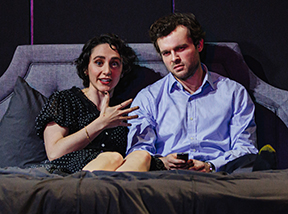
The title character is borrowed from Thackeray’s Vanity Fair. In that novel, Becky Sharp is a cunning, ruthlessly ambitious, amoral waif-like coquette. Gionfriddo has dropped that predator into contemporary New York City. This Becky (finely portrayed by Madeline Brewer) may be a predator masked as an innocent—or something more complicated. She presents herself as a victim while circling a rich man.
That man is Max (a brilliant, clever Alden Ehrenreich), who manages other people’s money. He is acerbic bordering on nasty, but very funny. Max’s best friend is Suzanna (Laureen Patten, who turns distress into a character trait). He was raised by her parents after his mother died. Suzanna’s mother, Susan (Linda Emond), has multiple sclerosis, walks with a cane, and has taken a lover named Lester, a redneck house painter. Mother and daughter are in conflict over Lester and money.
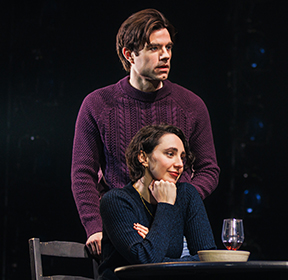
Susanna, distraught over her father’s death, is always angry. The relationship between her and Max seems curious. You begin to wonder when you learn Suzanna and Max spend their time watching dead prostitutes on the Autopsy Channel. “Siblings”? Something more? For a moment, it becomes more, though he tells her it will not change anything. If they are a match, it seems more a fight match than a love match.
Eight months later, Suzanna is in Providence, married to Andrew (a very mild, laid-back Patrick Ball), whom she met on a ski trip. They arrange a blind date between Max and Becky, a temp where Andrew is office manager.
Arriving at the apartment, Max disparages the smell of Portuguese food. And here comes Becky Shaw—blonde, in a short flouncy pink dress. “You look like a birthday cake,” Max says.
So, the date. After the restaurant, they go to a dive bar. Outside, something happens that will bind them in ways none of them expect. In the days that follow, Becky calls Max repeatedly. But for him, it is over. Max accuses Suzanna: “She wants a relationship with me. You fixed me up with a desperate woman. That woman is not my equal.”
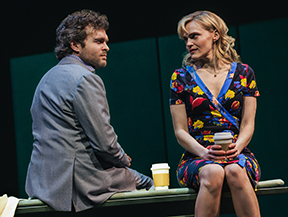
Becky reveals she has had past relationships that ended badly—men who, in her telling, ruined her life. She admits to complicated, uncomfortable feelings about those experiences. Then we learn that after the date, Max and Becky slept together, but he did not let her stay in his hotel room. He offered her cab fare or her own room.
Andrew will later tell Becky, “He’s emotionally a very… stunted man.” Becky replies, “Then why did you set me up with him?” Suzanna accuses Max. He says, “I have a sleep disorder.” She says, “You have an intimacy problem.”
At one point, Becky says to Max, “I’m not good enough to date, but I’m good enough to… to fuck and to be trusted with a confidence.” Max: “You just went from trying to date me to blackmailing me in about three minutes. You’re a scary person, Becky, and I knew it the minute I met you.”
Soon, a crisis erupts—one that involves Becky, a cut, and a trip to the emergency room. Andrew grows concerned for her. Suzanna grows jealous. Accusations fly. Loyalties fray.
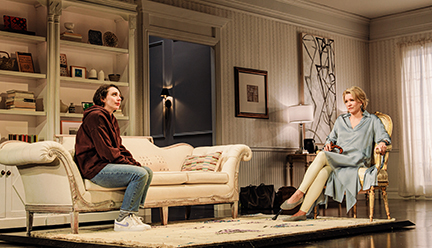
We end at Susan’s elegant Richmond apartment. Lester is in jail for mail fraud. Max is looking for a lawyer. Andrew brings Becky there. Suzanna and Max are furious. The best line of the play comes from Susan: “No one respects a woman who forgives infidelity. It will keep Hillary Clinton from becoming president.” Big knowing laughter from the audience.
A planned departure goes unexpectedly wrong. Now Max, in despair, is confronted by someone who may be a fragile innocent—or something more like a black widow spider.
“Becky Shaw” is a sharp, uncomfortable, and very funny play about people who are not quite what they seem—and about whether anyone in Vanity Fair ever really is.
Trip Cullman’s direction keeps the tension crackling. Brewer brings a deceptively fluttery vulnerability to Becky; Ehrenreich delivers Max’s acid wit with pinpoint precision; Patten grounds Suzanna’s rage in genuine hurt; Ball makes Andrew’s decency quietly complicated; and as Susan, Emond steals her scenes with dry, devastating timing.
“Becky Shaw.” Written by Gina Gionfriddo, directed by Trip Cullman. Helen Hayes Theater, Manhattan. 2hrs25min. Opened April 6, 2026, closes June 14, 2026.