

By Lucy Komisar
August Wilson’s “Joe Turner’s Come and Gone” arrives with the smoky weight of Pittsburgh’s steel mills looming in the backdrop—three-story houses and chimneys belching industry. It is 1911, barely fifty years after the abolition of slavery, and Wilson plants us squarely on the border between legal freedom and lived captivity. This is a haunting allegory about black Americans who came north in the decades after emancipation, carrying chains white people could not see.
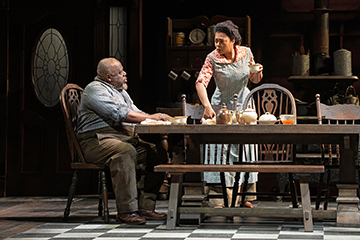
The setting is a boarding house run by Seth (Cedric The Entertainer) and Bertha (Taraji P. Henson) Holly. Seth works nights shaping pots and pans, gruffly insisting on decorum from his tenants while trying to finance his own company. Bertha throws salt on the table at the start—a small ritual against bad luck—and holds the household together with a warmth that softens Seth’s harder edges. Both actors ground the play in domestic reality, though Cedric’s natural comic presence occasionally works against Seth’s sharper demands.
Into this world drifts a small congregation of the lost. Bynum Walker (Ruben Santiago-Hudson), a “conjure man” who mixes mysticism with genuine psychological insight, claims to be tracking the “Shining Man” who holds the secret of life. Santiago-Hudson delivers Bynum’s wisdom with a sly, unhurried gravity that makes you believe in his powers and spells even when you know they are just common sense dressed in ritual.
Then there is Mattie (Nimene Sierra Wureh), a young woman whose husband left her and whose two babies died. (People leaving people bereft seems a theme.) She asks Bynum, “Can you fix it so my man come back to me?” Wureh plays Mattie’s exhaustion with a quiet, devastating truth.
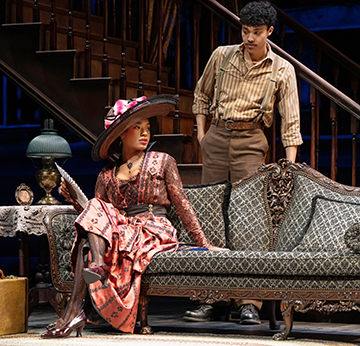
Jeremy Furlow (Tripp Taylor), a young guitar player working on a road gang, wants to make it with music and women. When the police take his two dollars—and later he is fired for refusing a fifty-cent payoff—Wilson sketches, in a few swift strokes, the routine theft that awaits black labor everywhere. Taylor plays Jeremy’s bravado as a thin coat over real hurt.
Molly Cunningham (Maya Boyd), a sultry woman who makes her way from men but insists on her independence, announces, “I like me some company from time to time.” She is cynical, untrusting, and Boyd gives her a sharp intelligence.
But the horrific center of the play is Herald Loomis (Joshua Boone). Once a sharecropper and a deacon, Loomis was seized outside Memphis by Joe Turner—based on the real Joe Turney, brother of a Tennessee governor, Peter Turney (1893 to 1897), who kidnapped black men and forced them into seven years of peonage. Turney would “go out hunting and bring back forty men at a time,” as the character Herald Loomis recalls in the play. He often lured men into crap games or simply rounded them up from jails. Once captured, these men were forced to work on his plantation or state prison farms for a fixed period: seven years. During this time, they had no contact with their families.
The phrase “Joe Turner’s Come and Gone” entered African American folklore as a coded warning. The 1915 song Joe Turner Blues by W.C. Handy describes the grief of women whose husbands had vanished. In black communities, if men disappeared, the news would spread that “Joe Turner’s come and gone,” serving as a terrifying signal to be vigilant. Joe Turner’s actions perfectly captured the play’s central theme: that for many black Americans, legal freedom was a cruel illusion as long as corrupt white power remained intact.
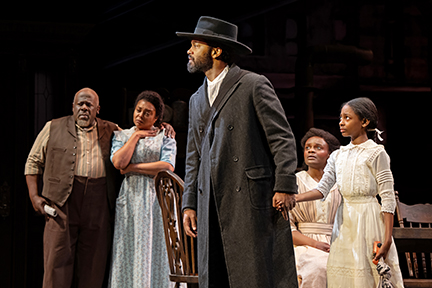
While he was in forced labor, the play’s Loomis had no contact with his wife Martha (Abigail Onwunali) or daughter. Freed, he found daughter Zonia at her grandmother’s house, where Martha left her while she followed her church north, and he spent four years searching for her. Boone plays Loomis as a man barely containing an earthquake. When he cuts his chest and bleeds, the gesture feels less like melodrama than the only language left to him.
Rutherford (Bradley Stryker), a white peddler who sells Seth’s dustbins, casually remarks that a horse is better than a wife. His father was a slaver and a catcher of runaways; now the son “finds people” for a fee. Stryker plays this with a chilling, matter-of-fact affability that reminds you how violence becomes ordinary.
The script’s episodic structure, on the page, sometimes threatens to tip into soap opera—lost spouses, romantic triangles, sudden entrances and exits. But director Debbie Allen takes what might appear to be soap opera and transforms it into a vivid cry of pain and also hope. Under her hand, the overlapping searches (Mattie for her man, Herald for his wife, Bynum for the Shining Man, Jeremy for a break) cease to feel like separate plot threads and instead resonate as variations on a single wound.
Allen finds the rhythm underneath the dialogue—the heartbeat of people who have been unhoused from themselves. When a lesser director might have let the melodrama sit on the surface, she pushes into the silences, the glances, the way bodies shrink or swell in a room. The result is not a tidy drama of resolution but something rawer: a community gasping for air and finding it, briefly, in each other.
Then the Juba comes. The cast breaks into the shuffling, stomping Ring Shout—a dance from the slaves, part Christian, part African. “People need to know their songs,” Bynum says. “When a man forgets his song, he goes in search of it.” Under Allen’s direction, the dance is not a release but a reckoning. You feel the bones of something older and truer.
When Herald comes onto Mattie —saying “A man needs a full woman. Come on and be with me,” she replies, “I ain’t got enough for you. You’d use me up too fast.” It’s a painful line, and yet at the end maybe one distraught soul can find comfort in another.
The actors take Wilson’s message to heart, delivering performances that define each character as a distinct individual and also as one voice in a shared, wounded, singing choir. And Allen, who understands Wilson’s cycle, never lets you settle into comfort.
“Joe Turner’s Come and Gone” conjures a mood both poetic and surreal, though on its face it is completely naturalistic. Perhaps that is the distance of time—nearly a century ago, 1911—when black people, only fifty years from the Civil War, were living on the knife’s edge between slavery and freedom. Wilson asks whether you can find your song when the man who stole it is still walking free. Under Debbie Allen, the answer is a bleeding chest, a dance, and a room full of strangers holding each other upright. It is not a happy ending, but an honest one. And a brilliant retelling of America’s treatment of black people where whites have been “Joe Turner.”
“Joe Turner’s Come and Gone.” Written by August Wilson, directed by Debbie Allen. Ethel Barrymore Theatre, 243 West 47th Street, NYC. Runtime 2hrs20min. Opened April 25, 2026, closes July 26, 2026.