

By Lucy Komisar
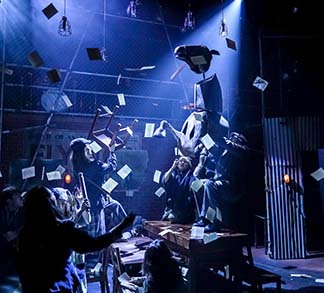
There’s a moment in “Cable Street” when the mounted police charge and the protesters scatter marbles and broken glass across the cobblestones. It’s the kind of theatrical image that is part history lesson, part battle cry, and entirely electrifying.
This new musical, book by Alex Kanefsky, music and lyrics by Tim Gilvin, directed by Adam Lenson, arrives at 59E59 Theaters after a successful London run. It tells the true story of the Battle of Cable Street (October 4, 1936), when 100,000 Jews, Irish workers, communists, and local residents blockaded London’s East End to prevent Oswald Mosley’s British Union of Fascists from marching through the neighborhood’s Jewish heart. It’s a story most Americans don’t know. I didn’t. And I left the theater wondering why not.
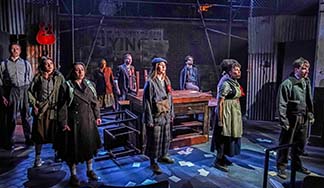
The show follows three families—the Jewish Scheinbergs, the Irish Kennys, and the English Williamses—packed like sardines into the cramped tenement apartments of the ironically named Camelot Mansions.
Sammy Scheinberg (a gritty Isaac Gryn), the essential character of the play, is a young aspiring boxer who changes his name to Seamus to get work on the docks, where the Irish control hiring. Mairead Kenny (Lizzy-Rose Esin Kelly, delivering a powerhouse vocal performance) works in a Jewish bakery by day and writes fierce, unsentimental poetry by night. Ron Williams (Max Alesander Taylor) is an unemployed Lancashire transplant who finds himself drawn to the Blackshirts’ promise of “English jobs for Englishmen.”
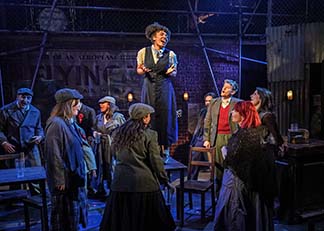
The show is sung-through, with very few spoken lines, and the score (keyboards, drums, bass, played live with real ferocity) owes an obvious debt to “Les Misérables.” That’s not faint praise. Gilvin’s music has the same anthemic sweep, the same ability to make a chorus feel like a crowd lifting a piano.
“My Street” functions as the show’s thematic engine, with each character claiming ownership of a place that keeps trying to reject them. Mairead’s “Bread and Roses” solo about the need for poetry alongside survival, is the kind of ballad that stops the show.
Ethan Pascal Peters as both Moishe, the observant teenager in the Jewish family, and Sol, a communist organizer, is a compelling actor presenting very different visions of the future.
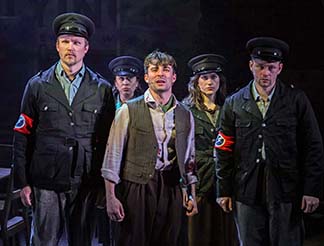
The fascists have been harassing Jews, but the community till then hasn’t found solidarity. The fascists don’t create these divisions; they exploit them. And the musical’s argument is as clear as it is moving: the powerful stay powerful by keeping the rest of us at each other’s throats.
Adam Lenson’s staging is economical but smart: a wooden table and a few chairs, backed by a brick wall, shifting configurations to become a pub, a town hall, tenement flats, a bakery, a synagogue, and barricades.
Some of cast double seamlessly—Debbie Chazenas Mairead’s mother Kathleen brings a Dublin accent and a mother’s weary wisdom to her scenes; she also plays the present-day Oonagh, an American woman retracing her mother’s East End roots in a framing device that gently asks what we owe to the past.
The second-act sequence depicting the battle itself is a marvel of low-tech stagecraft: a horse made of steel-gray sculpture, the cavalry represented by rhythmic movement and sound, the famous cry of “No pasarán” (they shall not pass) lifted from the Spanish Republicans fighting Franco.
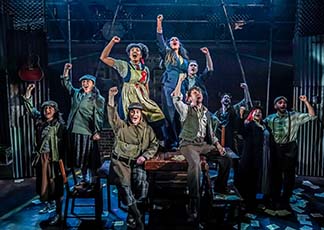
And then they win. For the time. The fascists return a week later to smash windows and beat Jews. Eighty-four anti-fascists are arrested. The landlords raise rents anyway.
There’s a moment late in Act II when Edie (Ron’s mother, played with aching vulnerability by Preeya Kalidas), Rachel (Natalie Elisha-Welsh) the Jewish mother, and Kathleen (Debbie Chazen) the Irish mother sing “Happening Again,” a trio about revolution, violence, and war. They’ve seen this before—the Easter Rising, the pogroms, the Great War—and they see it coming again. It’s the song that connects 1936 to 2026, and it’s the essence of this political play.
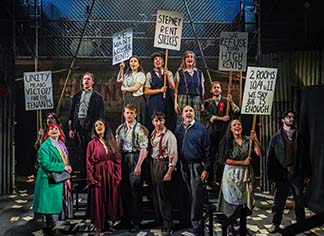
The show’s only real flaw is one of intelligibility. With accents ranging from East London to Irish to Lancashire to Eastern European Jewish, and with lyrics sung over a thrumming band, I missed more lines than I’d like to admit. This is a show that wants you to hear its words, and it’s a shame when the orchestrations swallow them.
“Cable Street” leaves you with raised fists and a sinking feeling that the battle it describes isn’t finished. The final scene, shifting to present-day rent strikes and a poet’s words echoing across generations, makes that explicit. But the show’s abiding faith is that when working people remember they have more in common than their landlords and their governments want them to believe, they can still build a barricade.
“Cable Street.” Book by Alex Kanefsky, music and lyrics by Tim Gilvin, directed by Adam Lenson. 59E59 Theaters, 59 East 59th Street, NYC. Runtime 2 hrs30min. Opened May 3, closes May 24, 2026.
Isn’t this just one of those Pro Israel displays with hints that anyone using the word Genocide is guilty of shock horror “anti-semitism”
It follows Fiddler on the root and the rather incredible performances of The Producers – where they try to resurrect jews dressing up in German uniforms as satire. Sick
LK: You misunderstand. It was about the German Nazi times almost a century ago when jackbooted fascists indeed practiced anti-Semitism. And targeted workers of all religions as shown in the play. Nothing to do with the current Israeli genocide in Gaza in which Israelis ironically have taken on the role of the Nazis.