

By Lucy Komisar
The lights rise on a high gray space, nondescript and suffocating. Pillars with chipped tiles flank the stage. Metal furniture doubles as kitchen table, office chair, restaurant booth. Then headlights cut through the dark—a burgundy Studebaker pulling into a garage. The year is 1949. When I first saw this powerful play, I thought it was a critique of capitalism, which has been a theme of playwright Arthur Miller. In Joe Mantello’s riveting production it seems to be more about the delusion of those who believe in capitalism.
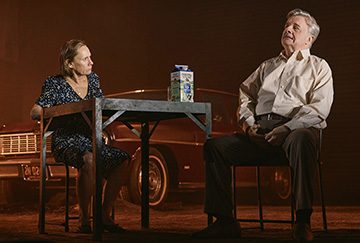
Nathan Lane plays Willy Loman, a sixty-year-old traveling salesman who has just driven home from a failed trip, unable to keep his mind on the road. “I’m tired to the death,” he tells his wife Linda (a brilliant Laurie Metcalf). He was supposed to be in Boston. He got as far as Yonkers. Lane is gruff and distraught.
Linda greets him with the careful tenderness of a woman who has spent decades absorbing his cruelties. When he complains she bought American cheese instead of Swiss, she apologizes. When he snaps about the windows, she tells him gently that they are all open. Miller writes that she “more than loves him, she admires him”—as if his temper and his massive dreams served only to remind her of longings she shares but cannot express. Metcalf inhabits Linda, even with a voice in low murmur, as if she were in her skin. The other actors in the play are fine, but Metcalf IS Linda.

Upstairs, their sons listen. Biff, thirty-four (a self-absorbed Christopher Abbott), has returned after years as a farmhand in Texas. He is still “finding himself.” Happy/Hap, younger (a self-indulgent Ben Ahlers), works in a department store, waiting for the merchandise manager to die so he can advance. “I don’t know what I’m supposed to want,” Biff confesses. Hap numbs his loneliness with women. He brags about seducing the fiancées of his superiors. Abbott and Ahlers portray the fakery of characters who live pretenses.
The play moves fluidly between present and past. In Willy’s memories, his sons are young and worship him. Biff is a high school football star, “built like an Adonis,” with scholarships to three universities. Willy tells his boys that being “well liked” is everything. “Be liked and you will never want,” he insists. Bernard (a serious Karl Green), the studious neighbor boy who begs Biff to study for his Regents exam, is dismissed as “anemic.” Bernard will never succeed in business, Willy declares, because he lacks personality.
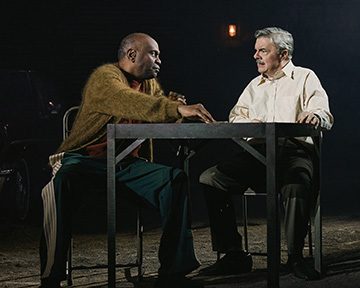
Years later, we see that Bernard’s father Charley has been giving Willy $50 a month, “a loan”, and offers him a job but he refuses. Not clear why, not stated, but we see that Charley is black. In early productions he was Jewish. Both outsiders.
But the past holds darker truths. We see Willy with a sultry blonde woman (Tasha Lawrence) in a slip in a Boston hotel room. She laughs as she puts on stockings Willy has given her. Linda, meanwhile, sits at home mending her own stockings, because they are so expensive. At another moment when Willy sees that, he explodes: “I won’t have you mending stockings in this house!” The cynicism of his inner corruption laid bare.
Willy’s memory of his brother Ben (Jonathan Cake) haunts him like a ghost. Ben walked into the African jungle at seventeen, found diamonds and walked out at twenty-one a rich man. “The jungle is dark but full of diamonds,” Ben’s vision whispers. Willy chases that phantom through his life.
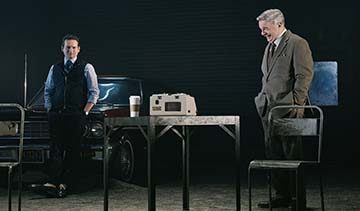
The collapse accelerates. Willy asks his boss Howard (John Drea) —the founder’s son, a man more interested in his new wire recorder than in loyalty—for a New York job. (Where do corporates have loyalty?) Howard fires him after 34 years on the job. “I don’t want you to represent us,” he says flatly, because he is not bringing in sales.
Willy recalls Dave Singleman, an eighty-four-year-old salesman who died “the death of a salesman” — in his green velvet slippers, on a train, with hundreds at his funeral. That was the old days, Willy mourns, when personality mattered. Today, nobody knows him.
Biff still imbibing Willy’s promotion of him as a brilliant entrepreneur waits six hours to see Bill Oliver, a wealthy businessman he once worked for, to whom he wants to promote a deal. Oliver doesn’t remember him. The truth: Biff was never a salesman. He was a shipping clerk. Biff emerges shaken. “I realized what a ridiculous lie my whole life has been,” he tells Hap. “We’ve been talking in a dream for fifteen years.”
Willy, lost in memory, hears echoes of the Boston hotel room where Biff discovered his affair fifteen years ago. The discovery destroyed his son. He failed math deliberately, burned his University of Virginia sneakers, gave up on everything.

That night, Biff confronts his father with a rubber tube hidden behind the water heater—Willy has been trying to kill himself with gas. In the explosive scene that follows, every illusion shatters. Biff admits he was in jail for stealing. Willy screams, “Then hang yourself! For spite, hang yourself!”
Biff breaks down crying. He puts his arms around his father. “Will you take that phony dream and burn it?” he begs.
Willy, astonishingly, misreads the moment. “Isn’t that remarkable?” he asks Linda. “Biff—he likes me!” He believes his son’s tears are love, not pity. In that misunderstanding, Willy finds forgiveness.
The ending is known, but leave it for those who haven’t seen this! The main difference of productions I have seen before is that the villain of the piece is not just capitalism, it is Willy Loman’s delusion about the system. And the Lomans’ immoral complicity. As we know, that is what keeps ruthless capitalism going.
“Death of a Salesman.” Written by Arthur Miller. Directed by Joe Mantello. Winter Garden Theatre, 1634 Broadway (50th St) NYC. Telecharge at 212-239-6200. Limited number of $45 rush tickets at box office beginning 10am day of performance. Runtime 2hrs50min. Opened April 9, closes Aug 9, 2026.