

By Lucy Komisar
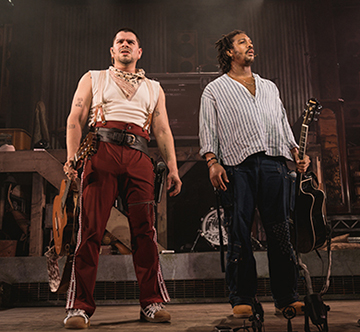
“Mexodus,” written and performed by Brian Quijada and Nygel D. Robinson, is an historical musical that feels urgent, inventive, and moving. Not something I would normally say about a pop production. Directed with clarity by David Mendizábal and performed with raw conviction by its two actor-musicians, this off-Broadway production reclaims a forgotten chapter of American history — the thousands of enslaved people who escaped not north, but south to Mexico, where slavery had been abolished. The result is compelling and eloquent.
The show starts like a rave or a rock concert, with the two protagonists urging the audience to shout at will. “If you need to yell, YELL,” they say. “If you need to dance, DANCE. You can even shake your ass…” Some yells and whistles accompany the opening hip hop. Then, fortunately, the audience quiets down, and the music turns to more appealing country, Hispanic rhythms, jazz, pop, and even classical.

Every sound is created live. Live looping. The two performers build the music from scratch using guitar, piano, accordion, harmonica, drums, electronic keyboard, upright bass, and beatbox. Video and projections appear across rear and side backdrops. Quijada and Robinson move around the space with their instruments, guided by staging from Mendizábal and choreography by Tony Thomas.
The history is laid out early. Mexico won independence from Spain in 1821. Mexico abolished slavery in 1829. But despite Mexican prohibitions, Anglo-American settlers had been bringing enslaved people into Texas as early as the 1820s. The United States was expanding. In 1848, America won the imperialist war against Mexico and seized ten territories, including Texas.
The new American administration did not enforce Mexican anti-slavery laws. As the opening song “Two Bodies” puts it: “From Eighteen Twenty-Nine to Eighteen Sixty-Five, / four to ten thousand slaves escaped to Mexico to thrive.”

Here is how that might have happened. It is 1851 on a cotton plantation in Victoria, Texas — land run by American slavers.
Henry (Robinson) fingers a bass and sings, “Take these shackles off my hands.” He works for a man named Jedediah Haskins. He remembers his mother, who comforted him: “Dry your eyes, / you don’t have to worry, / here’s my shoulder you can cry.” When he was eight years old, he was sold away from her. “I was stripped of my name and was given another.”

One night, the plantation owner’s wife lures Henry into the stable, then accuses him of assault when her husband arrives. The master beats Henry with a wooden board. “He keeps hitting me / and hitting me / and hitting me more,” Henry sings. Then: “I rip the board from his hands. / I black out. / And when I come to / my hands are red / and the pharaoh’s dead.”
Henry must escape. Most slaves fled north, following the Drinking Gourd. But Henry decides to go south, over the Rio Grande, to Mexico — where slavery has been banned. He floats across the river on a cotton bale. The song is “Wade in the Water Remix,” a spiritual reimagined.

On the Mexican side, a man in a Stetson saves Henry, who has been injured on the rocks. Carlos (Quijada) was a medic in the Mexican-American War. He bandages Henry’s chest. Why did he save him? In the song “Herido,” Carlos confesses: “I left my brothers on their own, / now I’m drowning in all this guilt alone.” He fled the war. Saving Henry is an act of restitution — “not for you,” he says, “for them.” (Herido means hurt or wounded.)
There is a modern connection. Nygel interrupts the story with a monologue about his own birth in 1993, surrounded by ancestors who worked as nannies, maids, soldiers, factory workers, sharecroppers, “and if you go back far enough, were slaves.” The spurs Carlos wears are attached to black-striped Adidas sneakers — a small but sharp reminder that this history is not remote.
Carlos works land as a tenant farmer, and Henry begins to help. Then a storm arrives — loud drums and cymbals, flashing lights. A flood. Carlos fears all is lost, but Henry, with farming experience from the plantation, tells him to dig a trench; the flood will bring nutrients to the land. They “dig” with the dipping of their guitars. Their connection is deepened.

Then banging on the door. Slave hunters. Carlos hides Henry. When the hunters leave, Carlos says: “They conquered and expect us to return the slaves that made their prosperity? Pinche gringos.”
Carlos: “You can’t stay here.” He arranges for Henry to travel south to Piedras Negras, where Seminole and Mascogo people protect fugitives. More than that, Henry must become someone new. “Henry is Enrique in Spanish,” Carlos tells him. They build a song together: “Mi nombre es Enrique, / soy hombre mexicano.”
The play ends with a coda. Between 1829 and 1865, four thousand to ten thousand enslaved people escaped to Mexico. The number is uncertain, the play admits, “because no one really knows. A story we’ll pass down by word of mouth.” It makes this play politically important. It ought to be presented in schools where kids who understand the music will learn the history.
The key dates:
- Year of Mexican Independence from Spain: 1821, formalized August 24 with the Treaty of Córdoba (the conflict began with the “Grito de Dolores” on September 16, 1810).
- Year of Abolition of Slavery in Mexico: 1829. President Vicente Guerrero officially abolished slavery on September 15, 1829.
- Year of the U.S. Invasion & Seizure of Land: 1846–1848. The Mexican-American War concluded with the Treaty of Guadalupe Hidalgo, signed February 2, 1848.
- Percentage of Mexican Territory Seized: 55% of Mexico’s pre-war territory — the Mexican Cession, including present-day California, Nevada, Utah, New Mexico, most of Arizona and Colorado, and parts of Oklahoma, Kansas, and Wyoming.
“Mexodus.” Written and performed by Brian Quijada and Nygel D. Robinson, directed by David Mendizábal. Daryl Roth Theatre, 101 East 15th St, NYC. Runtime 90 min. Opened March 10, 2026, closes June 14, 2026.