

By Lucy Komisar
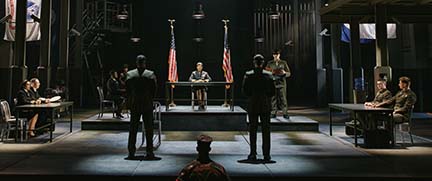
The Vivian Beaumont Theater at Lincoln Center has been transformed into a pressure cooker of military justice and moral decay in the new stage adaptation of Aaron Sorkin’s film “A Few Good Men.” This production, directed by Michael Arden, is a riveting, brutal examination of the clash between blind obedience and moral responsibility.
The play is a courtroom drama rooted in a real-life incident. The story was inspired by a 1986 hazing event at Guantanamo Bay, Cuba, involving U.S. Marines. Playwright Aaron Sorkin learned of the case from his sister, Deborah, a Navy JAG lawyer who defended one of the Marines. In reality, a group of Marines roughly handled a fellow Marine who had broken the unwritten code of silence by offering to snitch to superiors in exchange for a transfer. The hazing involved stuffing a rag soaked in gasoline into the victim’s mouth. The victim survived.
Sorkin used the real case as a springboard but changed the facts significantly, shifting the narrative into a murder trial to heighten the drama. The central characters, including the infamous Colonel Jessup, are fictional composites, and the iconic courtroom showdowns—including the famous “You can’t handle the truth!” scene—were invented for the story. The real case involving Deborah Sorkin’s client did not go to trial. Sorkin’s spokesperson explicitly stated that the Tom Cruise character was “entirely fictional.” Yet the play does not feel like fiction; it feels like a mirror held up to the dark heart of the military system.
The title is ironic, referencing the Marine Corps recruiting slogan “We want a few good men.” The play asks what it actually means to be a “good man” in a system that demands blind obedience to evil. Following orders was the Nazi defense at Nuremberg, and the play forces the audience to confront the limits of duty.
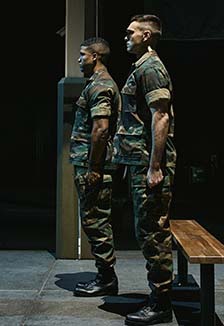
The story follows PFC Santiago (Daniel Velez), an 18-year-old who is killed after attempting to snitch on a fellow Marine for an illegal fence-line shooting in exchange for a transfer. It may be that the gun misfired. The accused—Lt. Corporal Harold Dawson (Lavel Schley) and PFC Louden Downey (Collin Kelly-Sordelet)—claim they were executing a “Code Red,” an illegal internal punishment meant to train Santiago in the code of “unit, corps, god, country.”
The play presents two different understandings of “Marine duty” through the opposing characters. Colonel Jessup, the authority figure, believes that Marines exist to defend the nation, and to accomplish this, harsh discipline and even illegal means are necessary.
To him, “good Marines” are those who obey orders unconditionally. Dawson, the defendant, acknowledges their mistake and says, “We were supposed to fight for people who couldn’t fight for themselves. We were supposed to fight for Willy (Santiago).” This reveals that the true meaning of “good” is not blind obedience, but the protection of those who need protection.
The staging is suffused with brutality. The set features large, industrial gray stairs and tables, accompanied by portentous music that sets an ominous tone.
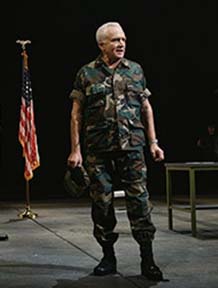
The production excels in its portrayal of systemic corruption. Bradley Whitford delivers a nasty, martinet-like performance as Lt. Col. Nathan Jessep, a corrupt authority figure who views harsh discipline as necessary for national defense. Beside him is First Lt. Jonathan Kendrick (John Zdrojeski), a religious zealot who justifies Santiago’s death as “the Lord’s will.” He would fit in well in the U.S. War Department.
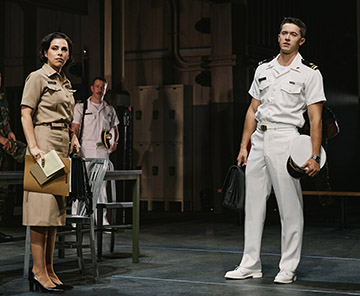
The military lawyers are equally compelling. Tom Blyth plays Daniel Kaffee, a pretentious, initially disinterested lawyer who took a Navy scholarship to a law school he couldn’t otherwise afford and is serving his three years. He is contrasted sharply by Joanne Galloway (the terrific, passionately committed Krysta Rodriguez), a determined internal investigator who rightly observes that the base is run by sociopaths. When she calls Kaffee “such a coward,” it sparks the transformation he needs to actually fight for his clients. Rodriguez is a standout, serving as the true hero of the piece, displaying immense guts as she puts Jessep on the stand.
The tension builds through damning revelations: a fabricated medical report claiming Santiago had undetectable toxins, Major Markinson’s (Thom Sesma) dramatic fake-reporter gun stunt to obtain flight logs, and the revelation that Dawson had sneaked food to a soldier punished with five days of only water. The play culminates in the legendary confrontation (no spoiler here!) that proves Jessep is not just tough, but a “murderous liar” and “a killer in his heart.”
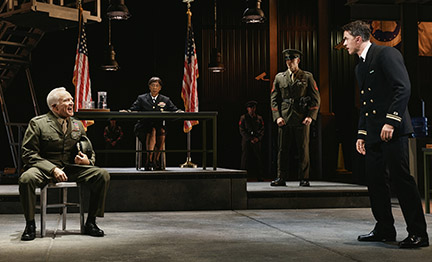
This production is a commentary on the deeply ingrained corruption and brutality of the military. True honor, the play suggests, is not found in the uniform or rank, but in the courage to uphold justice against wrongful orders.
That theme resonated offstage on November 18, 2025, when Senator Mark Kelly (a retired Navy captain and former astronaut) and five other Democratic lawmakers with military or intelligence backgrounds asserted that members of the military have both the right and the obligation to disobey orders that are unlawful: “Our laws are clear: you can refuse illegal orders.” Kelly later explained that he believed he was simply stating an obvious legal principle and emphasized that military personnel’s oath is to the Constitution, not to any individual.
This position triggered a significant conflict with the Pentagon and the Trump administration, which viewed the statement as inciting disobedience. Defense Secretary Pete Hegseth—who can be seen here as a composite of Jessep and Kendrick—condemned the lawmakers as the “Seditious Six” and ordered the Navy to review Kelly’s conduct, noting that as a retired officer he remains subject to the Uniform Code of Military Justice and could potentially be recalled to active duty for court-martial.
Hegseth issued a formal censure letter to Kelly and moved to downgrade his retirement rank and reduce his pension. Kelly sued the Defense Department, arguing that the punitive measures violated his First Amendment free speech rights. A federal district court ruled in his favor, temporarily blocking the Pentagon’s punishment; the case entered the appeals process, where the appellate court appears inclined to support Kelly. Hegseth, a man in the corrupt tradition of Jessep, still has his job at of this posting.
Verdict: “A Few Good Men” is a timely, powerful piece of theater that suggests the Marine Corps slogan is a fraud.
“A Few Good Men.” Vivian Beaumont Theater at Lincoln Center, 165 West 65th St, NYC. Runtime 2hrs35 min. Opened Oct 29, 2026; closes January 10, 2027.