

By Lucy Komisar
If the word “hokey” didn’t exist, it would have to be invented for “It’s a Wonderful Life,” the very corny (or schmaltzy) play by Joe Landry adapted from the famous 1946 fantasy film directed and produced by Frank Capra, in turn based on the story “The Greatest Gift” by Philip Van Doren Stern. The film had some of the feel of “Our Town,” with people growing up, marrying, having kids, etc. It starred James Stewart, Donna Reed and Lionel Barrymore.
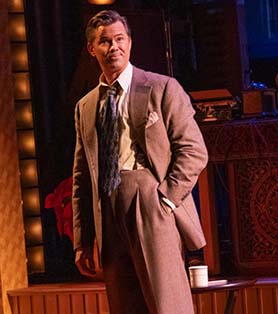
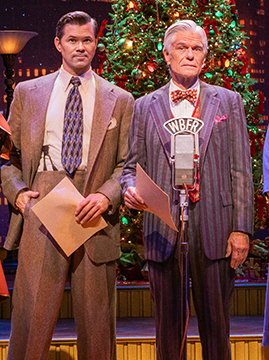
The story is about George Bailey (Andrew Rannells in the Stewart part), who is the nicest guy in Bedford Hills, New York. He saves his brother from drowning, keeps a pharmacist from accidentally putting poison in a prescription, and when his father dies gives up college to run the family building and loan business. The company helps working-class people buy homes.
But then his uncle Billy (Tituss Burgess) accidentally puts a bank deposit envelope with $8,000 in a newspaper he flips over to the bad guy, oligarch Potter (the Barrymore part), who of course will not reveal the mistake, just keeps the cash. The loan company is threatened with collapse and the loss of many depositors’ savings. The choice of the name Potter must relate to Potter’s Fields, where poor people were buried anonymously. Potter sneers at the mention of working people.
Bailey, distraught, regrets he was ever born and is about to commit suicide by jumping off a bridge when his guardian angel (Burgess) saves him, then shows him how the town would have suffered if he had not lived. Death and poverty would reign. The play owes something to the Scrooge fantasy.
But unlike the people in the Capra film, the figures presented by director Jerry Zaks are exaggerated caricatures.
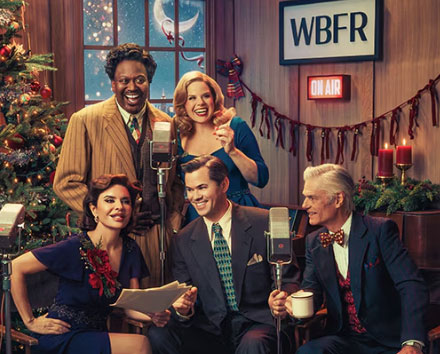
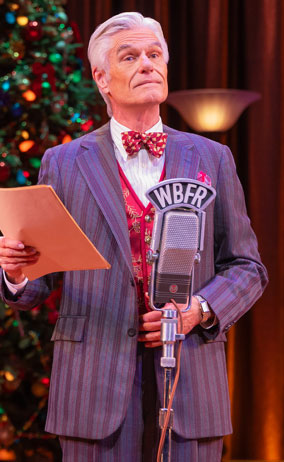
The actors are fine doing the roles they were assigned. Rannells does a good job of sounding like Stewart, and his face suggests the film actor’s chiseled look. Megan Hilty as Mary (the Donna Reed character) is a warm presence with a fine soprano we hear in carols at the end. Burgess is a terrific angel, Lisa Rinna is great as multiple characters of both sexes (I love her exaggerated male), and Harry Hamlin is a great Stooge stand-in as Mr. Potter, the oligarch you love to hate. But none of them are as real as in the film.
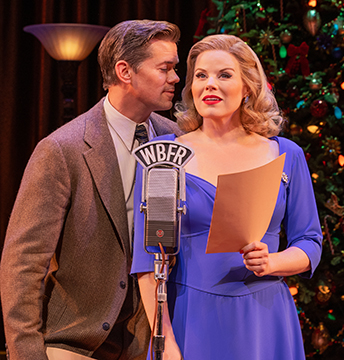
Yes, George marries Mary.
So what? The only interesting part of the story is the attack on the nasty Potter, which reflects the left-wing views of the forties. Capra used a few scenes from socialist Clifford Odets’ earlier screenplay.
Potter: Peter Bailey was not a business man. That’s what killed him. Oh, I don’t mean any disrespect to him, God rest his soul. He was a man of high ideals, so-called, but ideals without common sense can ruin this town. What does that get us? A discontented, lazy rabble instead of a thrifty working class. And all because a few starry-eyed dreamers like Peter Bailey stir them up and fill their heads with a lot of impossible hooey.
George: Just remember this, Mr. Potter, that this rabble you’re talking about, they do most of the working and paying and living and dying in this community. Well, is it too much to have them work and pay and live and die in a couple of decent rooms and a bath?
And later, George: Potter’s got the bank, he’s got the bus line, he’s got the department stores. And now he’s after us, ’cause he wants to keep you living in his shacks and paying the kind of rent he decides to charge. Now we can get through this all right, but we’ve got to stick together. We’ve got to have faith in each other.
But instead of organizing against Potter, they raise money to pay the bank. Where are you Odets!?
An attack on an oligarch would have made the play current, but the left politics are minimized by Landry and Zaks. One waits for another intervention by the guardian angel to imagine how Bedford Hills would be if the people challenged and ended Potter’s let’s-make-working-people-miserable power.
“It’s A Wonderful Life: A Live Radio Play.” Adapted by Joe Landry from the 1946 film directed and produced by Frank Capra, which was based on the story “The Greatest Gift” by Philip Van Doren Stern. Directed by Jerry Zaks. Broadhurst Theatre, 235 W 44th St, NYC. 75 minutes. Opened Nov 23, 2026, closes Jan 3, 2027.