Washington denies any problem, as does the International Monetary Fund. But Russians who should know are sure that a $4.8 billion loan never reached its destination. They have been joined recently by Swiss prosecutors who are equally skeptical. PNS contributor Lucy Komisar is a freelance journalist who, sponsored by PNS, spent three months in Russia on a U.S. National Research Council grant to investigate the impact of offshore bank and corporate secrecy.
When news broke in August 1999 that somewhere from $7 billion to $15 billion had been spirited out of Russia through the Bank of New York, in what looked to U.S. investigators to be money laundering, American bankers professed shock. A month after those revelations, Bank of New York CEO Thomas Renyi told the U.S. House Banking Committee how dismayed I have been by the suggestions in the press that the Bank of New York has been involved in, or been used as a vehicle for, money laundering or other illicit activities.
Two far-reaching and potentially controversial anti-money laundering measures would require professionals such as lawyers and accountants to file the same sort of suspicious transaction reports that banks do and would extend know your customer rules to include the owners of companies. The Council of Europe has already proposed the first. US authorities have not acted on either.
After it was revealed in August that $7 billion to $15 billion had been siphoned out of Russia through the Bank of New York, the nation’s influentials were shocked, shocked. America’s most sophisticated financiers were vulnerable to tawdry Russian fraudsters? The press gasped at the scale, congressional committees mobilized, and the Clinton administration trumpeted an anti-money-laundering strategy.
But the scandal was no surprise to federal immigration agent Thomas D. O’Connell. Nor was it the first time a New York bank had been soiled by money believed stolen by Russian con men. Though it has not been reported until now, the Bank of New York and other New York banks”including Chemical, Chase Manhattan, and Citibank” were and most likely still are conduits for the proceeds of a still-to-be-tallied series of crimes, with at least a thousand shell company bank accounts laundering dirty cash.
The Russian banking scandal should have been no surprise to Western financial experts. The Bank of New York laundered some $7 billion in Russian money through the offshore system.
The sudden attention by U.S. government officials and the mainstream media to the $7 billion or more of Russian money laundered through the Bank of New York might make you think this is the first time that multimillions have been stolen from Russia-or elsewhere-and washed through the international offshore system. In fact, it’s not even the first time for the Bank of New York.
Planning a visit to our cousins, the Brits? In London, there are several main areas best to stay in. Most convenient is the West End — known as Theatreland. You can move further west and live near one of the big parks or squares — Green Park or Grosvenor.
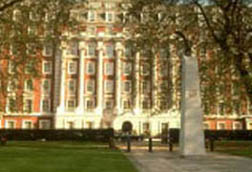
Here is the majestic Millennium Britannia in Grosvenor Square.
Or you can choose to be in Knightsbridge, Chelsea or Kensington, the trendy areas that are minutes from downtown by tube and have the flavor of an upscale Greenwich Village and Upper West Side. I checked out hotels in each of those neighborhoods.
The US government is making its boldest move yet to combat international money laundering via offshore bank secrecy havens. Officials who once insisted capital should flow to wherever the market says to flow now want to make it more costly for American banks to lend to entities in bad jurisdictions.
The American crackdown depends on the passing of new law that require banks to set aside reserves for the loans they have made to high-risk jurisdictions. The strategy, announced in September, is undergoing a 90-day US interagency review. It targets offshore centers that hide the beneficial owners of companies and bank accountants and refuse to cooperate with international law enforcers on the trail of illicit funds.
The dangers of international money laundering are massively magnified by electronic transfers and the new electronic cash. The really big challenge that’s coming, that’s arrived, is electronic cash, said Thomas Roche, Deputy General Counsel of the Federal Reserve Bank of New York. That’s going to present really daunting challenges. There’s always been an audit trail in credit cards and checks.
In the 1990s I was doing research about human rights policy and spent some time at presidential libraries. I was quite interested in a secret memorandum in the Ford Library. In the standard way classified documents are indicated, it appeared in the Chile files on a pink sheet as a memorandum with a date, the number of pages and not much else. It was 1995.I asked for it to be declassified. Four years later, it arrived in the mail.
THE SWISS, IT TURNS OUT, who long polished their image as upstanding burghers, were bankers and money-launders of the Nazis, confidence men who took depositors’ money, hid the records, and refused to pay back rightful owners. Incredibly, they are outraged that world opinion considers them unsavory and insists they return the booty, valued by the World Jewish Congress at $3 billion. Equally incredible, the Swiss continue to stonewall justice in the face of demands for restitution by governments, organizations, and individuals.
The Swiss, it turns out, who long polished their image as upstanding burghers, were bankers and money-launders of the Nazis, confidence men who took depositors’ money, hid the records and refused to pay back rightful owners. Incredibly, they are outraged that world opinion considers them unsavory and insists they return the booty, valued by the World Jewish Congress at $3 billion. Equally incredible, the Swiss continue to stonewall justice in the face of demands for restitution by governments, organizations and individuals.
Unfortunately, since there is no international criminal court, the Swiss bankers and their associates cannot be brought to trial for their actions. Since national governments are generally loathe to lean on, much less punish, allies (how else to explain why the United States and other Western nations let the Swiss get away with keeping much of the pilfered gold), citizens and local officials must force some measure of justice.
Acknowledging past U.S. failures to press the Swiss to return stolen funds, Under Secretary of State Stuart E. Eizenstat is brokering discussions between Swiss banks and American lawyers regarding a class action lawsuit filed in New York federal court in 1996. The suit seeks $20 billion in damages from the banks for cheating Holocaust victims and their heirs. There are more than 350,000 Holocaust survivors, 100,000 of them living in the United States.
Will people one day talk about the looting of Russia the way they recently talked about the looting of Zaire?
Western leaders meet this weekend (June 20-22) in Denver at the G-8 Summit on economic policy. They have the chance to take the drastic action needed to combat the criminalization of the Russian economy which threatens not only Russia but their own countries as well.
The G-8, which includes the US, Canada, the UK, France, Germany, Italy, Japan and Russia, probably won’t do anything to deal with this problem, but it won’t be for lack of knowing about it.
Three weeks ago, a conference was held in Curacao, Netherlands Antilles, on money laundering. Among those in attendance were two members of the Mansur family, which has gained international prominence for — you guessed it — alleged money laundering. Two other family members have been indicted by the U.S. attorney in Puerto Rico, but still enjoy life at home on Aruba, another Dutch dependency, and travel to Europe, beyond the reach of U.S. law enforcement.
The sponsors of the gathering included the Association of International Bankers of the Netherlands Antilles and the Association of the Compliance Officers of the Netherlands Antilles. The bankers and compliance officers of the Netherlands Antilles are, to say the least, not noted for rigorous action against money laundering — nor are their Dutch counterparts.
Lucy Komisar covered the women’s convention in Houston and wrote about it for The Nation, December 10, 1977. (text version is below) WITH THE WOMEN AT HOUSTON: FEMINISM AS NATIONAL POLITICS LUCY KOMISAR The blue and green bunting, the state delegation signs, the three-cornered hats that said Free D.C., the […]