It is classic musical farce. Book, music and lyrics by Cinco Paul based on the Apple TV series*. Melissa (Sara Chase) and Josh (Alex Brightman) are a couple in crisis. They met at the hospital where they are doctors when a candy machine didn’t work. He told her to kick it. She did. Every Snickers bar on planet Earth came tumbling out. An omen of sweetness to come. Cut to two years later: they’re in bed, staring at their phones, barely speaking. The candy has lost its magic.
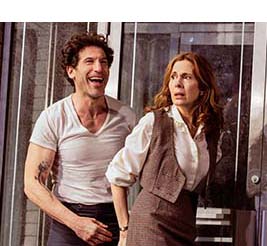
Here is a surprise: a dark comedy about “relationships” that is actually clever, funny and smart. To me, “relationships” usually signals a sit-com with laugh tracks. You will find none of that here. Gina Gionfriddo’s 2008 play “Becky Shaw,” set in 2007 and directed with sharp, energetic pacing by Trip Cullman, feels superbly modern—only the cell phones, you will notice, were smaller then.
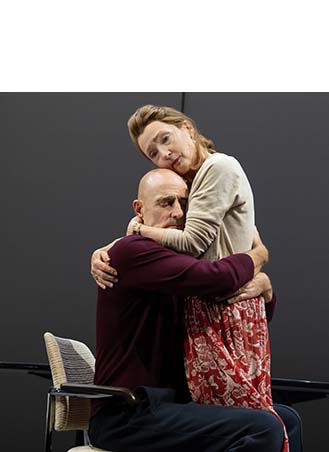
This powerful unsettling play by Mark Rosenblatt, directed by Nicholas Hytner, drops you into an argument—no, an intellectual and moral battle—that has riven peoples and governments in the West to the point where critics of their government’s policies are imprisoned or deported.
You know that feeling when a play grabs you by the collar, whispers “Attica” in your ear, and then can’t quite figure out how to let you go? That’s the new Broadway stage adaptation of Dog Day Afternoon, written by Stephen Adly Guirgis, directed by Rupert Goold. This production—set in the sweltering August of 1972 at a Chase Manhattan bank in Brooklyn—has moments of blistering, street-level brilliance, but too often plays like a sitcom that wandered into a tragedy.
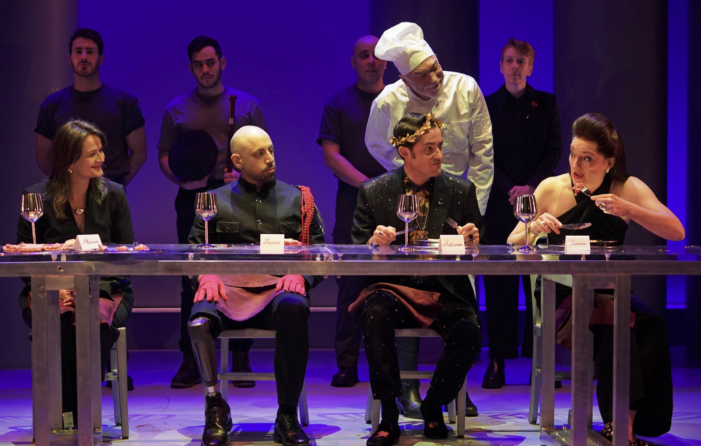
Red Bull Theater’s Titus Andronicus arrives like a punch to the gut—and stays there. This is Shakespeare’s bloodiest play given a production that understands exactly what it is: a horror film on a classical stage, rendered with precision, brutality, and moments of unsettling lightness that make the violence land even harder.
The production’s visual language is immediately striking. The choice to dress Saturninus (eldest son of the late emperor) and his court in black suits with red shoulder braid carries unmistakable echoes of fascist iconography, grounding the play’s political corruption in recognizable twentieth-century nightmare. Soldiers return in khaki, their war wounds visible and unglamorous—one with an artificial leg, another with an eye patch.
March 31, 2026 – Are you old enough to have marched in a protest when the major issue for Americans was the war in Vietnam? Way back in the 60s. Did the signs mention LBJ but not Vietnam or the war? How about a march against U.S. aggression in Iraq decades later? Just about Bush but not his war in Iraq? I still have a bumper sticker with the French tricolor and the slogan, “I drink Bordeaux and I vote.”
The best exhibit in the Whitney Biennial isn’t even a “found” object; it’s a collection of stolen ones. David L. Johnson’s installation, “Rule: Removed Codes of Conduct Signs,” is a brilliant act of creative defiance. These aren’t gallery relics but placards pilfered from Privately Owned Public Spaces (POPS)—those architectural loopholes born from a 1961 zoning resolution that let developers build skyscrapers in exchange for creating “public” plazas.
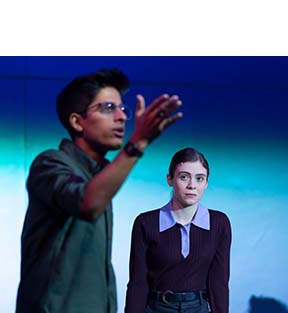
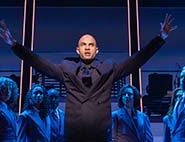
The stage is a sleek, white box. Suddenly, it is dark and edged with pulsing blue light, throbbing to an electronic score as if the room itself is booting up. This is the world of “Data,” Matthew Libby’s unnerving new play about the young engineers building the surveillance state, one algorithm at a time.
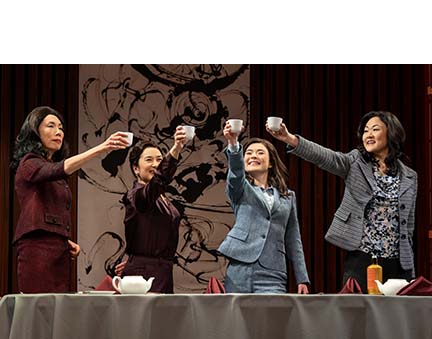
Alex Lin’s new play, “Chinese Republicans,” presented by the Roundabout Theatre Company, is ambitious, aiming to dissect the generational fissures within Chinese-American identity while simultaneously taking a sledgehammer to the glass ceiling of late-stage capitalism.
The thing about Key West is that it makes artists of everyone—the ones with brushes, yes, but also the ones who simply show up at dusk with a drink and an open gaze. Here, human hands and natural forces compete for your attention, and the remarkable thing is that both win.
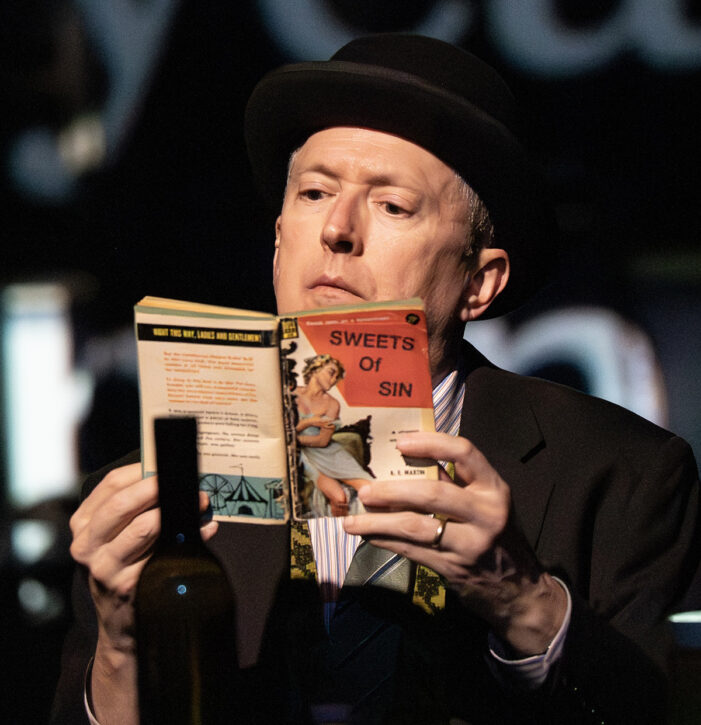
It seemed like a noble idea: take James Joyce’s 1922 novel, a book far more discussed than actually read, and put its famously dense prose in the mouths of actors. Surely, hearing the words spoken aloud would unlock something. Surely, the stage could illuminate what the page obscures.
Feb 17, 2026 – According to the NYTimes, “After Mr. Navalny’s 2020 poisoning, he released a video of himself — posing as an aide to a senior Russian security official — extracting a confession from one of his would-be assassins, essentially confirming the involvement of the Russian intelligence services. He was told the poison had been planted in his underwear at his hotel sometime before he boarded the plane.”
Feb 15, 2026 – I love Key West, one of my favorite cities. And on Saturday Feb 14 an ICE storm trooper attacked a kid on a bike because he was the wrong color.
Feb 15, 2026 – Among the nine people Donald Trump named to his Board of Peace to run Gaza – which holds its first meeting in Washington DC February 19 – is billionaire private equity operator Marc Rowan. The board’s stated tasks include establishing financial controls and managing the reconstruction of a Gaza. You might think a savvy financier would bring solid credentials to such a job.
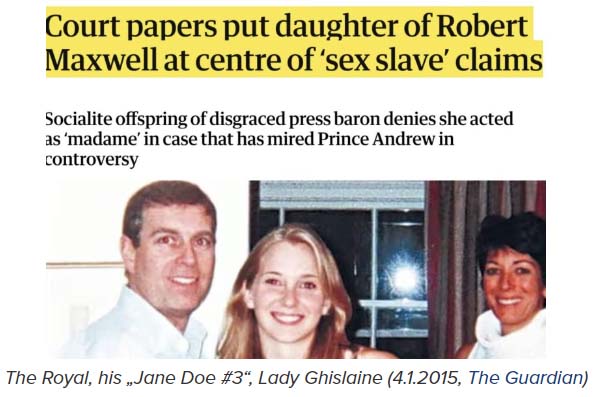
Feb 11, 2026 – This is a guest post by Lukas Hässig, a Swiss investigative journalist who runs “Inside Paradeplatz,” named for the Zurich square where the big international Swiss banks are located. An award winning reporter, he is famous for exposing Swiss banking corruption. He ran the Lucy Komisar exposé of the UBS stock trading scam when U.S. media was too afraid or too compromised to do so. This is his revelation of how UBS helped Ghislaine Maxwell launder her Jeffrey Epstein money. It appeared over a month before any American media wrote the story.
Feb 8, 2026 – See the key takeaways of brilliant James Rosen exposé in NYT that just revealed Pentagon threat to America in seven pages of a sealed Watergate file. Not revealed until now.
The key point of this stunning story based on documents which were sealed for 50 years, is that President Richard Nixon testified under oath that the most serious threat to his presidency came not from political opponents or the media, but from a covert espionage operation run by the U.S. military’s top commanders—the Joint Chiefs of Staff.
Feb 3, 2026 -Of course there is an Epstein-Browder connection! It runs through the corrupt Robert Maxwell, father of Ghislaine and first employer and mentor of tax fraudster William Browder in London in 1991 when he worked for Maxwell’s investment bank focusing on Russia and Eastern Europe. (Browder never mentions Maxwell.)
Jan 29, 2026 – At a Council on Foreign Relations reception last night I met Therese Marie Postel, who told me she worked at the UN for the U.S. State Department. We were at a drinks table before a meeting. She said she wrote the Board of Peace (ie the U.S. seizes Gaza) UN Security Council resolution. (Three others heard the conversation.) I said, “But the Palestinians…” She grabbed her wine and beat a hasty retreat. But now history knows who wrote that imperialist decree: it was crafted by Therese Marie Postel. (Po******@***te.gov as posted by www.securitycouncilreport.org/). She smiles, Palestinians die.
Tracy Letts’s psychological thriller, under David Cromer’s masterful direction, turns a motel room into a terrifying laboratory of American anxiety.
The true horror in Letts’s “Bug,” now receiving a skin-crawling and brilliant revival directed by Cromer, does not scuttle in on six legs. It enters softly, politely, a shy man emerging from a motel bathroom asking for a friend. The terror is in the quiet click of a mind latching onto an explanation—any explanation—for the pain of a lonely, battered life. By the final, frantic scene, the Manhattan Theatre Club stage has become a shrieking, tin-foiled monument to the American need to believe, even in monsters, if it means not being alone.
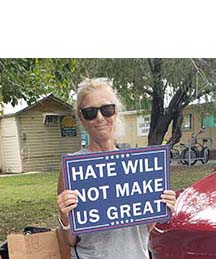
Jan 11, 2026- About two hundred protesters stood along Truman Avenue, a main street in Key West, to add their signs and voices to the national protests against Donald Trump’s ICE death squad execution of Renee Good. Cars passing on the road created a cacophony of horns to signal their support. Even the iconic Key West rooster paid attention.
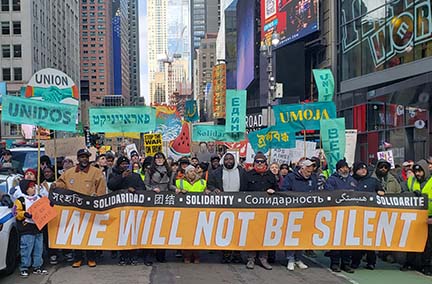
There is a moment in Bess Wohl’s new Broadway play “Liberation” when the characters—a consciousness-raising group in 1970 Ohio—discuss the upcoming Women’s Strike for Equality. One of them, Celeste, a black feminist scholar, scoffs: “I don’t really know that protesting changes anything… It sort of feels like they just laugh at everyone marching around and waving their signs.”
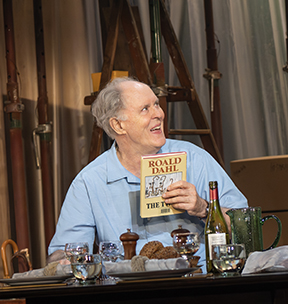
The bread crisis in the small Provençal town of Concorde is urgent, existential and entirely self-inflicted. This is the buttery premise of “The Baker’s Wife,” the charming, stubbornly hokey, and ultimately satisfying musical that has rolled into the Classic Stage Company with the comforting aroma of a warm baguette.
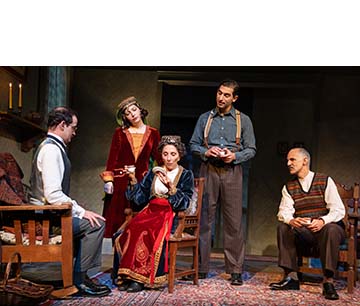
Talene Monahon’s piercing new play, “Meet the Cartozians,” is not merely a family drama; it is a forensic and often ferociously funny excavation of the American experiment itself. Under David Cromer’s meticulously calibrated direction, the work dissects a century of racial bargaining, cultural performance, and the enduring ache of identity forged in the crucible of a hostile state.
This play about a politically fraught chess match between an American and Russian champion in 1979 lasted only two months on Broadway in 1988, when Ronald Reagan was president. The time of the “evil empire.” (Plus ça change.) So maybe even then it was a wrong call.
Robert Icke at only 43 solidifies his place among Britain’s theatrical greats with his stunning new production of Oedipus at Studio 54. A master of turning classic plays into modern parables—from Hamlet to The Doctor— Icke now takes Sophocles’ 2,500-year-old tragedy and forges it into a riveting, contemporary political thriller.