President Bush‘s attorney general, Alberto Gonzales, has come under fire for politicizing the U.S. Justice Department for his dismissals of eight U.S. attorneys, apparently because they didn‘t target Democrats. But using the Justice Department for political ends isn‘t simply an invention of Gonzales or of the President; it‘s an old Bush family tradition.
In politicizing the Justice Department, Bush takes a page from his father. The George H.W. Bush Justice Department 25 years ago balked at investigating and prosecuting the key players in the scandal of the criminal, terrorist-friendly bank, BCCI, and moved only, and in limited fashion, after New York District Attorney Robert Morgenthau forced its hand.
Bush had a strong reason to want Justice to block pursuit of the case: the CIA used BCCI for its black ops, including funneling some of the $2 billion Washington sent to client Osama bin Laden and running money for the illegal Iran-Contra operation.
Eugene O‘Neill‘s play is a sharp political commentary about class, poverty and gender. That overlays what director Howard Davies projects as a story of personal relationships, a male-female pas de deux, with an interfering father thrown in.
It is 1923. The 30-ish Josie Hogan (an assertive, moving, dignified Eve Best) is helping her self-involved father Paul (played by Colm Meaney with a sense of true male entitlement) scrape survival out of a hard scrabble Connecticut farm.
Josie and Paul see their “way out” as Jim Tyrone (Kevin Spacey), a rich, alcoholic, third-rate actor whose inheritance makes him the Hogans‘ landlord.
But the cards are really held by T. Stedman Harder (Billy Carter), the owner of a neighboring estate, who is defined by his pretentious first initial and his position as an executive with Standard Oil.
The international focus on fundamentalist Islam might obscure the fact that western nations have their own experiences with fundamentalist religion — among them the country whose government has most targeted radical Islam, the United States.
As recently as 1999 the Kansas Board of Education voted to delete the teaching of evolution from the state’s science curriculum.
A sense of continuing conflict — not to mention the hardly-veiled contempt many educated people here have for the fundamentalists — is palpable among the New York audiences filling the Lyceum Theatre on Broadway to see a riveting star-studded production of Inherit the Wind. The production is a revival of the 1955 play by Jerome Lawrence and Robert E. Lee that tells the story of what came to be known as The Scopes Monkey Trial.
In the play, science teacher Bert Cates (Benjamin Walker) is jailed for the crime of explaining evolution to his students. Help comes quickly from a Baltimore newspaper which hires Henry Drummond (portrayed by Christopher Plummer as a wry, sophisticated lawyer) to defend the young man. To chronicle the story, it dispatches its prize reporter, smartly played by Denis O’Hare as a sarcastic, fast-talking cynic.
Paul Hewson, known as Bono, the rock star, is complaining that the seven wealthy nations in the G-7 which had promised to double aid to the developing world by 2010, are more than half behind target. The countries are the United States, Britain, Canada, France, Germany, Italy, and Japan.
Bono‘s protest might be taken more seriously if he and his U2 band were not participating in the system that deprives developing countries of far more than western aid – much of which has to be repaid.
Bono is a tax dodger. As a result of a change in Irish law that limits the tax exemption for artists and musicians to a punitive $625,450, Bono’s U2 has moved its music publishing company registration to the Netherlands, where the tax on its multi-million dollar income will be about 5 percent. To dodge taxes on non-royalty income, Bono‘s company has used offshore nominees.
Conflict historically has aroused playwrights’ passions — think Aristophanes’ famous War and Peace trilogy written more than 2,000 years ago.
In that tradition, New York stage voices are being raised against war in two revivals that clearly retain their relevance today.
Journey’s End, a gripping play about World War I written in the 1920s, is spare and direct, unsettling the audience with the prosaic waiting game of war. And The Brig details the numbing banality of military cruelty as the Living Theatre revives its famous gritty production of the 1960s.
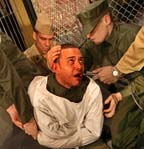
Kenneth Brown’s play The Brig, staged by The Living Theatre, is a numbing expression of the banality of cruelty institutionalized by the U.S. military.
A cell with five double-decker bunks is enclosed by a chain-link fence, and the area outside, concrete floor or gravel exercise yard, is separated from the audience by barbed wire. Ten men, who have committed unknown, apparently minor infractions, are confined for up to 30 days to suffer dehumanizing treatment at the hands of guards who punctuate their disapproval with punches to the stomach.
The guards turn basic minutiae of life – dressing, showering, shaving, smoking – into opportunities for control and humiliation. There is a Nazi sort of order, efficiency and gratuitous cruelty. The spectacle is a macabre dance, a cacophony of voices, repetition, and tension that sears and stuns audiences.
It‘s the ordinariness that at the end is so unsettling. This is not a Hollywood-style swagger tale about intrepid fighter pilots or its 70‘s version of pot-smoking infantrymen. No glamour or anti-glamour here.
Director David Grindley stages a story of prosaic people caught up in the military aspect of a political game whose purpose is far beyond them. These British soldiers – superbly portrayed by a uniformly excellent cast — just focus on staying warm and alive and carrying out orders. It is a powerful and often poetic production.
When it comes to tax cheats, the government has been vocal about catching the little guys but doesn’t spotlight the big-time frauds, like Swift Boat financier Sam Wyly (shown here), who happens to be a top-tier Republican contributor.
Wyly cheated the U.S. of at least $300 million in taxes. The money that paid for the Swift Boat campaign was your money!
But Wyly was not only the financier of the scam to discredit John Kerry during the 2004 presidential campaign. He and his brother were George W. Bush’s ninth greatest career contributors, Bush Pioneers, who collected $100,000 for the 2000 and 2004 presidential campaigns. They also funded other leading Republicans. Sam Wyly, since 1997 has given Republicans more than $1 million and his brother Charles and wife have donated more than $1.3 million. That‘s your money!
Wyly did his cheating through an offshore scheme that hid $1 billion in family profits via Isle of Man shell companies that existed only on paper, were registered under front men to hide the Wylys’ names, and were used to carry out transactions and launder money. And that’s only the hidden income that was found. The Dallas mogul, with a $1 billion admitted net worth, may be guilty of the biggest personal tax fraud in U.S. history.
Details of personal lives overwhelm epic of politics and action
Tom Stoppard‘s theater trilogy about Russian radicals and reformers of the 19th century is a drawing room drama of the upper class overlaid with the revolutionary ideas that set the stage for the Russian revolution. The content is disappointing, a Russian history “lite” that seems to want to make viewers feel as if they are getting to know the shapers of history without being forced to concentrate too seriously or for too long on their actions and ideas.
Characters are placed and moved through stylized vignettes as if in a diorama, in tableaux. The pageants are beautiful, but sometime they lack substance. Often there are pronouncements instead of dialogue. In spite of purporting to present to us the ideas and history of the figures he depicts, Stoppard appears fascinated primarily by the personal and especially love lives of the famous.
The best part of the production is the stunning staging by director Jack O‘Brien. While the “revolutionaries” are prancing around declaiming about life, illusion and art and how they will save the downtrodden, behind a gauzy curtain we see lines of people immobile, dressed in sepia shrouds, like spirits. The serfs remain a silent backdrop.
The NY Times reports today that Charles Prince, CEO of Citigroup, is planning to cut the corporation‘s compliance staff. Reporter Eric Dash says it‘s “to keep the bank from getting bogged down” because “the compliance overhang has made it difficult to be competitive” and “unnecessarily slowed the company down.”
Translation: other banks are laundering profits or running scams to help clients cheat tax authorities and investors, and they make good money at it. Why shouldn‘t we?
Dash noted that Citigroup had beefed up its compliance staff after scandals, including its dealings with Enron. He skimps on details: that Citigroup set up offshore shell companies to help Enron cook the books.
Now that the U.S. Congress is investigating the truth of President George W. Bush’s statements about the Iraq war, they might look into one of his most startling assertions: that there was a link between Saddam Hussein and Osama bin Laden.
Critics dismissed that as an invention. They were wrong. There was a link, but not the one Bush was selling. The link between Hussein and Bin Laden was their banker, BCCI. But the link went beyond the dictator and the jihadist — it passed through Saudi Arabia and stretched all the way to George W. Bush and his father.
Los legisladores de Estados Unidos que investigan la veracidad de los argumentos del presidente George W. Bush para invadir Iraq deberÃan analizar una de sus afirmaciones más resonantes: la del vÃnculo entre Saddam Hussein y Osama bin Laden.
Los crÃticos de Bush desacreditaron tal aseveración, a la que calificaron de invención. Estaban equivocados. El vÃnculo existÃa, pero no era el que el presidente le vendió al público.
It‘s a fascinating tale, and Doug Hughes‘ direction engrosses us even if we might predict the ending. Flashbacks show the path of anger and despair to self-destruction.
Russia, through its energy company Rosneft, has started to recover the multibillion-dollar oil company Yukos that was stolen from it in the mid-90s. It is buying the assets in auctions. Indignant protests are heard from westerners.
Funny there was no indignation from western officials when Mikhail Khodorkovsky and other oligarchs, with the help of crooked President Boris Yeltsin, were appropriating Russian national oil and mineral wealth for kopeks on the ruble.
A Khodorkovsky company ran an auction at which a Khodorkovsky shell company won Yukos, paying $309 million for a controlling 78 percent. Months later, Yukos traded on the Russian stock exchange at a market capitalization of $6 billion.
In view of the news that Billionaires for Bush were among those targeted by spies run by NYC Mayor Bloomberg and his Police in the months up to the 2004 Republican Convention, here’s a reminder of the Billionaires’ dangerous tactics.
What would you choose for the opening music of a play about Dick Cheney and George Bush? “Money makes the world go around…” from “Cabaret,” of course. In the tradition of good satire, this tongue-in-cheek play-length musical skit by The Billionaire Follies, the performing wing of Billionaires for Bush, is witty political commentary and enormously entertaining. This is “Dick Cheney’s Holiday Spectacular 2006!”
Swiss travel the world to help mega-rich evade taxes
The NY Times headline yesterday said, “Discreet Swiss Banks Now Offering Sophisticated Investment Vehicles.” Further down, the story noted that Geneva has becomes an “aggressive haven for the global elite.” And, “Now the Swiss can be found throughout the world, selling more sophisticated investment vehicles to attract high-net-worth individuals, mostly multimillionaires.”
So what is the real story about? The headline should have been, “Discreet Swiss travel the world to help the mega-rich evade taxes.”
How else has bank-secrecy Switzerland, with only 7.5 million people, become the third-largest asset manager in the world, after the United States and Britain, with global banking assets under management of $5.5 trillion?
A few days ago, Manhattan District Attorney Robert Morgenthau announced the indictment of Paulo Maluf, the former governor and mayor of Sao Paulo, Brazil, and four co-conspirators, for stealing more than $11.6 million from a Brazilian public works project. The money moved through the Safra Bank in New York. It was only part of the $130 million that Maluf passed through Safra in 18 months alone.
The case offers another example of how the offshore banking system, controlled by the global banks, helps the world’s crooks.
Until now, IDT, the giant U.S. telecom accused of bribing former Haiti President Jean-Bertrand Aristide to get a lucrative phone contract, has managed to keep details of the case under wraps. That is because IDT lawyers succeeded in getting the U.S. District Court Judge, Mark Falk, to gag whistleblower D. Michael Jewett and seal his testimony.
But somehow, three weeks ago — unaccountably in the face of Jewett‘s lawyer‘s unsuccessful attempts to unblock the court record — the statements of Jewett and of the top IDT officials were posted on Pacer, the US government court website.
What interesting reading those documents make, especially Jewett‘s detailed account of what may happen in a major corporation when a lone employee stands up against corruption.
A UK photographer just sent The Scoop this email about The Photographers Gallery in London. He says:
The Deutsche Borse photography prize, formerly the Citibank photography prize, is perhaps the most prestigious and important photography prize and one of the most important art prizes. Those who win become name photographers/artists, and their work becomes literally over night very valuable, exchanging hands for many thousands of dollars.
Durang spoofs stock Chinese character, bar singers and man on the run.
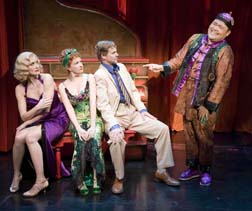
Christopher Durang‘s clever, witty and marvelously staged musical parody of film noir, set in Macao, circa 1952, gathers the requisite long lanky blonde in slinky purple gown, the slightly seedy but good-looking bar owner, the deposed former club singer, who fights gamely for her job, a “scrutable” Chinese factotum called Tempura because he‘s been battered by life and – well, you get the idea.
How big pharma and technology companies move patents offshore to cheat on $ billions of home taxes
Last week, Merck, the pharmaceutical multinational, announced that it will pay 2.3 billion dollars in back taxes, interest and penalties in one of the largest settlements for tax evasion the U.S. Internal Revenue Service (IRS) has ever imposed. Merck had cooked its tax books by moving ownership of its drug patents to its own Bermuda shell company — an entity that has no real employees and does no real work — and then deducting from U.S. taxes the huge royalties it paid itself.
What Merck did isn’t unusual but in fact is becoming common for multinationals in the era of globalisation. It’s one of the ploys in a corporate bag of tricks called profit laundering. In an era where much of a company’s assets may be intangible intellectual property — patents, logos, manufacturing processes — this strategy can make reported profits and taxes disappear.
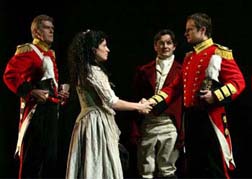
Brian Friel‘s play examines how Brits used English language to dominate the Irish. The Manhattan Theatre Club’s revival of Brian Friel’s 1980 play ”Translations” is a stunning and moody production that examines the use of language to bond and to divide in both a personal and a political sense. It also becomes a symbol of patriotism and conscience as it plays into the conflicts and connections among the occupied and the occupiers in Ireland in 1833.
Setting his tale in the imaginary Irish village of Ballybeg, (itself renamed from the Gaelic, Baile Beag) in a hardscrabble dirt-floored school house in a mud-walled old barn, Friel presents a ”conquered” people who may be dirt poor and no match for British military power, but who are literate and thoughtful.
Beth Leavel in the title role offers the only bright witty moments By Lucy Komisar “The characters are two dimensional and the plot is well worn,” says “the man in the chair” (Bob Martin). He‘s got it right. The nervous laughter from the audience is the kind that is elicited by TV sitcoms aimed at […]
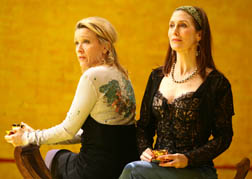
The subject could be sitcom. It involves a family of women. The mother Pilar (Zoe Caldwell) is a widow who has just found a younger lover. Her daughters, both actresses, Aurelia (Linda Emond) and Nuria (Katherine Borowitz), are excruciatingly jealous of each other.
As this is by French playwright Yazmina Reza, it‘s not sitcom, but cultural commentary. But the attempts at commentary are slight. If her apercus had sharp edges in France, they were worn down crossing the Atlantic.
There is movement on the Hill to go after tax shelters and enforcement against tax cheats.
With acute budget pressures, the time is ripe.
The Democrats are in a box. They have promised to eliminate the deficit, not raise taxes, to expand health care and more for Americans. Nobody is going to press for tax increases. The only place to find cash is the tax gap, to figure out how to go after the corporations and people who cheat. Members of Congress are actively talking about the problem.
Legislation is coming out of the Senate. Senator Carl Levin is pushing the idea of criminalizing the proceeds of tax evasion, which would be remarkable. The House Banking Committee will have bills. There is likely to be something out of Finance and Ways and Means.


 Bush had a strong reason to want Justice to block pursuit of the case: the CIA used BCCI for its black ops, including funneling some of the $2 billion Washington sent to client Osama bin Laden and running money for the illegal Iran-Contra operation.


 In that tradition, New York stage voices are being raised against war in two revivals that clearly retain their relevance today.

 (shown here), who happens to be a top-tier Republican contributor.
 Reporter Eric Dash says it‘s “to keep the bank from getting bogged down” because “the compliance overhang has made it difficult to be competitive” and “unnecessarily slowed the company down.”
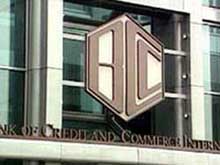 Critics dismissed that as an invention. They were wrong. There was a link, but not the one Bush was selling. The link between Hussein and Bin Laden was their banker, BCCI. But the link went beyond the dictator and the jihadist — it passed through Saudi Arabia and stretched all the way to George W. Bush and his father.
 The command that dismisses his assistant is Exit!
 Yukos that was stolen from it in the mid-90s. It is buying the assets in auctions. Indignant protests are heard from westerners.
 Further down, the story noted that Geneva has becomes an “aggressive haven for the global elite.” And, “Now the Swiss can be found throughout the world, selling more sophisticated investment vehicles to attract high-net-worth individuals, mostly multimillionaires.”
 The money moved through the Safra Bank in New York. It was only part of the $130 million that Maluf passed through Safra in 18 months alone.
 to get a lucrative phone contract, has managed to keep details of the case under wraps. That is because IDT lawyers succeeded in getting the U.S. District Court Judge, Mark Falk, to gag whistleblower D. Michael Jewett and seal his testimony.
 photography prize, formerly the Citibank photography prize, is perhaps the most prestigious and important photography prize and one of the most important art prizes. Those who win become name photographers/artists, and their work becomes literally over night very valuable, exchanging hands for many thousands of dollars.