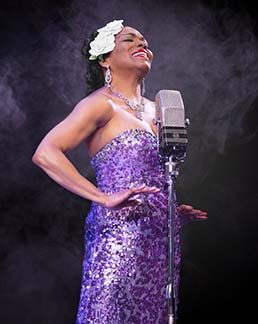
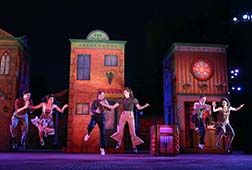
This projection/play by the Canadians Michel Lemieux and Victor Pilon is fascinating as an artistic piece, gorgeous as staging and projection. Unfortunately, the plot and text are rather silly. Perhaps it should have been done as a dance theater piece, without voices.
Think of the fall as the prelude to the end of life, the difficult bumbling interval preceding finality and death. It‘s a time that presents more misery than joy in Samuel Beckett‘s “All That Fall,” a 1957 BBC radio play being staged with exquisite tenderness by Trevor Nunn at 59E59 Theater. But there‘s also a quirky and bizarre sense that makes you marvel for a moment at peoples‘ ability to hang on and assert themselves even as their physical beings are failing. “Fall” here is the verb.
This production is anchored in brilliant performances by Eileen Atkins and Michael Gambon, among Britain‘s best actors, as the frail married couple who retain just enough energy to flail and thrash at each other. Old life is passing, new life is budding, or is it nipped in the bud?
This is a play for which the word “riveting” was invented. It’s got action, history and ideas, stimulating on all accounts. It‘s the early 1980s in Mississippi. Two low-life whites, whose prime amusements are drink and drugs, have raped a 10-year-old black girl they came upon carrying groceries on a lonely rural road. They leave her for dead. But in the hospital, she identifies them, and they are arrested.
John Grisham graduated from the University of Mississippi Law School in 1983 and practiced criminal law as a trial lawyer for about a decade. The play, based on his 1989 novel, was inspired when he was at a courthouse where a 12-year-old told a jury how she had been beaten and raped.
Terrence Rattigan‘s “The Winslow Boy” is a British period piece that is still eminently satisfying. Written in 1946 and set in 1912 to 14, it is based on a true story. A father in an upper class household – at least upper class enough to afford a full-time servant – gets a letter informing him that his son has been accused of purloining a five-pound postal order from another boy at the Royal Naval College. He believes the son that the accusation is unjust and must immediately make a moral choice that could risk the family‘s financial status.
Cherry Jones is acknowledged as one of the best actresses on the American stage today. I first saw her in 1998 in “Pride‘s Crossing” at Lincoln Center where she played a woman from childhood to dotage with no change in make-up, making you believe the age of the characters with the expressions and twists of her face and the angles and rhythms of her body and walk.
She dominates this play in a portrayal of a character who she makes at once sympathetic, annoying and absurd.
Dee Dee Bridgewater is an accomplished jazz singer who recreates Billie Holliday so expertly you‘d swear she had channeled her. Musically. But the play written and directed by Stephen Stahl is so hokey and histrionic that it gets in the way of the artistry. Stahl has been working on this production and trying to bring it to New York for years, decades. But perhaps his emotional connection overwhelmed his artistic sense.
The play shows Billie in London where her manager (a too-laid-back David Ayers) is trying to steer her sober as she rehearses with a band for a bet-the-house performance to salvage her reputation so she can return to work in New York.
I think the Elevator Repair Service could dramatize the telephone book.
I went to its performance of “Arguendo” — it‘s the legal term for the sake of argument – with a soupçon of curiosity leavened with “ok, show me.” After all, the play text was the transcript of the Supreme Court arguments in the 1991 case of Barnes v. Glen Theatre. It was a challenge to the Indiana law that banned nude dancing in clubs. The law said dancers had to wear pasties and G-strings.
Horton Foote‘s “The Old Friends” reminds one of a Tennessee Williams play or a Faulkner novel. Director Michael Wilson in fact is a Williams scholar. Wilson knows how to direct Foote‘s dysfunctional Southern family yarn to make it engrossing and keep it from descending into soap opera.
This 1897 play about marriage and the relations between the sexes is a fluffy confection. It‘s part of a group called the “Pleasant Plays.” It skewers male chauvinism, social snobbery and even rigid feminist ideology which falls before true love.
Gripping, disturbing, unsettling, this picture of Robert Mugabe, the despotic president of Zimbabwe, depicts a psychopath who is haunted by the spirit of a man he killed, a fellow fighter in the armed movement of the 1970s to oust the white minority that ruled Rhodesia.
The play was written by British writer Fraser Grace, who was inspired by newspaper accounts that Mugabe, depressed, had sought treatment from a white psychiatrist.
The musical Annie is based on the comic strip by Harold Gray, a reactionary who opposed unions, welfare and Franklin D. Roosevelt. But book writer Thomas Meehan has turned a right-wing cartoon into a pro-New Deal musical where FDR has a cameo role. Gray would be turning in his grave.
It‘s a smidgeon corny, but I found this play about the rabbi-rock singer Shlomo Carlebach (Eric Anders) and the jazz singer Nina Simone (Amber Iman) rather charming. And very entertaining.
The story takes Carlebach from Nazi-occupied Vienna, from which he escaped with his chief rabbi father, but not before the young Shlomo saw people he knew murdered or sent to concentration camps.
The defining moment of “Forever Tango” is the opening production number that takes place in a bordello. The men wear pin stripes, black cravats, Borsalino hats and menacing looks, and the women, in slinky gowns, move among them, sometimes passing bills to the pimp. The language is tango, as the men and women interact with the circles and twists and back kicks that define this dance.
In 1960, I was among a handful of college students who volunteered at the 125th Street offices of “The Committee to Defend Martin Luther King and the Struggle for Freedom in the South.” The sit-ins had started, southern sheriffs were brutalizing protesters, and King had been arrested and would be released on the intervention of President Kennedy. The committee had been organized in Harry Belafonte’s New York apartment and was run by Bayard Rustin, a pacifist and King‘s leading strategist. One of the “older” activist volunteers was Michael Harrington, 33, a writer who used his pen to help the campaign. Rustin was also the lead organizer of the 1963 March on Washington, which I attended.
Delicious surreal theatrical games are featured in Tennessee Williams‘ Southern Gothic drama of brother and sister actors of a failed theater company where the characters in a play-within-a-play mirror the duo‘s real-life desperation.
Williams, the famous chronicler of Southern psychological disintegration, goes one better by giving the neurotic pair, Clare (Amanda Plummer) and Felice (Brad Dourif), a life as absurd as in the interior play. The actors are brilliant in the expression of their characters‘ neuroses.
Tiny white figures move over projected scenes on the high perpendicular wall of a former factory. The figures appear to catch and throw boxes from a conveyer belt. The video changes from the factory to a prison to a road with speeding cars that seem to run over the curious shapes.
The music is clanging, electronic, repetitive, sometimes with an Asian or African feel. The white forms scamper over the wall, sometimes appearing to be at 90-degree angles to the ground. We can see thin black ropes that keep the spectacular gymnastic dancers defying gravity.
The Gerald Clayton Sextet suffused the sultry Nice air with cool melodic jazz. Logan Richardson on sax did trills, and Thomas Crane on drums hit cymbals that matched Clayton‘s piano‘s high notes. Joe Sanders‘ bass maintained the mood.
This was classic jazz, a bit of swing, and everything had a resolution. The musicians are sophisticated New Yorkers. There were no screeches or wails to assault the ears or the senses.
I haven‘t seen such a clever, funny, outrageous satirical play in years as this work by Nell Benjamin! It‘s London in 1879. A very stodgy club of naturalists and explorers is having its annual meeting in a Victorian townhouse whose every inch of wood-paneled walls is decorated with tusks and stuffed animal heads and paintings of illustrious members. At the back, center, is a bar. (The explorer-spoofing set is by Donyale Werle.)
This rather conventional play by J.B. Priestley (famous for “An Inspector Calls”) occurs and premiered in London in 1935, a period of economic crisis. It’s not brilliant, but it is engrossing. Briggs and Murrison, a London dealer in aluminum, is going through a rough patch. Trade is devastated by the conflict in Europe. A cable from the company man in Ottawa says embargo is certain on everything but low-grade sheet metal. Murrison has gone into the country seeking orders to save the company from collapse. Jim Cornelius (Alan Cox) is in the office trying to stave off the creditors.
Susan Sontag was a precocious, smart, self-involved writer whose literary canvas was herself. Let me add the word “pretentious,” which seems best expressed by the white streak in her dark hair which in this dramatic memoir directed by Marianne Weems is exaggerated to a thick snowy patch.
The play, based on her diaries and edited by her son David Rief, is essentially the young Sontag (Moe Angelos) conversing with older one (also Angelos) projected on a large screen. (The various projections by Austin Switser are brilliantly done.) The play is fascinating as a psychological if not a literary portrait.
Imagine a Shakespeare play set to 1940s big band swing. What could go wrong?
Daniel Sullivan‘s production of “The Comedy of Errors” at the Delacorte is a smashing, charming, cool, jazzy production that leaves the story a bit in the dust.
One wonders what happens when some of Shakespeare‘s less significant works are produced without emphasis on the poetry of the iambic pentameters. In this case, the abbreviated (cut to 90 minutes) story of twins lost in a shipwreck and then reunited seems to disappear. The fun is in the 40s jazz and mafiosi characters. That is not to be minimized. This show is a delight.
Dan Gordon‘s bittersweet memoir about a Belfast shipyard comes alive through the stunning performances of Gordon and Michael Condron as two pals and workers, Davy and Geordie.
Gordon and Condron also create numerous other characters, laborers and bosses, in a play inspired by Gordon‘s father‘s years after World War II building ships at the huge Harland and Wolff plant.
Sue Mengers (Bette Midler) was the kind of person who sucked up to those above her and had contempt for those below. A perfect fit for Hollywood, where the title, “I‘ll Eat You Last,” refers to an affectionate comment by a cannibal, in, as she describes it, “a cannibal love story.” Think about it.
Her story, in fact, shows how those whose careers she helped dropped her when it was convenient. But they were all playing the same game, so you can‘t really feel sorry for her.
“The Last Cyclist” is fascinating in its conception and existence as a satirical political cabaret put on in 1944 by prisoners of the Theresienstadt concentration camp 40 miles from Prague. While suffering from unspeakable hunger, grueling forced labor and other horrors, inmates presented original plays for their fellows to see late nights in building attics.
Bertolt Brecht‘s 1944 play with music – almost a chamber opera – is an ironic parody about selflessness and greed. As the narrator puts it, “Terrible is the temptation to do good.” Classic Stage director Brian Kulick helms a strong production laced with Brecht‘s irony, colored by caricatures and riven by strong performances. In his conception, the plays begins at the turn of the last century and ends with the collapse of Soviet communism.