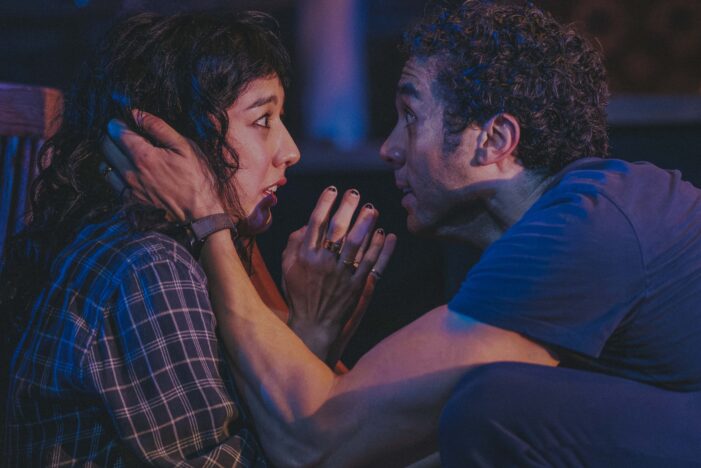
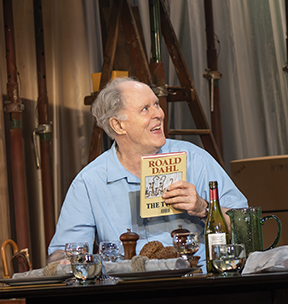
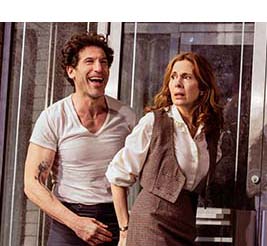
When a stage adaptation of “Paranormal” Activity by Levi Halloway opens with a man video-calling his mother in Boca Raton, you’d be forgiven for wondering if you’d wandered into a sitcom taping instead of a horror play. Based on the found-footage film franchise — though “based on” is generous — this two-story set (living room, kitchen, bedroom, bathroom, and a tellingly empty nursery) houses something far less frightening than the title promises. (Director is Felix Barrett)
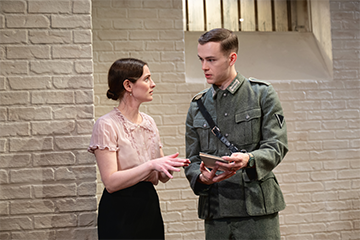
As I watched this play by Jenny Lyn Bader about the arrest in Nazi Germany of Hannah Arendt, my first question as a journalist was “Is this story true? And did Arendt write about it?”
In the play, admittedly fascinating, Arendt (Ella Kaille) has been arrested on suspicion of collecting German media articles for a Zionist operation to share examples of anti-Semitism with people abroad. She insists she is a philosopher reading historical books, that someone must have left some articles in the “machine” she was using.
Sept 25, 2026 – The most bizarre comment of Polish Foreign Minister Radoslaw Sikorski at the Council on Foreign Relations yesterday was his comment about the Ukrainian Nazi who organized massacres of tens of thousands of Poles during WWII and who has been praised as a hero by Ukraine. He called him “flawed.” FLAWED?? But look, if you are a Russophobe promoting Ukraine you can’t say bad things about a Nazi who slaughtered your countrymen, can you?
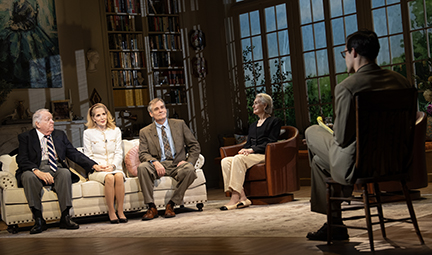
This play by prominent feminist playwright, the late Wendy Wasserstein, was presented on Broadway in 1997. It got mixed reviews then. It’s been rewritten. But looking at the old reviews, it appears flawed from the start. It is a soap opera, but even some melodramas may be convincing. This one is not. Its characters are caricatures and its plot is full of holes.
The stuff of this play is over 40 years old, perhaps an avatar of what became a staple of a certain dark corner of the entertainment industry, vulgar sex-themed comedy. This is why I don’t go to comedy clubs. Boring silly stuff, lots of crude jokes. Most aimed at 13-year-old boys or people of that mental age. This show is on stage because Whoopi Goldberg is now famous, but she didn’t get there because of what she wrote in 1984.
Can Marilyn Maye sing the blues? You’ve never heard anything like it! This past weekend at Don’t Tell Mama, the brilliant cabaret singer took a detour from the traditional American Songbook and dove headfirst into the gospel-tinged grit of “Don’t Nobody Bring Me No Bad News,” the showstopper from The Wiz, music and lyrics by Charles Emanuel Smalls. And the lady didn’t just sing it—she sermonized it.
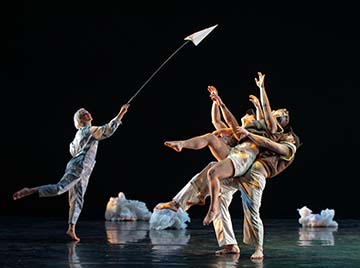
Pilobolus’ “Trips” is surreal, fantastical, sometimes jokey, and more movement and acrobatics than what one is used to in modern dance.
“Pseudopodia” my favorite, a fiery red tumbleweed choreographed by Jonathan Wolken and performed by Hannah Klinkman. She twirls and somersaults, her body glows, it indeed seems like a tumbleweed, ethereal, charming.
There are moments when history doesn’t just surround you—it carries you with it. On July 7, 2026, I will experience exactly that when I step aboard the Schooner America 2.0 for a narrated harbor cruise through what organizers are calling the largest maritime spectacle in American history.
The story of the New York State “justice” authorities prosecution of Lenny Bruce in 1964 would be surreal if it weren’t for the fact that the iniquity of the officials who attacked him and the courage of his defenders continues apace, most obviously the attack on the free speech of critics of Israel.
May 17, 2026 – New York City’s annual Dance Parade is a gorgeous testament to the colorful diversity and talent of its citizens, with 10,000 people marching and dancing down a route from Sixth Avenue and 17th Street to Tompkins Square Park in groups that largely display ethnic dances and costumes and the joyous talents of school kids. Yes, a lot of people do rock and pop dancing but they don’t have groups that march in parades! Here’s a day for people to show off their ethnic heritages.
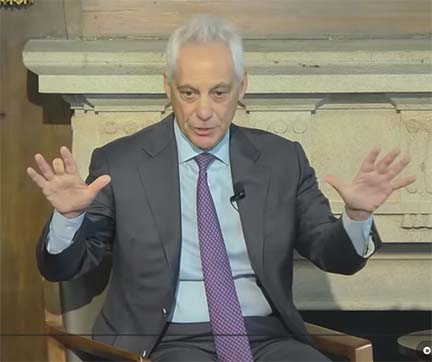
May 15, 2026 – At a recent Council on Foreign Relations meeting on U.S. foreign policy, Rahm Emanuel, on the long list for the Democratic nomination for president, didn’t mention Gaza, the only international issue that galvanizes Democratic voters, except to say the Trump-Netanyahu strategy didn’t work: “You unilaterally acted in Lebanon and in Gaza, and you got Hezbollah and Hamas.”
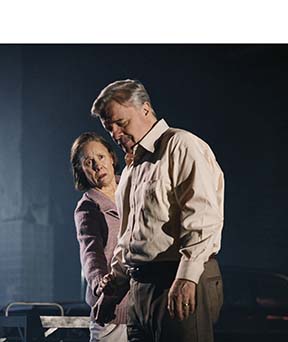
The lights rise on a high gray space, nondescript and suffocating. Pillars with chipped tiles flank the stage. Metal furniture doubles as kitchen table, office chair, restaurant booth. Then headlights cut through the dark—a burgundy Studebaker pulling into a garage. The year is 1949. When I first saw this powerful play, I thought it was a critique of capitalism, which has been a theme of Arthur Miller. In Joe Mantello’s riveting production it seems to be more about the delusion of those who believe in capitalism.
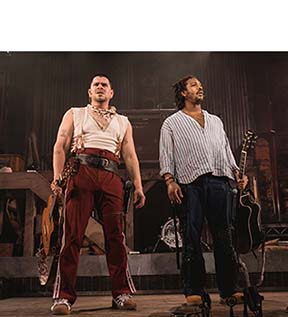
“Mexodus,” written and performed by Brian Quijada and Nygel D. Robinson, is an historical musical that feels urgent, inventive, and moving. Directed with clarity by David Mendizábal and performed with raw conviction by its two actor-musicians, this off-Broadway production reclaims a forgotten chapter of American history — the thousands of enslaved people who escaped not north, but south to Mexico, where slavery had been abolished.
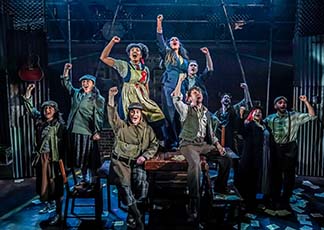
There’s a moment in “Cable Street” when the mounted police charge and the protesters scatter marbles and broken glass across the cobblestones. It’s the kind of theatrical image that is part history lesson, part battle cry, and entirely electrifying.
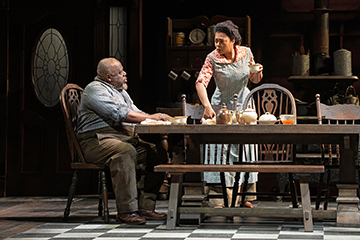
August Wilson’s “Joe Turner’s Come and Gone” arrives with the smoky weight of Pittsburgh’s steel mills looming in the backdrop—three-story houses and chimneys belching industry. It is 1911, barely fifty years after the abolition of slavery, and Wilson plants us squarely on the border between legal freedom and lived captivity. This is a haunting allegory about black Americans who came north in the decades after emancipation, carrying chains white people could not see.
There’s a moment late in the second act of “KENREX” when the lights flash, the sound crashes, and Jack Holden becomes, for the thirty-fifth time, someone else entirely. By then, you’ve stopped counting. You’ve stopped wondering how one actor does it. You’re just gripping your armrest, watching a small town finally do what the law wouldn’t. This isn’t just good theater—it’s essential, electrifying storytelling.
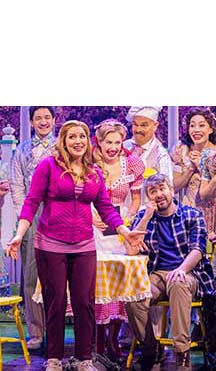
It is classic musical farce. Book, music and lyrics by Cinco Paul based on the Apple TV series*. Melissa (Sara Chase) and Josh (Alex Brightman) are a couple in crisis. They met at the hospital where they are doctors when a candy machine didn’t work. He told her to kick it. She did. Every Snickers bar on planet Earth came tumbling out. An omen of sweetness to come. Cut to two years later: they’re in bed, staring at their phones, barely speaking. The candy has lost its magic.
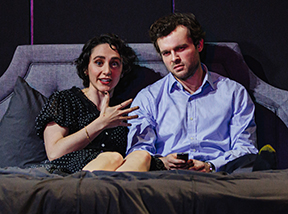
Here is a surprise: a dark comedy about “relationships” that is actually clever, funny and smart. To me, “relationships” usually signals a sit-com with laugh tracks. You will find none of that here. Gina Gionfriddo’s 2008 play “Becky Shaw,” set in 2007 and directed with sharp, energetic pacing by Trip Cullman, feels superbly modern—only the cell phones, you will notice, were smaller then.
This powerful unsettling play by Mark Rosenblatt, directed by Nicholas Hytner, drops you into an argument—no, an intellectual and moral battle—that has riven peoples and governments in the West to the point where critics of their government’s policies are imprisoned or deported.
You know that feeling when a play grabs you by the collar, whispers “Attica” in your ear, and then can’t quite figure out how to let you go? That’s the new Broadway stage adaptation of Dog Day Afternoon, written by Stephen Adly Guirgis, directed by Rupert Goold. This production—set in the sweltering August of 1972 at a Chase Manhattan bank in Brooklyn—has moments of blistering, street-level brilliance, but too often plays like a sitcom that wandered into a tragedy.
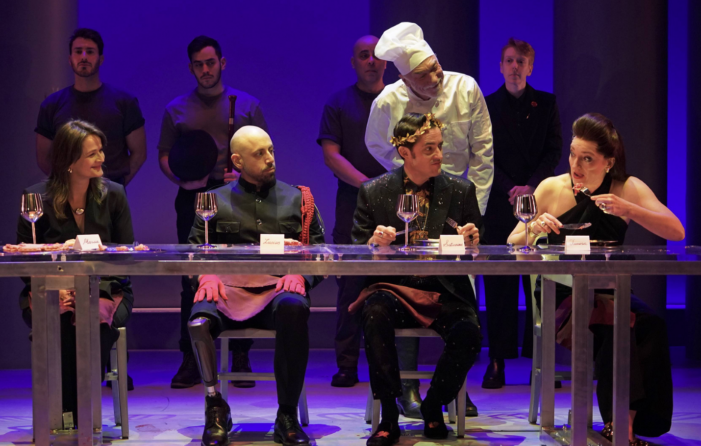
Red Bull Theater’s Titus Andronicus arrives like a punch to the gut—and stays there. This is Shakespeare’s bloodiest play given a production that understands exactly what it is: a horror film on a classical stage, rendered with precision, brutality, and moments of unsettling lightness that make the violence land even harder.
The production’s visual language is immediately striking. The choice to dress Saturninus (eldest son of the late emperor) and his court in black suits with red shoulder braid carries unmistakable echoes of fascist iconography, grounding the play’s political corruption in recognizable twentieth-century nightmare. Soldiers return in khaki, their war wounds visible and unglamorous—one with an artificial leg, another with an eye patch.
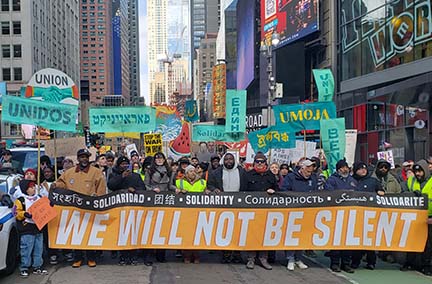
March 31, 2026 – Are you old enough to have marched in a protest when the major issue for Americans was the war in Vietnam? Way back in the 60s. Did the signs mention LBJ but not Vietnam or the war? How about a march against U.S. aggression in Iraq decades later? Just about Bush but not his war in Iraq? I still have a bumper sticker with the French tricolor and the slogan, “I drink Bordeaux and I vote.”
The best exhibit in the Whitney Biennial isn’t even a “found” object; it’s a collection of stolen ones. David L. Johnson’s installation, “Rule: Removed Codes of Conduct Signs,” is a brilliant act of creative defiance. These aren’t gallery relics but placards pilfered from Privately Owned Public Spaces (POPS)—those architectural loopholes born from a 1961 zoning resolution that let developers build skyscrapers in exchange for creating “public” plazas.
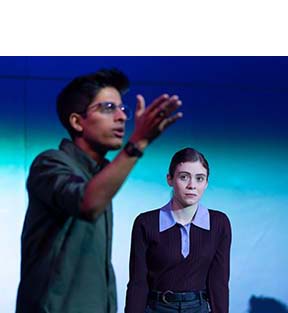
The stage is a sleek, white box. Suddenly, it is dark and edged with pulsing blue light, throbbing to an electronic score as if the room itself is booting up. This is the world of “Data,” Matthew Libby’s unnerving new play about the young engineers building the surveillance state, one algorithm at a time.
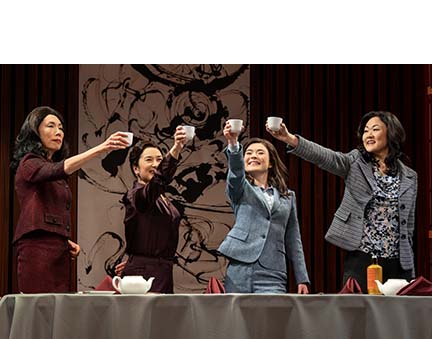
Alex Lin’s new play, “Chinese Republicans,” presented by the Roundabout Theatre Company, is ambitious, aiming to dissect the generational fissures within Chinese-American identity while simultaneously taking a sledgehammer to the glass ceiling of late-stage capitalism.