A stage musical/documentary may be a new genre and this one, created and directed by Stephen Sondheim’s longtime collaborator James Lapine, works smartly and engagingly to provide a tour through the life and works of the master songwriter. The man who is known for sustained peaks of imagination comes to life through a very innovative combination of video and musical numbers, with an appealing cast led by Vanessa Williams and Tom Wopat.
Dreariness is the design motif of Gordon Edelstein’s persuasive staging of Tennessee Williams’ 1944 memory play about a family trapped in unhappiness and illusion. Dreary dark wallpaper hovers over the single bed with a rose spread in the New Orleans hotel room that the writer, Tom (Patch Darragh), Williams’ alter ego, inhabits. The same claustrophobic space becomes the St. Louis tenement rooms he shared with his mother Amanda (Judith Ivey) and sister Laura (Keira Keeley) .
A table is set with bread and cakes, back-dropped by a forest created from a jumble of cross-hatched planks painted and splotched to suggest leaves. A servant is angry at the housekeeper who enters the space without warning. Do we barge in on you? Class stratification and conflicts ripple through this richly comic production of Alexander Ostrovsky’s satire of a Russian aristocracy high on self-importance and low on cash.
The American Interest, July-Aug 2010 (online May 18, 2010) –
As I write this, the U.S. Senate is debating a major financial reform bill in which the credit default swap, a kind of derivative, plays a significant part. An amendment to that bill, proposed by Senators Carl Levin (D-MI) and Jeff Merkley (D-OR), would ban banks from proprietary trading. There are a lot of high-rolling bankers who do not want that amendment to pass, because it will mess up their plans to repatriate foreign profits into the United States, untaxed, by trading in derivatives on their own accounts. The clearinghouse ICE Trust U.S. forms a central part of these plans.
What is ICE Trust U.S., and who owns it? ICE US Holding Co., which was established in 2008 as the parent of ICE Trust U.S., is located in the Cayman Islands. Yet none of the owners of ICE US Holding Co. are based in the Caymans. Among the owners of the Cayman‘s company are Citigroup, Goldman Sachs, J.P. Morgan, Merrill Lynch and Morgan Stanley, which are headquartered in New York. Bank of America, which now owns Merrill Lynch, is based in Charlotte, North Carolina.
Martin McDonagh takes weird to new levels in this ultimate shaggy dog story. It’s bizarre and funny and if you suspend disbelief and don’t take it too seriously, you will have a good time. It seems that a 17-year-old kid was playing catch in Spokane, Washington, when six hillbillies dragged him to the railroad tracks, forced his hand on the rail and watched while a train sped by and sliced it off. Then they used it to wave him good-bye. He, Carmichael (Christopher Walken), decided if he didn‘t die he would retrieve his hand and pay them back. He has spent the ensuing 47 years doing just that.
I have won the Sigma Delta Chi journalism award for Non-Deadline Reporting (Daily Circulation 100,001+) for “Allen Stanford’s Miami Connection.” This is the exposé I brought to the Miami Herald that told how the Florida Banking Department allowed Stanford to set up an unregulated office to move money offshore. I worked with two Herald reporters, who shared the award. It is one of the country’s major journalism prizes.
According to the Society of Professional Journalists, which presents the award, Judges chose the winners from over 1,300 entries in categories covering print, radio, television and online. The awards recognize outstanding work published or broadcast in 2009. They will be presented Oct. 2 during the 2010 SPJ Convention and National Journalism Conference in Las Vegas.
RALEIGH, North Carolina, Inter Press Service (IPS), April 27, 2010 – Robert Moses, 75, a legendary leader and organiser in the 1960s U.S. civil rights movement, was huddled with a dozen people discussing plans for a campaign to make quality education a constitutional right. On one side was his son Omowale, 38. Next to Omo was John Doar, 89, head of the civil rights division of the U.S. Justice Department in 1960-67 and prosecutor of the major civil rights cases of that era.
The age differences were noticeable at the conference they attended this month in Raleigh, North Carolina, to commemorate the 50th anniversary of the founding of the Student Nonviolent Coordinating Committee. It was a moment for the elders – as high school and college students at the conference called them – to pass the torch to a new generation of activists.
Last week, I was at Shaw University in Raleigh, NC, for the 50th anniversary conference of SNCC, the Student Nonviolent Coordinating Committee, which led the sit-in movement of the 1960s. I attended SNCC’s founding conference at Shaw in April 1960.
That meeting had been called in response to the February 1,, 1960 protest in Greensboro, NC, when four black students sat at an all-white Woolworth’s lunch counter, demanded to be served and were arrested.
Million Dollar Quartet is hot on music and slight on story, the latter a chance 1956 gathering of country and rock innovators Elvis Presley, Johnny Cash, Carl Perkins and Jerry Lee Lewis at a Memphis recording studio. Fans will like the stars’ doubles’ performances of the songs that made them famous. And this jukebox musical jumps off the charts whenever Levi Kreis, who plays Jerry Lee Lewis, dominates the stage with his wild jazzy piano playing and furious rock lyrics.
Creating a richness in their arrangement that adds to the beauty of each poem, director Peter Brook has ordered 31 Shakespearean sonnets, dramatically recited by Natasha Parry and Michael Pennington, to create a striking theater piece. It elegantly expresses love as it consumes men and women in the highs and lows of their relationships and into their later years. The poems are grouped to praise love that lasts through time;and to plumb the pain of separation; the torments of jealousy, self-deception, and guilt; and the sorrows of older age. That doesn’t quite make a play, but it’s more than a poetry reading.
This is not the kind of black tie London cocktail party that Noel Coward was wont to attend. There may be champagne poured and secret infidelities going on, but the darkness that bubbles out of those glasses up reminds one of Albee or Pinter. The Actors Company Theatre has mounted a striking production of T.S. Eliot’s 1950 play that one won’t soon forget.
Horton Foote’s story of a young boy growing to manhood in rural Texas in the early decades of the last century is so gripping, and elegantly performed, that it’s hard to acknowledge that the mundane events of family interactions, marriage, divorce, illness and death in the extended Robideaux clan are in themselves, presented with great subtlety by Michael Wilson, understated and sometimes almost without great drama. Or else, they are the drama of the every day.
Helen (Abigail Breslin) is 10, a wild child, throwing tantrums, screaming. Annie (Alison Pill) is 20, saucy and opinionated. She says, The only time I have trouble is when I’m right which is so often.
Both of them are whip-smart as well as strong-minded, and William Gibson’s 1985 play tells the fascinating story of how teacher Annie Sullivan got Helen Keller, deaf and blind since infancy, to understand, to touch-sign, and to express herself so brilliantly that she became a world-famous traveler and lecturer. The fact that all this occurs in a small town in 1880s Alabama makes it the more astonishing.
This Kander and Ebb show, given an astonishing and dazzling staging by director Susan Stroman, tells the story of what happens to nine blacks accused of collaborating in the rape of two white women in Alabama in 1931. The mood is a jazzy operetta. The dramatic vignettes of the story are interspersed with numbers of a minstrel show, which allows you to catch your breath between horrific events and adds the element of satire.
Who better to craft a political musical than John Kander and Fred Ebb, who wrote the 1993 classic Kiss of the Spiderwoman, about the movie fantasies of a prisoner tortured by the Argentine dictatorship that brutalized the country nearly half a century ago. And director-choreographer Susan Stroman stages this in a cutting, jazzy minstrel style that takes irony to new levels.
I’ve been awarded a National Headliner Award for the story on Ponzi-schemer Allen Stanford I took to the Miami Herald last year. It exposed how the Florida Banking Department ignored the strong advice of its own lawyer and allowed Stanford to set up an unregulated office to move money offshore.
When the devastating earthquake hit Haiti in January, IDT, the New Jersey-based global phone company, moved fast to help.
It announced it was setting up calling stations at hotels and other sites so Haitians could use its Internet calling-service to reach family and friends around the world. It cut rates on its U.S. prepaid calling-card to 2 cents a minute to Haiti (at least for 12 days), donated 4,000 $2-prepaid calling-cards to Haitian community groups in New York and Florida, and said it would give some proceeds from prepaid calls to Haitian Red Cross relief.
Such a warm, fuzzy response from a U.S. corporation often wins plaudits, though, of course, IDT has a business interest in the impoverished island. In 2005, in its latest publicly available figures, the company reported $4 million in profits from $17 million in revenues for routing calls there.
One year ago, a group of financial institutions quietly launched ICE Trust, a new and theoretically safer way to trade derivatives, a key element of the financial crisis. As lawmakers debate reform, banks at the center of the storm are remaking the market”and stand to profit.
As the financial crisis exploded with full force in 2008, it was obvious that something was gravely wrong with the huge, unregulated market for derivatives.
Lehman Brothers had $738 billion of these contracts”which are based on the value of some other asset, such as a stock or a bond or a hog belly”on its books when it failed on September 14, 2008.
Lehman certainly wasn‘t alone. Over the next few months, insurer AIG reported as much as $53.5 billion of derivatives losses”losses that were linked to nearly one third of its $182.5 billion federal
Arthur Miller’s story of the betrayal that tears apart a longshore family in Brooklyn was a metaphor for the treachery of the people who named names in the anti-communist witch hunts of the 1950s. In this powerful revival directed by Gregory Mosher, we witness the inexorable downfall of Eddie Carbone (Liev Schreiber), a longshoreman, who forgets the sense of honor and loyalty that is the glue that holds together the hard-working Italian community in Red Hook, on the Brooklyn waterfront, where he and his wife Beatrice (Jessica Hecht) live. His self-interest is not the careerism of the film and theater people who betrayed colleagues to HUAC, but jealousy ignited by the illicit passion he feels for his niece Catherine (Scarlett Johansson).
Donald Margulies’s powerful and moving play dissects the professional and psychological passion of a photographer who covers the horrors of wars, famine, and genocide. Time stands still represents the moment when she presses the shutter button and sees the world only through the view finder. Time stops, sound cuts out; her experience is just what is taking place in the rectangle. There is an objectifying and separation from reality. And for Sarah Goodwin (Laura Linney) it’s the only moment in life that counts.
Garry Essendine (Victor Garber), who has the sense of a flighty youth, is a self-absorbed actor of 54. He is wont to shave a decade or so off his life, especially when he is playing up to pretty young women. Noel Coward’s semi-autobiographical comedy is at times amusing – it is meant to be a send-up of the actor and his entourage — but it’s nowhere near as clever as Coward can be. And the production by director Nicholas Martin lacks sparkle.
Taking us back to Clybourne Park, to where Lorraine Hansbury’s black family moved in A Raisin in the Sun, Bruce Norris has written a clever, pointed comedy, acted by a superb cast under the well paced direction of Pam MacKinnon, that plumbs the depths of racism to see how it’s changed from the blatant late 50s to the more subtle present.
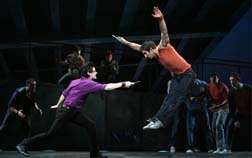
The free-floating anger exuded by the Jets and Sharks as they clash under and leap onto fire escapes is combustible. Any reason for the gangs’ hostility? Well, when Officer Krupke (Lee Sellars) arrives in the neighborhood, along the Hudson River on the Upper West Side of New York City, he slams one kid in the stomach with a Billy club. Lt. Schrank (Steve Bassett) comes into a local drugstore and insults the Puerto Ricans as migrant scum. The sociological stage is set. There’s nothing dated about Arthur Laurents’ revival of his own West Side Story. This American theater classic is another proof that the best, most enduring musicals (and plays) combine personal stories with political ones.
My guest at Hair was an old friend who had been a leader of the 1968 protest movement in Germany. As we left the theater, he shook his head. He said, We were much more political. That said, and history corrected, Diane Paulus’s revival of the 1968 musical now on Broadway captures the mood of part of a generation of young people (a minority of their contemporaries) that helped change the culture.