I can’t remember when I’ve seen a play as hokey and charming and full of fun as Brief Encounter. Okay, I take that back. It was The 39 Steps. But not surprising, it is also a spoof of an iconic British film, that one by Alfred Hitchcock. This one is by Noël Coward. If you want to have a very good time, go to this production. But notice the deeper meaning underneath it all.
The American Interest, Jan-Feb 2011 (online Dec 9, 2010)
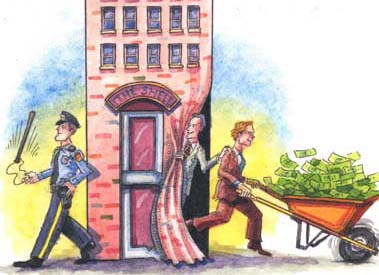
Corporate secrecy, which involves hiding the identities of company owners from tax and other legal authorities, is itself no secret. It is well known that offshore banking centers such as Switzerland, Liechtenstein and the Cayman Islands have for many years enabled fraudsters all over the world to carry out scams, launder illicit profits, stash stolen loot and hide money from tax authorities.
What most people do not know, however, is that there is a vast and growing American offshore. Foreign crooks prize states such as Nevada, Wyoming and especially Delaware for state laws that don‘t require them to list owners or even company officials when a new company is formed. Corporate interests and the Obama administration are blocking congressional efforts to change that.
Dec 6, 2010 – Bush Secretary of State Condoleezza Rice spoke at the Council on Foreign Relations Friday and used the occasion to attack WikiLeaks. I used the occasion to ask her a question: If WikiLeaks should be charged criminally for putting up this information, should The New York Times be charged criminally for doing the same thing?
Dec 4, 2010 – I was invited to CNBC’s Power Lunch to talk about a report by the IRS Inspector General that prisoners had received $112 million in tax refunds they shouldn’t have gotten. I surprised the interviewers by turning the question to tax cheating by those outside prison walls.
Nov 30, 2010 – I went on CTV, the Canadian News Network, to debate Martin Collicott, a former Canadian ambassador, over the WikiLeaks document release. Here’s a link to the video, done live yesterday, and then the text of what I said.
This engrossing play starts in 1934 Britain, when over a million men worked brutally hard ten-hour days in coal mines at standard survival wages. The back story is that some miners, who started in the pits at 11 and were deprived of education, had prodigious artistic talent. And probably other natural gifts as well, if only they’d had the chance to develop them. We get to see their paintings in this inventive production by director Max Robert that audiences will savor.
Imagine that you are hidden in a corner of Sigmund Freud’s cozy Hampstead study, with a wall of book shelves, a large window onto the garden and a leather chair next to the iconic couch. It’s 1939, King George speaks on the radio, sirens warn people to extinguish their lights to evade the bombs of the Luftwaffe. Freud (Martin Rayner) is being visited by a young Oxford professor, C.S. Lewis (Mark H. Dold) who had satirized him in a book. Their conversation is stimulating, spellbinding.
Maybe it’s because hypocrisy never goes out of style that George Bernard Shaw’s 1893 play, Mrs. Warren’s Profession, seems so up-to-the-moment and not in the least dated. This delightful production by Doug Hughes, with the inimitable Cherry Jones as the madam/mother and a stand-out Sally Hawkins as her daughter, Vivie, charms, amuses and instructs. It is a very feminist play. And not to be missed.
[Update, by Dec it’s 60 countries and more than 460 signers.]
Journalists from every region of the world have joined together to support the whistle-blowing organization Wikileaks and its founder Julian Assange who, they say, have provided an extraordinary resource for journalists around the world and made an outstanding contribution to transparency and accountability on the Afghanistan and Iraq Wars.
I am one of the organizers of the campaign.
The journalists, many of whom are prominent investigative reporters, come from countries as diverse as Russia and Namibia, and Israel and Indonesia, plus many from European countries and North America. The journalists, who are linked through investigative journalism networks, decided to speak out publicly after watching a growing campaign of threats and unfair criticisms against Assange and Wikileaks.
Lillian’s Hellman’s account of the greed that tears apart a family is as powerful and compelling today as in 1939 when it opened on Broadway. It takes place at the turn of the last century, but was written at the end of the Depression. It’s about the advance and avarice of predatory capitalism. The little foxes, yapping and biting at each other’s heels, can be found on Wall Street and in corporate America.
Edward Albee is like a painter with a single overpowering theme. For him, it is the searing experience of being an adopted child of parents he hated. In Me Myself and I, a mother names her twin boys Otto (actually OTTO and otto), a way of divesting each of identity, and much later – when they are 28 – tells otto that he doesn’t exist. The play is bizarre, engaging, even amusing, especially when Mother, the blousy, intense, very talented Elizabeth Ashley is on stage.
Michael Frayn’s sprightly 1975 comical satire of newspaper life takes place in the library of a provincial paper. These were the days before computers, when librarians clipped the local papers and folded and filed the stories so reporters could get background on what they were writing. In spite of the title, Frayn’s newspaper library is anything but ordered, and filing by alphabet seems haphazard as well. But the ordered and disordered personalities that pass through among the piled high cabinets provide some comic pleasure as well as a gentle lesson about managing one’s life.
Sarah Ruhl’s inspired adaptation of Virginia Woolf’s novel Orlando is a poetic and vivid paeon to the art and importance of discovering oneself. It is also wildly clever and funny. Directed by Rebecca Taichman, it is yet another reason why the Classic Stage Company is so invaluable to New York theater. And why Ruhl is a playwright on the not-to-be-missed list.
China is the major international power blocking a global solution to the offshore bank and secrecy problem. It is doing so because of its own secrecy jurisdiction, Hong Kong, says José Manuel Barroso, the president of the European Commission.
He said some countries hadn‘t been reacting positively to efforts to change the system , to establish a level playing field.
After the meeting, I asked him why the major financial powers hadn’t been able to achieve a solution. He said the problem was China, because of Hong Kong.
Sept 24, 2010 – Last Saturday, Barron’s ran my story in which IDT CEO Howard Jonas admitted for the first time a suspect deal with then Haitian President Jean-Bertrand Aristide that involved sending payments due Haiti to a law firm in the Turks and Caicos. Jonas told me the company had gotten a lawyer’s ethics letter clearing the deal. But he wouldn’t provide it.
A day before the story was to run, Barron’s got a call from a lawyer of the firm representing IDT in a lawsuit by former IDT executive D. Michael Jewett, who says the company fired him for objecting to the offshore deal. He promised to provide the ethics letter. It was the end of day, Friday. The magazine noted that promise when it published the next day.
Days later, the lawyer called to say he couldn’t provide the letter because it was sealed. Hard to believe: there is no sealing order for the letter in the case docket.
Scoop summary: Howard Jonas, CEO of U.S. telecom IDT, in an interview with Lucy Komisar, acknowledges for the first time that then Haiti President Jean-Bertrand Aristide in 2003 met with an IDT official during discussions about a contract to pay Haiti Teleco for calls from U.S. customers. That contract included agreement for IDT to send payments to a shell company in the offshore Turks and Caicos Islands. Jonas said IDT got an ethics letter from a law firm clearing the deal, but the lawyer said in a memo filed with the court, published here for the first time, that he simply told IDT to do due diligence. IDT signed the contract the next day.
A former IDT official, who objected to the deal, was fired and is suing the company; trial is set for Nov 9th. The Justice Department and Securities and Exchange Commission are investigating violation of the Foreign Corrupt Practices Act. Jonas’s revelations are likely to have a major impact in the trial and investigations.
Shakespeare certainly understood the neurotic jealousy of husbands. In this play, a very foolish man named Leontes locks up his wife and orders the death of his infant daughter out of belief the child was fathered by his best friend. His metaphor is of a man who has his pond fish’d by his next neighbor.
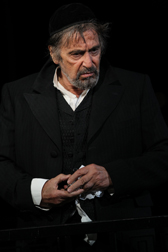
Consider a play where the villain is a Jewish banker who demands the murder of a client who couldn’t pay his debt. Is this a TV crime show picking up on the current hostility toward Goldman Sachs? No, take it back more than four centuries. Shakespeare’s play is believed to have been written between 1596 and 98, so there wasn’t any financial crisis going on, that we know about. What’s fascinating about the play and Al Pacino’s dazzling portrayal of the banker, Shylock, is the sociological take of a time when Jews were reviled; Jews were bankers (money-lenders) because Christians were told by their church they couldn’t do it; Christians borrowed from the Jews when they needed money; and Christian reviled the Jews for lending to them
The global food services company Sodexo, which I exposed last year for exacting rebates from suppliers and charging clients full price, has agreed to a $20 million settlement with NY Attorney General for that illicit practice.
I’m usually suspicious about people who do plays about themselves. But this autobiographical cabaret was a lot better than I expected. Sherie Rene Scott is certainly very self-involved, perhaps par for the course among performers, but she’s also got something interesting to say and, directed by Michael Mayer, an appealing way of saying it. Everyday Rapture is what happens when godliness turns into show biz.
June 30, 2010 – Last night I accepted a Gerald Loeb award trophy for the Allen Stanford investigation. The Loeb awards are the highest honors in U.S. financial journalism. I and my colleagues, Miami Herald reporters Michael Sallah and Rob Barry, won in the category of medium & small newspapers. The prize submission was entitled Keys to the Kingdom: How State Regulators Enabled a $7 Billion Ponzi Scheme.
What happens when the victim becomes the victimizer? When a man’s spirit is so thwarted that he turns hard in his soul and becomes so self-centered that he can’t love or care for anyone else? It’s the message of August Wilson’s tough 1983 play set in the late fifties that attempts to explain the dysfunctional working class black men who were being studied to death.
June 25, 2010 – Another award for the Stanford investigation, this time from the National Press Club in Washington DC, bestowing the prize for Newspaper Consumer Journalism.
The NPC award categories are consumer reporting, Washington correspondence, press criticism, regional, diplomatic and environmental reporting, online journalism, freedom of the press, political journalism, animal reporting, and geriatric writing.
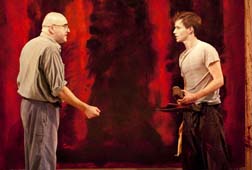
Can an art lecture in the form of a theater piece push you to the edge of your seat? This rich, engrossing play by John Logan does! Painter Mark Rothko’s inflated sense of self collides with the challenges of youth’s new visions in Logan’s fascinating pas de deux about the meaning of art and its indelible connection to commerce.
Alex Timbers’ play is a stunning satirical revisionist history of America’s seventh president Andrew Jackson as a genocidal Indian killer. It’s done in a rock idiom that takes the edge off and makes him seem almost a man of his time as well as/rather than a political murderer. But with some present day vernacular, it takes on immediacy. It’s a commentary on the past and also on the present day politics of state killing that is rare in its gut-wrenching toughness.