Inter Press Service (IPS), Nov 14, 2009 – To end poverty, you have to know how it began – with globalisation. No, not the 20th century variety engendered by multinationals and their friends at the IMF, World Bank and WTO. They just codified practices that kept developing countries poor.
French filmmaker Philippe Diaz, in an illuminating documentary opening in New York Friday, traces globalisation back 500 years to the Spanish and Portuguese conquests of the Americas. Diaz shows how the colonial North used the South’s resources to build its industrial base and how its continued control over resources, global trade and debt rules prevents developing countries from ending poverty.
Nov 8, 2009 – The 20th anniversary of the fall of the Berlin Wall has called forth a plethora of memories and celebrations. Here are mine.
I visited West Germany in 1983 as it held massive demonstrations against the U.S. plan to station medium range missiles on German territory. The peace movement – objecting to the Ronald Reagan hard line against the East — had another view of how to bring down communism from within. The German government Ostpolitik – East politics – though denounced by the Reagan politicians, was ultimately successful.
If there’s a king and queen in this production of The Royal Family, the George S. Kaufman-Edna Ferber 1927 parody of the Barrymore acting dynasty, they are Jan Maxwell and Reg Rogers, who steal the show with their theatricality.
The device of the play is that Julie Cavendish (Maxwell) and her daughter Gwen (Kelli Barrett) are torn between their love of the stage and their desire to have married lives. Julie’s mother Fanny, (Rosemary Harris), the grande dame of the family revels in having had both.
A Steady Rain by Keith Huff, a television script writer, is a thriller about two beat cops, partners, friends from childhood, that would seem to belong on TV. On the other hand, some of the events they describe are so bloody, that I’d rather see them described in the two interlocking monologues that make up the play rather than watch them in full color.
The stories are gripping. On the other hand, like most TV, you forget them pretty quickly.
Patrick Marber’s After Miss Julie is a psychological thriller, a rich drama that has three characters enmeshed in a web of conflicts that shift the upper hand from one to the other, depending on whether the field of battle is class or gender.
If it’s about class, then Miss Julie (Sienna Miller), the rich daughter of a lord, is on top. If it’s about gender, then it’s John (Jonny Lee Miller, no relation), the lord’s chauffeur-valet. But that holds only if the woman is as neurotic as Julie. Or a woman defeated by her time.
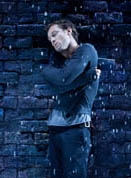
Jude Law drives Hamlet with an animal energy and naturalistic fervor that overwhelm the stage. This is not the tentative or tormented Hamlets we are used to. This Hamlet is a thriller and Hamlet the vengeful detective. The excitement is palpable. It’s a brilliant interpretation you won’t soon forget.
Nathan Louis Jackson’s play about a black family in Kansas City struggling to achieve a middle class life avoids the pitfalls of sitcom due largely to the four accomplished actors and director Thomas Kail, who breathe life into what on its face is a rather predictable story.
It hangs on whether Malcolm King (an appealing Alano Miller), who has managed to get a masters degree in Connecticut, will give up chances of a good university teaching job under his mentor, an environmental professor, or will he stay home to care for his father William (a warm-spirited Wendell Pierce) who has muscular dystrophy.
Yasmina Reza’s God of Carnage smartly shows the disintegration of the thin veneer of civilization that keeps people civil. Reza, perhaps coming from the salon culture of France, has a habit of locating her dramas in living rooms. These tête-à -têtes ought to show the height of culture. Instead, they display the dark sides of polite society.
This story begins with a touted civilized meeting between two couples, one clearly upper class, the other middle class, one couple chic, the other dowdy, to deal with fact that son of the first hit the son of the second. They start out honest, each admitting the family faults. As the evening gathering of nice people progresses, they descend from throwing words into throwing things. Taken further, we see the basic failure of ethical man. It is a fascinating transformation.
Back in 2004, when Chris Christie was the U.S. Attorney for New Jersey, his office first heard allegations that IDT Corporation, a Newark, N.J.-based global telecommunications company, was involved in a case of international bribery. No federal criminal case was ever brought against IDT, in contrast to several successful federal prosecutions in similar cases elsewhere. The company is run by James Courter, a former Republican congressman from New Jersey.
Fast forward to the present, and Christie is now the Republican candidate for the governor of New Jersey. And, an examination of campaign finance records shows, Christie has thus far racked up $26,800 in campaign contributions – earning him a total of $80,400 including state matching funds ” from 27 individuals who could have a direct interest in the IDT case.
Oct 17, 2009 – When he was interviewed for the investigative story I did in March on Sodexo’s practice of demanding rebates (ie kickbacks) from suppliers, Sodexo deputy counsel Tom Morse argued that working only with “compliant” vendors was necessary to assure health and safety. (Compliant means they pay rebates.)
He said that “the first thing we vet our vendors for is safety” against food-borne illnesses …”
This charming, vivid musical biography tells the story of two American composers who changed the idiom of western popular music. The curious parallel personal tragedies of Scott Joplin and Irving Berlin exist in contrast to their generally upbeat lively sounds.
In the early 1900s, the two musicians created musical sounds that established a new American music that would echo across this landscape and the world. Both were consummate outsiders: one the son of a slave, the other a Russian immigrant who had escaped the anti-Jewish pogroms with his parents. Mark Saltzman’s play – with the stunning music of Joplin and Berlin – is a lively, appealing, often fascinating look back at what motivated these American musical giants. The motivations and the men were quite different.
In January 1986, I went to the Philippines to chronicle the growing movement against the Ferdinand Marcos dictatorship. I was there for the people power revolution, a non-violent massive street protest that in February finally drove Marcos from power. I remember being outside the presidential palace that night and racing through the streets when gunfire erupted. The U.S., which had supported him for decades, flew him and his wife Imelda to Honolulu. Along with documents that detailed how they had looted the country and where the money was.
About the political and personal struggle between Queen Elizabeth I and Mary, Queen of Scots, the play underlines the eternal reality of struggles for power. Written by Friedrich Schiller in the 18th century and adapted by Peter Oswald, it is a political thriller that gets a memorable staging by Phyllida Lloyd.
Inter Press Service (IPS), July 14, 2009 – At a recent conference in Miami organised by Offshore Alert, a specialised media organisation focused on financial crime, IPS sat down with veteran investigator Bob Roach to discuss the hurdles facing regulators trying to crack down on tax havens, which cost the U.S. alone an estimated 100 billion dollars annually.
Alan Ayckbourn’s play is an ultra-sophisticated comedy that verges perilously close to sitcom, then skirts around it. The round-robin of three plays is what the clever British author posits against the normal sequential serial, a Rashomon style
The idea behind Noel Coward’s play is quite promising. Charles Condomine (Rupert Everett), a middle-aged murder mystery novelist – obviously quite successful in writing or marriage, from the country villa he inhabits – invites a medium (Angela Lansbury)
Winner of the Gerald Loeb award, the most important prize in financial journalism
Years before his banking empire was shut down in a massive fraud case, Allen Stanford swept into Florida with a bold plan: entice Latin Americans to pour millions into his ventures ” in secrecy.
From a bayfront office in Miami in 1998, he planned to sell investments to customers and send their money to Antigua.
But to pull it off, he needed unprecedented help from an unlikely ally: The state of Florida would have to grant him the right to move vast amounts of money offshore ” without reporting a penny to regulators. He got it.
The mystery of Samuel Beckett’s play about two down-at-the-heels hobos who watch an overbearing master abuse a pathetic slave is the division of the audience into those who laugh and those who don‘t.
Simon Cato (Gavin Lawrence) in his gold and purple stripes is cheeky, witty, a charmer as a jockey. Step back. This is 1861 and he is black; cheeky translates to impudent, (a challenge to power). A witty black man probably had no translation. Colonel Wiley Johnson (Chris Mulkey), who has hired Simon to ride his racing horse, pleads, Will you try and behave like a slave for just a few minutes!
August Wilson’s powerful, moving play conjures up a mood that is both poetic and surreal, though on the face of it, it is completely naturalistic. Perhaps it’s the distance of time, nearly a century ago, 1911, when blacks, only 50 years away from the start of the Civil War, were living on the border between slavery and freedom. Or it could be the ethereal staging by director Bartlett Sher, who excellently follows Wilson’s intent to turn the characters into symbols of their kind as well as real people. Sher starts that by showing the characters first in silhouette.
Key civil society criticisms are that the OECD standards require bilateral agreements for information on request, not automatic multilateral tax information exchange; that they call for only 12 such agreements to be signed by each tax haven; and that getting off the blacklist entails only promises, which have not been kept by tax havens in the past.
Exit the King is Ionesco’s witty satire on the corruption of those in power, given a tongue-in-cheek staging by Neil Armfield with a bravura performance by Geoffrey Rush as King Beringer, the man with only 90 minutes to live. Berenger loves parties. Well, the party’s over. Or about to be. The party, of course, is life.
Inter Press Service (IPS), April 30, 2009 – The U.S. Internal Revenue Service (IRS) is hitting pay dirt with a novel legal tactic designed to catch tax evaders. And it’s going to use it to force international banks to give up the names of tax cheats. It’s called the John Doe summons. Using John Doe means the IRS doesn’t know the names of the suspected tax evaders. So it sends a summons to a bank or credit card company that says, Give us the names and account information of all your U.S. clients with secret offshore accounts. Daniel Reeves, an IRS agent in charge of the tax agency’s offshore compliance initiative, afforded an unusual look into the broad swath of projects that seek tax-cheating John Doe’s every place from accounts of the giant Swiss bank UBS to the records of Pay Pal.
I have never seen anything like the three acrobatic contortionists who twisted and bent to the sound of Indian music under the Cirque de Soleil tent on Randall’s Island. Their movements created living sculptures that shifted and held and then moved to another pose. Clad in colorful, patterned skin-tight leotards (costumes by Marie-Chantale Vaillancourt), they were stunning. Memorable.