Sept 22, 2022 – Lucy Komisar talks to Hrvoje Morić about the Browder hoax, including Browder’s start as a crook skimming profits from Russian titanium company, Avisma, illicit buys of Gazprom shares for himself and the Ziff Brothers, the role of the Trump Tower meeting, proof Magnitsky wasn’t murdered, how Magnitsky Act was passed in a deal for the Jackson-Vanik trade amendment repeal and why Congress and the media lie about it all.
Sept 12, 2022 — Some of Wall Street’s biggest firms are using accounting gimmicks in life insurance companies to bolster their profits by overvaluing their assets and holding risky investments on books in secrecy jurisdictions, according to government, trade union and financial regulatory experts.
Oct 2, 2022 –Paul Best, reporter for Fox News, takes stenography from William Browder. Everything he writes is easily refuted by evidence that he failed to examine.
Sept 9, 2022 – Senator Elizabeth Warren (D-MA) asked some tough questions at a Senate Banking Committee hearing yesterday about the danger to millions of Americans having their pensions transferred to private equity firms. She got a “no problem” response from the Treasury Department representative and, not surprising, the same from an insurance commissioner speaking for the association that generally goes along with the interests of the industry.
I was going to ignore what follows, but then, on top of so many stories about the “cancel culture” (person disagrees with you, banish them!) and today’s article in the NYTimes about the issue of masking or not masking at theater, I thought it worth adding this story to the conversation.
The McKittrick Hotel is known since 2011 as the home of “Sleep No More,” the interactive “Macbeth” in which the audience wanders through rooms in which scenes of the play are enacted. But it also has a rooftop restaurant, Gallow Green, a place of rustic elegance and five-star ambience on Manhattan’s West 27th Street, steps from The High Line.
Taking a sunset cruise is a terrific way to get a sense of Key West as an island . You pick up a Sebago catamarin sailboat on the Harbor Walk in the north of town, and as it moves out, you see people lined up on shore to see the sunset from a less exotic angle. Later on the two-hour trip, you pass near Sunset Key, a private island you can visit if you reserve at the restaurant, Latitudes.
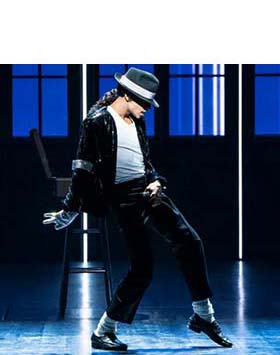
Lynn Nottage who wrote the book for “MJ” is known for serious plays about the black experience, and this fits that bill as a struggle against the system. Director Christopher Wheeldon, also the choreographer, is the perfect helmsman. The show is about movement and the choreography is overwhelming.
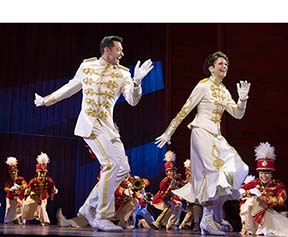
Part romance, part con game. Both require some self-deception. So, therefore a classic American musical. A corny hit when it premiered on Broadway December 1957, a time more naïve than now. Today, it’s not dark enough.
Robert Icke’s “Oresteia” is a brilliant takes-your-breath-away modern version of the Greek narrative of Athens’ war on Troy which, at its center, is about male warmongering and sexism. It makes you realize that little is new about rulers who would sacrifice their own children as well as masses of citizen subjects to maintain their power over other lands. The universality is made clear when Calchas (Michael Aabubakar), a Greek god and seer, intones names of god Zeus, and then goes on to name two dozen others, Allah, Apollo, Buddah…, because military in every land called up gods to bless their marauding.
It’s interesting to see how political art changes. This year’s Whitney Biennial, rather than in-your-face commentary on American injustice here and abroad (including at the 2019 biennial black football players taking the knee), my favorites here were more subtle takes, one on the consumer culture, another on the military and a third that rivets your eyes on U.S. corporate destruction abroad.
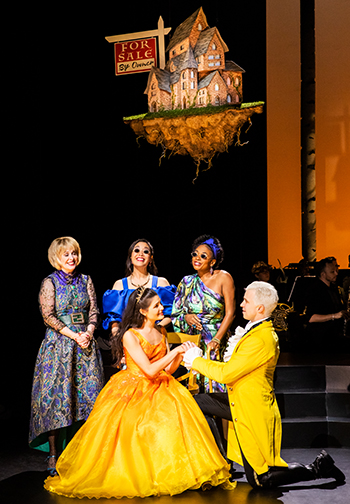
When you’re talking about a musical theater genius such as Stephen Sondheim, it’s hard to pick favorites among his oeuvres, but “Into the Woods” is high on the list. Because with Sondheim’s music and lyrics, and James Lapine’s book, this staging by Lear deBessonet infuses joy. Because Sondheim-Lapine (who directed the original in 1987) take some vintage western fairy tales and, mining recognition for surprise, turn them magically into witty morality tales.
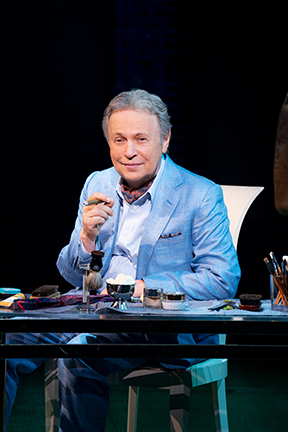
Billy Crystal’s story, book by Crystal, Lowell Ganz and Babaloo Mandel, based on the 1992 film, requires you to believe that Buddy Young, a washed-up comic got a new start when an Emmys broadcast mixed up names and announced he had died and the Today Show invited him on to show it wasn’t true. Maybe this worked 30 years ago. Now the book is silly, often crude, a bit vulgar, a bit TV, with jokes as dated as the Borscht belt routines he started out with.
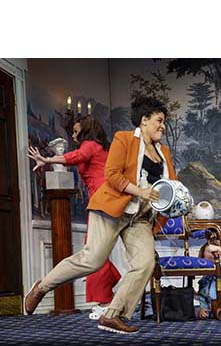
“POTUS,” which I am surprised to find on Broadway, is misogyny masquerading as feminism. It is crude, vulgar, at the intellectual level of 13-year-old boys, or maybe a local sex-themed comedy club that serves up booze and cheap laughs. Harriet (Julie White), the president’s top aide, reports to staff that he has just said at a press conference, “Please excuse my wife’s absence. She’s having a cunty morning.” You heard that right.
What’s amazing about Shakespeare is that directors can do a complete change of time, venue, mood and still the magic works. The trick is to pull you into the story.
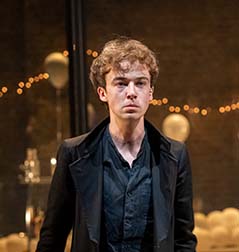
Robert Icke’s “Hamlet” at the Armory starts with a video, could be the news, the funeral of the king of Denmark. The backdrop is a foreign military conflict. Then back at the palace we see 12 surveillance screens watched by security. Suddenly there’s an apparition: the ghost of Hamlet’s father.
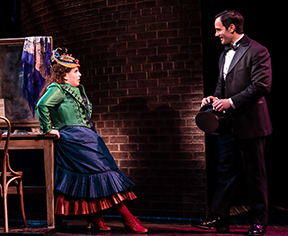
When you first see Fanny Brice (Beanie Feldstein) she is shown in a very covered up outfit, looks matronly, and she is of that middle age. Later it’s clear in a flashback that the story begins with her as a young girl – and that she was always fat. That blocked me from believing her portrayal of the story of Fanny Brice – who had been a lithe dancer as well as comedienne – and the romantic connection with her lover, the gambler Nick Arnstein (Ramin Karmiloo), a suave charming David Niven type who had squired gorgeous long legged chorus girls.
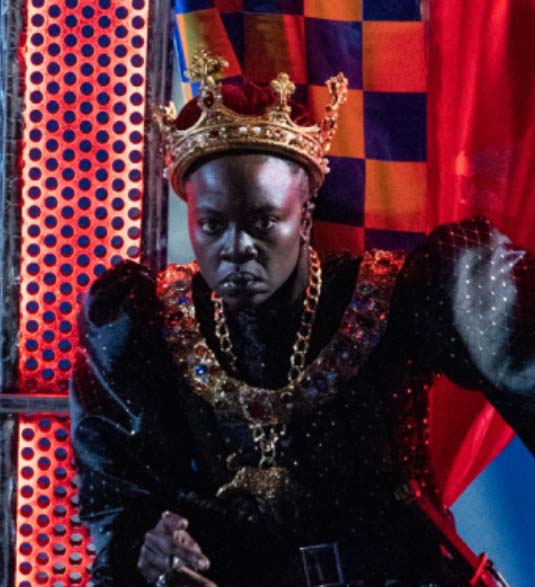
Richard III, the evil scheming murderous soon-to-be king of England, after he kills the competition, was obsessed with his deformity, now believed to be a disease of the spine, which has been portrayed in Shakespeare’s play over the centuries as a hump or a withered arm. In the vision of director Robert O’Hara, that essential part of the play is turned on its head. Richard, portrayed by the fiery Danai Gurira, is damaged only in his mind, his ethic, his soul. When he speaks lines about his infirmity, it makes no sense.
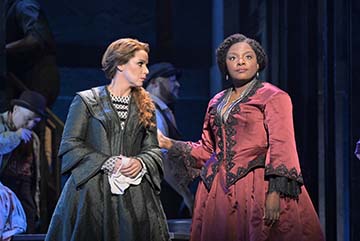
Larry Kirwan’s “Paradise Square” is a smart, entertaining, serious, important musical about a real time in America, a look at the role of capitalism in slavery, whites and blacks running the underground railroad, and how capitalists divided them. Director Moises Kaufman knows how to make a show suffused with music into a riveting dramatic play.
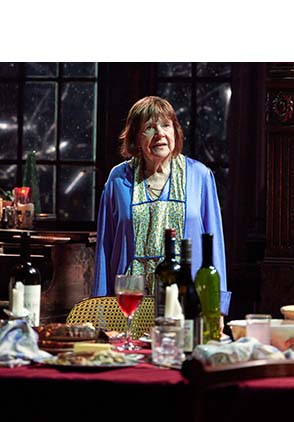
It’s snowy outside probably someplace north of New York City. The guests, most in their 40s and 50s, are artistic or professional, and the conversation, which is the centerpiece, is the kind that wafts around New York parties when people show off their knowledge or talents or, no talent needed, loneliness and the need for other people. They mostly talk past either other, but it doesn’t matter, because nothing new is said. Maybe this is satire.
A few years ago I wrote about French actress Nathalie Schmidt appearing in a web series, “I DO,” which was getting a lot of attention from web festivals around the country. The prizes keep coming.
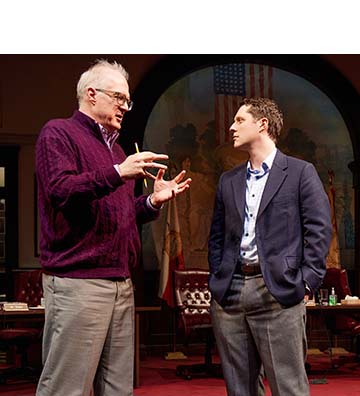
If you want to see a serious, piercing, unforgettable play about America, see Tracy Letts’ “The Minutes.” It could be subtitled “The American Killing Fields.” The expansion of colonial America to the West, its manifest destiny, a myth we’ve all learned in school, was a cover for genocide. The U.S. was built on savagery, a holocaust, the slaughter of Native Americans, and Tracy Letts tells it brilliantly, with Anna Shapiro’s direction emphasizing the banality that covers up horror.
Igor Golyak’s adaptation of Chekhov’s “The Cherry Orchard” stars a brilliantly effervescent Mikhail Baryshnikov, a fine dreamy Jessica Hecht, talented supporting players, a giant robotic arm topped by a ring-lit camera and a cute scampering robotic dog. And that’s only the half of it, since I saw the in-person play but not the virtual on-line version. Golyak also directed, marshalling good performances and pulling out a plot from what could have gotten lost in a three-ring atmosphere.
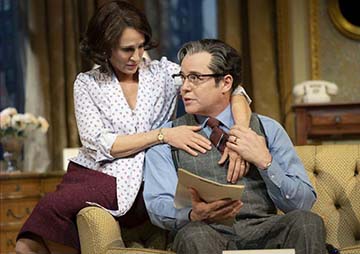
Neil Simon’s Plaza Suite is a collection of sitcom sketches that worked in 1968 but a lot less so in 2022. The last about the parents of a young woman terrified of getting married is very funny, the middle extended bit about fans of the celebrity culture is so-so, and the first about an unhappy wife who discovers her businessman husband is having an affair with his secretary is so dated it should have opened with a time lapse warning.
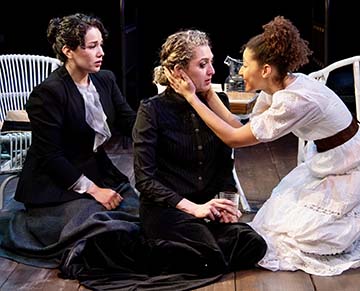
Will Pomerantz’s staging of Chekhov’s “The Three Sisters” may be small in size, in a space with just a few sticks of furniture and runtime cut from 3 hours to 2, but the conception and production work grandly. The set by Brian Staton is fine and the cutting seems to leave nothing out. Bass, fiddle and guitar set a mood with evocative music by Nancy Harrow.
May 17, 2022 – The “money quote” in the documentary “Gaming Wall Street” by Tobias Deml, premiered on HBO MAX, is former stock trading executive Tobin Mulshine saying, “I would illegally naked short sale stocks every day. As long as I was collecting commissions, the bank did not care.”