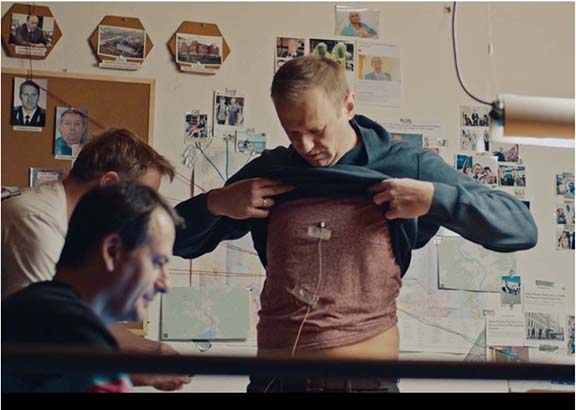
Feb 22, 2023 – How do you make a good propaganda film? How do you expose it before it wins a truth-telling award and embarrasses the prizegivers — before they discover it’s a propaganda pseudo-documentary that has been nominated for an “Oscar” – before the white envelopes are opened before millions of people on Oscar night, March 12th?
Dec 30, 2022 – Major U.S. life and annuity insurance companies are endangering their policyholders’ benefits
with risky investments that trade client security for bigger payouts for executives and shareholders, according to an examination of financial filings, annual reports, and experts on insurance finance.
“Memorial” purports to be the story of how young architect Maya Lin got the U.S. government to build her design of a Washington Mall memorial to the U.S. veterans of the American war against Vietnam.
The invite was to a play featuring Judge Andrew P. Napolitano in “Why is the Government in My Soup?” promoted as an evening of political humor and insight. Sounded interesting. I haven’t seen a clever political comic I liked since Mort Sahl. This wasn’t it. But there were some surprises.
Key West – It takes a while before you begin to figure out the truth of this mystery that excoriates the capitalist oppression of the working class. And I won’t spoil it. Priestley, a British socialist, wrote it in 1945, setting it in 1912. It gets a terrific production, helmed by director Patrick New, expertly cut in half from the original three-hour script.
Key West – Ken Ludwig’s delightful two-hander is an affectionate memory of his parents’ epistolary courtship during World War II when his father was a small town doctor working in army hospitals and at the front and his mother was an aspiring actress from Brooklyn. Cody Borah is perfect as the low-key Jacob S. (Jack) Ludwig and Jessica Miano Kruel is excellent as the tough, sometimes cutting New Yorker, Louise Rabiner.
In this dysfunctional family near-soap opera by Stephen Adly Guirgis, the “good guys” and the “bad guys” are all con men, or women. The venue, a middle-class apartment on Riverside Drive in Manhattan, is a place for drive-by scams and attacks that have you shifting the characters between the hero and villain columns. And asking some questions for which answers are never there. That said, the acting, headed by lead Stephen McKinley Henderson, and direction by Austin Pendleton are fine, as complex but also as hokey as you are likely to see on TV.
“How did you get to be here?” A common question often rephrased in conversation. But this Stephen Sondheim – George Furth production takes it dramatically smarter in multiple musical flashbacks, each chosen year before the previous one. And each vignette is a surprise.
Brilliant, clever, trendy, stunning, wonderful, the best musical of the season, every number a show-stopper. It’s 1933 Chicago, time of depression and prohibition. A couple of musicians, Joe (Christian Borle) and Jerry (J. Harrison Ghee), sax and a double bass players looking for a gig in a show bar, see a gang murder by mafioso Colombo, known as “Spats” (Mark Lotito), and his confederates. Witnesses will be killed. They run into a dressing room and appropriate the clothes and wigs which of course yields the costumes of the girl band.
A novella is not a play. The 75-minute drama by Adrienne Kennedy is largely a monologue, delivered expertly by Audra McDonald, but still a monologue. It was first produced thirty years ago, but this is the first time it’s been on Broadway.
Deirdre O’Connell is wonderful as Becky, the neurotic inheritor of the mantle of 17th century Salem’s witchcraft victims. She is as out-front and aggressive as her flaming red hair. But the Sarah Ruhl play she inhabits is a confusion of current issues (depression and opioids), fantasy witching (potions to make people fall in and out of love) and suggestion that the present echoes the bad historic past.
I saw David Lindsay-Abaire’s comedy in 2001. It was clever and funny, as his works tend to be. About a girl who has a disease that ages her very fast so while in high school she looks like she’s 72. What a difference a couple of decades makes. Now it’s a musical, with Lindsay-Abaire doing lyrics and Jeanine Tesori the music. And more school kids have been added.
Dec 12, 2022 – This is a video interview by journalist Regis Tremblay of Lucy Komisar providing a step by step analysis of the Browder hoax. How he did it.
“Ain’t No Mo’” by Jordan E. Cooper is a fantastical surreal in-your-face satirical pastiche of American black experience. It targets blacks (read the black bourgeoisie) as well as whites. You won’t find anything as adventurous on or off Broadway. Which makes it sad it has posted a closing notice for Sunday, Dec. 18th, just two weeks after its opening. So here is what you will see if you go and what you will miss if you don’t.
Rodney Zelenka is an artist from Panama whose exhibit now in New York shows stunning colorful realistic/fantastic paintings that comment on how abusive power by major governments has caused suffering among peoples worldwide.
It is Aug 13 2021. Henry Naylor is a topical comedian looking back at the Taliban departure from Afghanistan a decade before. Naylor was a writer for the British TV satire show “The Spitting Image” and a stand-up comic. He likes satires on war like Mash, Catch 22, Dr. Strangelove. A decade earlier, he had a chance to do a show on BBC comedy radio, and he wanted to talk about the Afghanistan conflict, but the state-funded broadcaster said Afghanistan is not funny. Too many dead bodies. He noticed that journalists talking about Afghanistan were not really there. They gathered on the border. Including a BBC reporter who faked reports. Yes, the BBC was full of fakery. Naylor wanted to expose the media lies. So, flashback.
A history of American jazz in 90 minutes? The Anderson Brothers’ “The Journey of Jazz” does so in fascinating pastiche of music and visuals, starting with Scott Joplin’s “Maple Leaf Rag,” smartly performed by pianist Dalton Ridenhour, and finishing with Henry Mancini’s “Pink Panther Theme.” They show along the way how styles evolved, how jazz composers were affected by classical music (think Thelonious Monk) and went on to influence the music of Broadway and popular culture (Richard Rodgers).
I choose to lead my parade with the Women in STEM float. It means science, technology, engineering and mathematics. It was the only float I saw (maybe I missed earlier ones) that dealt with serious issues of the time.
In 1918, at age 18, Noël Coward wrote a feminist play about a novelist who gave up working to be wifely support for her less talented playwright husband. Coward was a great admirer of George Bernard Shaw, and this is due homage. It is an amazing feminist play for the time. And gets a fine production from the Mint Theatre which specializes in bringing out plays of many years past.
It’s not quite Mel Brooks’ “2000 Year Old Man,” but Ed Weinberger attempts a take with two 3500 year-old geezers wandering in the desert on Moses’ famous trek to “the promised land.” Lou (Josh Mostel) complains his boots are too tight and “How come in all these 30 years, not once has anybody — ever — had the decency to tell us the truth? We’re lost…. We’ve been lost ever since we left Egypt.”
Bud (Richard Masur) red robe, black glasses, tells him to have faith in God’s miracles.” Who dropped manna from Heaven? Who brought forth water from a rock?”
What’s better than seeing an artist’s work at a museum? There are some event promoters who would like to persuade you that it’s even better to experience an “immersive” event, meaning you are surrounded by huge blow-ups of the painter’s works as in this exhibit of Claude Monet’s art.
That doesn’t cancel out museums, but it has some advantages.
We know Edward Hopper’s iconic “Early Sunday Morning,” the low red buildings. But at the Whitney Museum’s Hopper exhibit, there are paintings most of us have never seen before.
August Wilson’s “The Piano Lesson” is not about learning how to play the piano. It is about the powerful lesson an old ornately carved piano teaches about history and about the respect and honor one owes one’s forbears, especially when they suffered greatly to preserve the dignity they bequeathed to their children. It’s about slavery.
KT Sullivan, a doyenne of jazz through the Mabel Mercer Foundation she heads, presented the Cabaret Convention’s Great “American Songbook: American Standards,” at the three-day event’s finale at Jazz at Lincoln Center on Oct 28. This thrilling event brought singers from the U.S. and abroad to an annual gathering of cabaret fans. And as they are standards, it’s worth noting who wrote them.
Suzan-Lori Parks’ plays is about fantasy and fakery, the desperation and dysfunction of the underclass. The brothers Booth (Yahya Abdul-Mateen H) and Lincoln (Corey Hawkins) had parents who cheated on each other, left when the sons were 13 and 16. He had women on the side, she had her “Thursday man.” “Why do you think they left us? They were struggling.” Well, a lot of parents are struggling.