When the music is by John Kander and the lyrics by Fred Ebb, you think dark. “Chicago,” “Cabaret,” “Kiss of the Spiderwoman.” “The Visit” fits perfectly into that very satisfying canon. This is a stunning production, with director John Doyle using the musical pieces to build the psychological and intellectual tension.
The story is shadowy and shocking, a political fantasy based on the 1956 play by the Swiss Friedrich Dürrenmatt. Writing soon after the end of World War II, he crafted this as a morality tale for our times. Now it‘s a chamber opera.
Love, sex, age and class. Key elements in David Hare‘s 1995 play about a rich guy who had an affair with an employee a few years before and would like to start it up again.
He runs restaurants. She was a lawyer‘s daughter (ie. privileged) who wandered into his eatery on London’s Kings Road and got a job. And a promotion. And a lover. She left six years later when his wife discovered the affair.
The Fiasco Theater has become the clever modern interpreter of Shakespeare, and this production is no exception. When two rivals for her hand sing “Who is Sylvia?” – the name of a pop song — it gets a laugh, because the sad-romantic song is perfectly in tune with this contemporary, light-hearted production.
Sometimes theater awards shows are a chore to sit through. Lots of “thank you, thank you…..” to boredom. But the Fred and Adele Astaire awards June 1 for best dancers and choreographers was a delight.
The top dancer awards went to Leanne Cope “An American Paris,” and in a tie vote, to Robert Fairchild, “An American in Paris” and to Tony Yazbeck, “On the Town.”
The Awards were established in 1982 by the Douglas Watt Family Fund for the Performing Arts, to recognize outstanding achievement in dance on Broadway and in film.
My favorite in Charlotte Patton‘s show at the Metropolitan Room was “Quality Time,” a satirical piece by Dave Frishberg (1996) that fits today, as she tells us about a guy telling his wife that, “We‘re up to our ears in our careers and putting our hearts on hold,” so they need quality time. He says, “I know a small hotel remote and quiet, if they decide to sell my firm could buy it, then we‘d develop it and gentrify it.”
That said, the songs in this charming production are of a piece – not mushy or sad, but upbeat and smart.
Dael Orlandersmith‘s “Forever” is a powerful blend of fact and fiction about this talented writer/performer‘s growing up as the daughter of an abusive, alcoholic mother in Harlem. And her discovery of the roots she chooses to adopt after a visit to the Père Lachaise cemetery in Paris where great artists, writers, musicians, are buried.
Orlandersmith has done fine autobiographical works in the past, among them “Yellowman,” about a dark, over-weight black woman falling in love with a light-skinned black man. So one knew that this production would be dark in the psychological sense. But the story takes one by surprise.
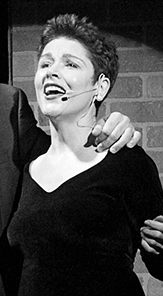
The very fine Broadway and cabaret singer Christine Andreas channels Edith Piaf in an elegant, sharp, charming dance production choreographed by Pascal Rioult, a former Martha Graham Dance Company principal dancer.
The space is a cabaret/dinner theater space at the 42West Nightclub. Tables are set around a center runway and look at a proscenium stage. Andreas in gamine hairdo, black glittery silk dress, looks (a bit) and sounds like Piaf, her trills and tremors.
April 18, 2015 – German Finance Minister Wolfgang Schäuble spoke at the Council on Foreign Relations on Wednesday. With a politician‘s practiced spin, he declared that Germany didn‘t owe any money from billions it had extorted from Greece during its World War II occupation, because for a period after the war, it had no sovereign government. WHAT!
Wendy Wasserstein‘s play about the impact of feminism on women is troubling for a feminist. The movement has attempted to persuade women that the essence of their destiny and dignity is not writ out biologically as wives and mothers, but as self-fulfillment with choices in the same wider world as men.
Daniel Beaty‘s portrait of Paul Robeson in his one-man show at BAM is stunning and moving. Memorable. It won an immediate standing ovation. Of course, Beaty had as a subject a man of great talent, courage and fortitude. For Americans to understand their history, this play should be seen in universities and theaters around the country.
March 30, 2015 – In a talk to the Council on Foreign Relations Thursday, Afghanistan‘s president, Ashraf Ghani, spoke of the international drug trade and grand corruption damaging his country. He said: “The global criminal economy is 1.7 trillion [dollars] a year. Afghanistan is certainly among the 20 top contributors to this because of the heroin trade. But heroin has been sidelined as a phenomenon and its impact.
We have at least 15”or 35 people who are worth $10 to $20 billion, and they have yearly income from this trade, it’s 300 to $500 million. We”they fuel insecurity. So, that, again, needs to be understood.”
And, “The first problem is grand corruption. Corruption is the system.” He emphasized that “corruption has become very deep and entrenched and we have to break it.”
So, I asked him this: You talked a number of times about the grand corruption and also about the international drug trafficking that has a number of billionaires in your country.
To what extent do you think that this is facilitated especially by the big players, by the international offshore bank and corporate secrecy system, where they can stash their money in accounts that do not have their names?
British playwright Peter Morgan is a subtle political historian, here suggesting what went on over sixty years in private meetings between ten British prime ministers and Queen Elizabeth. In Buckingham Palace. It‘s all in his imagination, but it is a careful critique of the politics and class loyalties of the characters and the Queen.
The play is fascinating, and I enjoyed it immensely. Helen Mirren is brilliant as Elizabeth through the years. Cool, contained, to the manor born, aging but ageless in her sense of self.
Morgan has written a number of notable political works, including Frost/Nixon and The Special Relationship,about the U.S. and the UK. Stephen Daldry, who directed the play Billy Elliot,” with Margaret Thatcher the villain in the miners’ strike, does an excellent job etching Morgan‘s critique of privilege. (Morgan’s father was a German Jew who escaped the Nazis, his mother a Polish Catholic who emigrated after the Soviet takeover.)
People that do bad things should be punished for them. People that video bad things and post them on the internet should get punished. What about people who use avatars to do bad things on fantasy internet sites? And what if those bad things are realistic pedophilia and murder?
Jennifer Haley‘s unusual play shows a fantasy world where bad things, (which you don‘t ever see) go on. It is not an erotic or sadistic drama. It‘s sci fi, but only partly. It‘s rather an intellectual provocation. It is crisply directed by Anne Kauffman.
March 16, 2015 – You don‘t expect the CIA director to give away the crown jewels, but you do expect him to take seriously a question about the offshore bank and corporate secrecy system. That is the opaque system of bank accounts and shell companies set up in banking centers and networked islands and mini-states and used by terrorists, criminals, arms traffickers, corporate crooks, tax evaders and the like.
But when I asked him about it at a Council on Foreign Relations meeting, that was later broadcast on the Charlie Rose show Friday, he evaded and waffled.
Rosemary Loar is a major cabaret singer, throaty, breathy, with drama in her strong torch-song voice. In a white lace tunic over a short purples dress, black tights and boots, she is edgy. Some of the stories she tells are dark, and she makes them come alive. Her cabaret is almost theater.
Money is power is the message of Beth Henley‘s engrossing 1990 feminist play about two mail order brides and the men they marry in the late 19th-century Wyoming Territory. It gets a realistic staging by director Jenn Thompson. The story starts in the 1860s and for 25 years follows the reversal of fortunes of the two couples. Henley based the story and characters on true events.
It takes a while, through your laughter, before you realize that Branden Jacobs-Jenkins‘ comic play, “An Octoroon,” is forcing you to confront slavery. Sure, the plot is about slaves who are being sold off because their owner can‘t pay the mortgage. But the dialogue of those slaves seems like it comes from a TV sitcom, mixing current daily realities with that of the slaves. Director Sarah Benson‘s stunning light touch sneaks up on you.
David Ives is the master of comically surreal theatrical sketch comedy. Nobody comes close. Because not only are his one-acts witty, but they play cleverly outlandish intellectual games.
One of Ives‘ games is to play with doubles. My favorite in this collection being staged at The Duke is The Enigma Variations.
The back story of “Churchill,” the solo play finely adapted and performed by Ronald Keaton, is class politics. Winston Churchill was to the manor born. His grandfather was the Duke of Marlboro and Viceroy of Dublin, his father Henry Spencer-Churchill (Lord Randolph) was a Conservative member of parliament who hadn‘t done well at Eton. Winston couldn‘t get into college and took the exam three times to finally get into Sandhurst, the British military academy. Privilege screams.
A prisoner‘s account of what goes on in New York City‘s holding pen for arrested men is unexpectedly and often hilariously funny. He deftly skewers, no, impales, the Alice-in-Wonderland quality of the criminal justice system, there and in the courtroom.
Joe Assadourian discovered his theatrical talents in prison. He got in trouble at 22. He‘d always been in trouble, but that depends on how you define trouble. He said, “I‘d been doing voices in school. If I was sent to the principal, I‘d do him.” An upper class family would have sent young Joe to acting school. But soon he would get into big trouble — a gun, a struggle, a shot — and land in jail. Confined for 12 years, he‘d been writing in notebooks. Then he got into a prison theater program where Richard Hoeler, now his director, unearthed his very large talent.
This is the back story of Grimms‘ fairy tales, for adults. It‘s a deconstructed Grimms.
The show, with music and lyrics by Stephen Sondheim and book by James Lapine, was a brilliant conception when it was first produced in 1986.
Grimms‘ fairy tales were morality tales. Having the fairy tale characters intersect with their stories, Sondheim and Lapine turn the events in the woods into a metaphor for the challenges of life. The message is that the woods are full of dangers; be careful what you wish for. It‘s also about community.
Edward Albee, who is gay, has made a fine dramatic career skewing the gloomy relationships of heterosexual couples and establishing the women as villains. (This may have started because he hated his adoptive mother.) His 1962 “Who’s Afraid of Virginia Woolf?” made his reputation.
This 1966 play continues the theme a few years later. The partners of the two married couples don‘t sleep with each other, and the daughter of one of them has just left her fourth husband. Most of the blame is on the distaff side. Yes, I know that the director is a woman, Pam MacKinnon. And with her taught direction, the actors are superb.
Jan 29, 2015 – Even out of office, U.S. officials evade crucial questions about U.S. policy. Here is Janet Napolitano, former head of the U.S. Dept of Homeland Security, 2009-13, also former Gov. of Arizona, at the Council on Foreign Relations Jan 29th evading a crucial question about U.S. policy in the era of cyber-war.
She spoke at a Home Box Office History Makers Series “on the contributions made by a prominent individual at a critical juncture in international relations.” Given her answer to this question, which measures intellectual and political honesty, we have to think, “maybe not so much.”
Red Barn director Joy Hawkins brings Key West a pitch-perfect staging of Alfred Uhry‘s funny, political and subtly biting play about an assimilated 1939 Atlanta Jewish family whose status-conscious matriarch rejects their heritage. Uhry wrote from childhood memories.
Boo (Beulah) Levy (given a sharp, tough portrayal by Karen Grant), criticizes her daughter Lala (played nicely as a bit ditsy by Lisa Elena Monda) for putting a star atop their decorated Christmas tree. Excuse me, Chanukah bush. Boo says the tree is fine without the star, which makes it Christian. Lala doesn‘t see the distinction. (Neither does Uhry.)
Her main concern, however, is getting her daughter into society and married. There are limitations. It has to be German Jewish society. Boo looks down at those who came from “east of the Elbe,” the river that runs between Germany and Czechoslovakia. She boasts that their house is on a block filled with Christians, though their neighbors of course don‘t accept them.