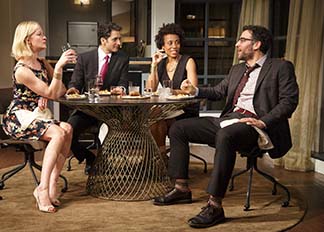
It takes a while, through your laughter, before you realize that Branden Jacobs-Jenkins‘ comic play, “An Octoroon,” is forcing you to confront slavery. Sure, the plot is about slaves who are being sold off because their owner can‘t pay the mortgage. But the dialogue of those slaves seems like it comes from a TV sitcom, mixing current daily realities with that of the slaves. Director Sarah Benson‘s stunning light touch sneaks up on you.
David Ives is the master of comically surreal theatrical sketch comedy. Nobody comes close. Because not only are his one-acts witty, but they play cleverly outlandish intellectual games.
One of Ives‘ games is to play with doubles. My favorite in this collection being staged at The Duke is The Enigma Variations.
The back story of “Churchill,” the solo play finely adapted and performed by Ronald Keaton, is class politics. Winston Churchill was to the manor born. His grandfather was the Duke of Marlboro and Viceroy of Dublin, his father Henry Spencer-Churchill (Lord Randolph) was a Conservative member of parliament who hadn‘t done well at Eton. Winston couldn‘t get into college and took the exam three times to finally get into Sandhurst, the British military academy. Privilege screams.
A prisoner‘s account of what goes on in New York City‘s holding pen for arrested men is unexpectedly and often hilariously funny. He deftly skewers, no, impales, the Alice-in-Wonderland quality of the criminal justice system, there and in the courtroom.
Joe Assadourian discovered his theatrical talents in prison. He got in trouble at 22. He‘d always been in trouble, but that depends on how you define trouble. He said, “I‘d been doing voices in school. If I was sent to the principal, I‘d do him.” An upper class family would have sent young Joe to acting school. But soon he would get into big trouble — a gun, a struggle, a shot — and land in jail. Confined for 12 years, he‘d been writing in notebooks. Then he got into a prison theater program where Richard Hoeler, now his director, unearthed his very large talent.
This is the back story of Grimms‘ fairy tales, for adults. It‘s a deconstructed Grimms.
The show, with music and lyrics by Stephen Sondheim and book by James Lapine, was a brilliant conception when it was first produced in 1986.
Grimms‘ fairy tales were morality tales. Having the fairy tale characters intersect with their stories, Sondheim and Lapine turn the events in the woods into a metaphor for the challenges of life. The message is that the woods are full of dangers; be careful what you wish for. It‘s also about community.
Edward Albee, who is gay, has made a fine dramatic career skewing the gloomy relationships of heterosexual couples and establishing the women as villains. (This may have started because he hated his adoptive mother.) His 1962 “Who’s Afraid of Virginia Woolf?” made his reputation.
This 1966 play continues the theme a few years later. The partners of the two married couples don‘t sleep with each other, and the daughter of one of them has just left her fourth husband. Most of the blame is on the distaff side. Yes, I know that the director is a woman, Pam MacKinnon. And with her taught direction, the actors are superb.
Jan 29, 2015 – Even out of office, U.S. officials evade crucial questions about U.S. policy. Here is Janet Napolitano, former head of the U.S. Dept of Homeland Security, 2009-13, also former Gov. of Arizona, at the Council on Foreign Relations Jan 29th evading a crucial question about U.S. policy in the era of cyber-war.
She spoke at a Home Box Office History Makers Series “on the contributions made by a prominent individual at a critical juncture in international relations.” Given her answer to this question, which measures intellectual and political honesty, we have to think, “maybe not so much.”
Red Barn director Joy Hawkins brings Key West a pitch-perfect staging of Alfred Uhry‘s funny, political and subtly biting play about an assimilated 1939 Atlanta Jewish family whose status-conscious matriarch rejects their heritage. Uhry wrote from childhood memories.
Boo (Beulah) Levy (given a sharp, tough portrayal by Karen Grant), criticizes her daughter Lala (played nicely as a bit ditsy by Lisa Elena Monda) for putting a star atop their decorated Christmas tree. Excuse me, Chanukah bush. Boo says the tree is fine without the star, which makes it Christian. Lala doesn‘t see the distinction. (Neither does Uhry.)
Her main concern, however, is getting her daughter into society and married. There are limitations. It has to be German Jewish society. Boo looks down at those who came from “east of the Elbe,” the river that runs between Germany and Czechoslovakia. She boasts that their house is on a block filled with Christians, though their neighbors of course don‘t accept them.
A jazzy glorious sound fills the living room of the Harry Truman Little White House, in Key West, where the 33rd president took winter vacations, playing poker with his buddies. It comes from the rich, luscious voice of Miriam Pico and the fine jazz piano of David Chown. A few times a month, cabaret takes over the building built in 1884 where Truman spent some winter weeks and which is now called Truman‘s Little White House. The living room, except for the intimate collection of a few dozen round tables, is at it was then. The cabaret shows that take place there are appropriate, since Truman was a piano player.
Here‘s a case in which it helps to pay attention to the playbill. Michael Frayn‘s 1982 classic play within a play, or in this case, a farce within a farce, gets a first rate production by Key West‘s Waterfront Playhouse under the deft hand of artistic director Danny Weathers.
Even if you don‘t know the script, the opening play called “Nothing On” seems an odd disaster. Roger Tramplemain (Brandon Beach), a real estate agent is taking his girlfriend Vicki (a very good screaming- red-head Erin Mckenna) for a few days at a country house he is supposed to be renting out. The property owners Philip and Flavia Brent (David Black and Susannah Wells) are conveniently in Spain to clock resident days in order to cheat on British taxes. Vicki, who is always angularly posing, has the opportunity to prance around in her underwear. (Non-salacious attire is by Carmen Rodriguez).
Jan 15, 2015 – Anne Applebaum wrote an article about Putin’s Russia in the Dec. 18, 2014 issue of the New York Review of Books that was filled with distortions. When I saw NYRB editor Robert Silvers at a Dissent magazine party in New York Dec. 5th, I told him my opinion. He said to send him my comments. But then he declined to print those comments and said that he would run this editorial statement:
Lucy Komisar has written to us that she has a statement to make about the article by Anne Applebaum in our December 18, 2014 issue. This statement is available on her website, The Komisar Scoop. ” The Editors.
The problem with “The Last Ship,” a recitative musical written by John Logan and Brian Yorkey, with music and lyrics by pop artist Sting, is politics. In a play about workers‘ response to the closing of their shipyard, there really isn‘t any. The play is a feel-good story about workers taking over the shipyard to build one last ship to sail around the world. And then what? How does that challenge or even explain the forces that closed their shipyard?
The story begins when the young man, Gideon Fletcher (Michael Esper), rejects his father‘s wish – symbolically represented by a gift of his work boots – that he follow him as a shipyard worker in Newcastle. Instead, Gideon leaves home and girlfriend, Meg Dawson (Rachel Tucker), to see the world and make his fortune.
A mix of cruelty and humanity, a bit of voyeurism, and some fascination at an indomitable human spirit are the stuff of Bernard Pomerance‘s play “The Elephant Man,” in a moving revival directed by Scott Ellis.
The play, staged first in 1977 in London, imagines the trials and unusual accomplishments of Joseph Merrick, who lived in Europe in the late 1800s, afflicted by a disease so appalling – misshapen body, face distorted by a fungus that grew massively on his head, skin like an elephant‘s hide – that his unfeeling Belgian mother shipped him to a carnival freak show.
Here‘s a remake of the classic 1944 play and more famous 1949 movie of three sailors on a weekend pass in New York who leave the ship determined to find romance. Or at least women. The brassy Bernstein music is wonderful, the actors are terrific, with a couple of voices a touch above what you often get on Broadway, and the staging is fine, if unexceptional, but hey, this is New York, where, as Chip says,
“The famous places to visit are so many,
or so the guidebooks say.
I promised daddy I wouldn‘t miss on any,
and we have just one day.
Gotta see the whole town
right from Yonkers on down to the bay…”
We‘re in a gorgeous Upper East Side apartment with floor to ceiling windows. Amir (Hari Dhillon) is a lawyer and wife Emily (Gretchen Mol) a painter. The first bizarre thing is that she is painting him while he is dressed in a proper business suit above the waist but only boxer shorts below. What is that about? Playwright Ayad Akhtar never makes that clear, and it‘s not the only conundrum.
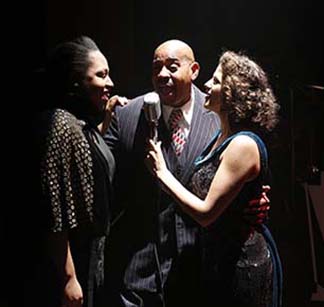
It‘s 1948, the tenth birthday of Café Society, where great jazz and cabaret in a corner of Greenwich Village clashed with the worst know-nothings of the McCarthy era. But we‘re over that now, so come to this musical memoir to enjoy the delicious sounds of the 30s and 40s. And recall how evil the thought police of that era were. The club became a target of slimy columnists such as Dorothy Kilgallen, who called it a “Moscow-line nightclub.” It was the only place that welcomed whites and blacks, certainly enough to make Mme Kilgallen call it subversive.
If only the radical Islamists were just like the people who run the West, capitalists! If you think that‘s the answer, be careful what you wish for. Ayad Akhtar‘s clever, ironic, compelling play shows what could happen when a Wall Streeter, kidnapped for ransom, persuades his captors that he is more valuable to them by showing how to manipulate the West‘s financial system – especially the stock and currency markets.
It‘s presented off Broadway at the New York Theatre Workshop. One wishes it had a broader reach.
Between the rock and roll of the sixties and the disco of late seventies stood the golden age of the great singer-song writer. Urban Stages, in its sixth season of December cabaret, this year presented twelve days of performances that ranged from the songs of Stephen Sondheim to a tribune to Big Crosby. The performers were major cabaret artists.
Based on the real story of the conjoined twins, Daisy and Violet Hilton, who in the 20s and 30s had a glamorous career in vaudeville – even touring with Bob Hope – this fascinating musical is colorful, clever, and funny. It also has some subtle, non-preachy things to say about who is a “freak.”
What better way to spend election night than with prominent politicians, Democrat Anthony I Was Hacked Weiner, Republican Mark Appalachian Trail Sanford, Republican Larry Wide Stance Craig, and Republican Mark Underage Page Foley.
In the back of my mind was the thought that some of the bozos being elected might appear in the play‘s second edition. Because of course, there will be more.
Is this yet another depiction of the brutality and cruelty of rulers who, so full of themselves, wreak havoc on anyone who doesn‘t bow down? Not quite. It‘s an early anti-war play. Plus ça change.
Except, when John Douglas Thompson is the evil guy, you are drawn by his brilliant performance as well as fascination at what makes this real 14th-century character tick and why those around him succumb. (The play was inspired by the life of Central Asian emperor, Timur the lame. Or Tamerlane. But plenty of others followed.) And at the fact that Christopher Marlow wrote this in the 16th century. Not much progress in half a millennium.
A major problem with this production of British playwright Tom Stoppard’s play about infidelity is that the unfaithful pair don‘t seem very hot, at least not with each other. Annie, an actress (Maggie Gyllenhaal), is married to Max, an actor (Josh Hamilton). Henry, a playwright (Ewen McGregor), is married to Charlotte, an actress (Cynthia Nixon). Henry is obviously a stand-in for Stoppard.
Max/Hamilton and Charlotte/Nixon are both rather bland. Lots of talk and no sparks. Nixon is cool, hard-faced, flat. But then, so are Annie/Gyllenhaal and Henry/McGregor when they get together. Gyllenhaal as Annie is hot, but she makes no connection to her paramour.
Whatever playwright Susan-Lori Parks turns her hand to is bound to be surprising and memorable. Her latest work, the first of three parts, is a brave Brechtian drama about slaves during the time of the Civil War. Nothing and no one are quite what they seem. It‘s a commentary about blacks today who sell out their people for, what? (Can we put Clarence Thomas in this equation?) And a powerful feminist commentary.
The star of this mesmerizing production is director Marianne Elliott. Her co-star is video designer Finn Ross. Of course, Alexander Sharp is superb as the intense, erratic, edgy, wound-up Christopher, the 15-year-old autistic youth whose mind works like a machine but who can’t get personal connections in gear. He is literal, as precise as math. “Where is heaven?” he asks the pastor. He speaks in great detail but doesn‘t like metaphors, because they obscure reality. When a cop says, “Park yourself,” he goes “beep! beep!” and moves backwards.