“Harvey” is a cute fantasy for adults produced in 1944, a difficult era when some Americans were perhaps considering the meaning of life in the wake of the horrors of war. It was a time when a sermon of how to live the right life, proposing simple goodness against social climbing, could win a Pulitzer Prize for its author Mary Chase. That wouldn‘t happen today: there are no hard edges even in the work‘s social criticism.The play lacks bite.
This witty, pointed, clever play, which opened on Broadway in 1947, was written by Martha Gellhorn, ex-wife of Ernest Hemingway, and by Virginia Cowles. Both were journalists who had met covering the Spanish Civil War and then chronicled the Nazi assaults in Europe and North Africa. Their alter-egos, Jane Mason (Angela Pierce) and Annabelle Jones (Heidi Armbruster) have arrived at an Allied press camp near Naples in February 1944 to cover the campaign against German forces in Italy.
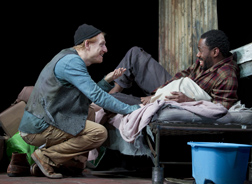
The original title of this play was to be “Sleeping Demon.” In the script, a preacher (Ron Cephas Jones) says, “Conscience is a sleeping demon.” In this third of John Patrick Shanley‘s trilogy called Church and State, which began with “Doubt” and “Defiance” about tough moral choices, he deals with the bankers who foreclose on mortgages and a local politician whose attempt to save a constituent‘s home is compromised by the fact his mother co-signed the mortgage and the bank CEO wants his approval for a $300-million shopping mall.
Kenneth Lonergan‘s spoof historical drama is a weird, funny, outrageous cartoon commentary on the bloody cruelty and crudeness of the 14th century, with subtle suggestions that “plus Òa change….” The language of the characters – mercenaries, nobles, high-ranking clerics – shifts between the “thee, thou” we expect medievals to talk, to pretentious academic locutions to the modern vernacular, including teen-speak, and the vocabulary of beer-drinking men, except that the women use as many four-letter words.
Curious how the sounds and sights of Elizabethan madrigals and forests of the turn of the 17th century work just fine with a country bluegrass touch. The rough and tumble of courtly wrestling is transplanted easily to a timbered stockade, and men chasing women in the woods exhibit quite the raw way to romance. Nor are family feuds unknown in either place.
Maybe it’s because I expect religious music to be, well, religious that I enjoyed the moralistic, be a good person “Godspell,” loved the lively, jivey singing and dancing, and didn’t seriously notice till the final crucifixion scene that the parables belong to the Christian God story. Appealing Hunter Parrish, who plays Jesus with a cowlick, looks like one of the Beach Boys, and the motley crew he interacts with, representing ordinary folks, look like, well, ordinary folks, in all shapes, colors and sizes.
Amy Herzog‘s play is a moody piece about connections between generations that sometimes has broken synapses but also lights up pathways that remind us of the value of family links. Of the sort you can depend on when everything else disintegrates.
For Leo (Gabriel Ebert), 21, most of his emotional connections are broken. He is estranged from his parents and his girlfriend. He‘s just been on a cross country bike trip where, we learn mid-way through, his biking buddy has died in a freak road accident. So apparently, faute de mieux, with nowhere else to turn, he ends up late one night at the West Village apartment of his grandmother, Vera Joseph (Mary Louise Wilson), an 80-something left-winger (pro-Cuba and pro-peace), whose sharp intelligence only occasionally runs into the potholes of the ravages of age.
It‘s agitprop, and it‘s powerful. In Athol Fugard‘s tradition of very political plays, this theatrical metaphor about South African racism is first didactic, but then it takes off so that you think, well, yes, this is a rather obvious political statement, but it‘s also a dramatic truth.
John Lithgow is perfectly cast as Joseph Alsop, the venomous, fanatically anti-communist newspaper columnist who built a career off his access and influence with U.S. presidents and politicians. But as David Auburn’s play shows, he was not a garden variety right-winger. Auburn (Proof) adds depth and subtlety to the character by highlighting his contradictions. He had the courage to oppose the vicious Senator Joseph McCarthy, though it’s not clear here why.
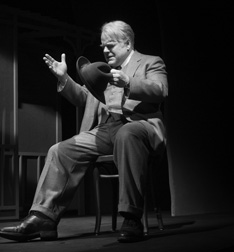
The house in Brooklyn seems ramshackle. Willy Loman (Philip Seymour Hoffman) enters it slowly, wearily, pushing through the dreary light, carrying two leather cases that seem weighted down more with his angst than with anything he could be carrying. It is Hoffman‘s best moment in the play. For the rest, he portrays Loman too much on one note, in a voice too raucous that doesn‘t quite give us the sense of tragedy Arthur Miller intended. Or maybe I‘m remembering the superb Brian Dennehy in the role in 1999. And director Mike Nichols has put together a cast that doesn’t quite come together.
A luscious feast for the soul, “The Big Meal” by Dan Le Franc is a simple but charming, sometimes lighthearted, sometimes serious family drama with four pairs of males and females playing characters as they age through 80 years and four generations. The notion is simple and might be a bit schmaltzy, but under Sam Gold‘s crisp direction, it is smart and sensitive.
It‘s the American frontier in the late 1800s. The wood cabin set is probably too burnished to resemble the shabbier wood of the time, but you get the idea. What is surprising is that setting Shakespeare‘s play in a time and place when women were extremely independent and self-reliant, director Arin Arbus – a woman – has given it an egregiously sexist staging.
The Signature Theater Company revival of Edward Albee‘s 1977 play is subtle and biting at the same time, an allegory wrapped in what could have been a dark neighbors sitcom.
The party Sam (a sensitive Michael Hayden) and Jo (a tough and powerful Laila Robins) are hosting in their suburban house for some friends seems pretty deadly. How can they be having a party when Jo, curled up in an easy chair, is dying of a cancer which occasionally sets her to writhing in pain. She sets it out pretty clear, pretty early: “I am your wife and I am dying.”
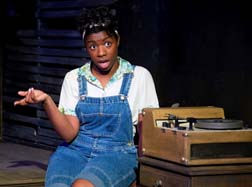
Monica Bauer‘s play about jazz and race, presented by Urban Stages, is a finely polished gem. Inspired by the playwright‘s youth in Omaha, Nebraska, it is a love song to jazz and its ability to unite people across color lines and also a sorrowful memoir of the time in the sixties when racism erupted into riotous violence. Director Frances Hill uses frequent jazz passages and projections (by Kevin R. Frech) to create mood and reality in an intimate space.
In almost a chamber concert of a play, memory and fantasy intrude in Tina Howe‘s drama of a family in which the parents are in decline from their artistically productive years and the daughter is moving up. Her feelings for them are part love and part resentment at what she sees as their self-centered interference with her own artistic development and triumphs.
Annabella (Lydia Wilson), a young woman in black leggings, puts on rock music and dances to it. Wilson plays her as she might an insouciant high-fashion model. Men in suits come on the stage prancing, knees jutting up to the disco beat.
This is Parma and a bloody story of incest and revenge will be told, though not exactly as 17th-century author John Ford had in mind. It‘s a stunning campy melodrama by Britain‘s inimitable Cheek by Jowl company.
For me the most shocking moment in Katori Hall’s play, Hurt Village, was when two grungy teens amuse themselves with a nasty rap in which they cruelly and crudely insult each other and their families. In this down-at-the-heels housing project in Memphis, even these kids’ amusement is mean and self-destructive. Forget about normal civility. The people we meet address each other as nigger, bitch, and mother fucker.
It has been reported today, March 17, that Mike Davey made up many of the details in his monologue about Apple and the workers who make its electronics at the huge Chinese factory, Foxconn, described in the review below. Some of those facts are true about dangerous working conditions are true, but not as he said them. He described meeting workers poisoned with hexane. In fact, such a problem occurred 1,000 miles away. There have been under-age workers at some Apple suppliers, but he didn’t meet a gaggle of them at Foxconn. His interpreter was reached by another reporter, Rob Schmitz, China correspondent for the radio show Marketplace, and she denied that Davey met 13-year-old workers or a man with a mangled hand. Davey’s response was that he is not a journalist.
Athol Fugard’s 1961 parable about apartheid South Africa, directed by the author at the Signature Theatre, blazes with its audacious concept and staging. It is one of those small number of plays that stand out for both their literary and political significance.
Marieann Meringolo’s rich mellow slightly jazzy alto voice presents Michel Legrand’s romantically charged music with almost theatrical intensity. Legrand, famous for music for such films as The Umbrellas of Cherbourg, The Thomas Crown Affair, and Yentl, needs someone like Meringolo to provide the necessary drama to his muse.
I hated this 1956 play by John Osborne, one of the angry young men of England’s 1950s. That era was a bad time for women in the U.S. and according to the production directed by Sam Gold for the Roundabout Theatre Company, it was true in spades in England.
This pretentious play by the otherwise talented playwright Theresa Rebeck gives writers a bad name. Four wanna be novelists fork over $5000 to get ten lessons from Leonard (Alan Rickman), a failed writer turned book editor, who must represent every nasty, self-centered writer or editor Rebeck ever met.
This could almost be about any wealthy family, except it is not, because they are black. The Levays (we meet the father and kids but not the wife) are rich, because Dad is a neurosurgeon. So they’ve got a summer house on Martha’s Vineyard. In case you doubted his wealth, there is a Romare Bearden on the wall.
The irony of Vivian Bearing, a profession of John Donne’s poetry, fighting a futile battle against Ovarian cancer, is caught in Donne’s most famous work, Death be not proud. It is a challenge that says mortals will cheat death through eternal life. Pulling an IV pole or sitting in a hospital bed, a red baseball cap covering a scalp made bald from chemotherapy, Cynthia Nixon is cynical and acerbic as the 47-year-old professor. She expertly portrays this unflinching woman’s struggle to keep her soul.
Playwright Athol Fugard is most known for distilling into intimate personal stories the physical and spiritual struggles against apartheid in South Africa. In this engrossing play he plies the same theme, but this time it’s not about blacks and coloreds, but about women and non-conformists. A society that keeps the former in thrall will without too much difficulty stomp on the latter. And Fugard asserts that they have to fight back as much as the racial victims.